Poço Azul
"The blue lasts about forty minutes and then fades. Forty minutes is apparently enough to change someone's understanding of what blue means."
An underground cave lake near Nova Roma where light enters at noon and turns the water a blue so vivid it looks like someone placed a light source beneath the surface.

You descend into Poço Azul through a narrow limestone passage that smells of damp rock and the particular cool of places the sun doesn’t reach. Your group — no more than ten people at a time, by regulation — shuffles in single file with headlamps, the cave narrowing, the sound of outside life diminishing. Then the passage opens into the main chamber and the guide turns off the headlamps and you are for a moment in total darkness. Then your eyes begin to adjust to what is already in the cave: the noon light coming through a natural opening in the limestone ceiling, falling directly onto the water of the underground lake below, and turning it a blue so concentrated and so strange that for several seconds you don’t fully trust your own eyes.

The color is the result of specific geometry: the opening in the ceiling is positioned so that direct sunlight hits the water at the correct angle for approximately forty minutes around noon, penetrating the crystal-clear water to illuminate the pale limestone floor below and reflect back as this extraordinary electric blue. Outside that window, the cave is beautiful in a more conventional way — deep and cool, limestone formations on the walls, the sound of water dripping — but ordinary. The blue is the event, and the event has a schedule.
We arrived at eleven-thirty and descended to a wooden platform at the water’s edge to wait. The light was already entering the cave but hitting the rear wall rather than the water directly. Then, incrementally, the angle shifted. The water started to change color from the far end — palest turquoise first, then intensifying as the shaft moved, until the center of the lake was glowing with a blue that had no natural reference in my experience. Not sky blue, not sea blue, not the blue of the Chapada’s surface pools. Something else entirely. I watched a woman next to me cry. I didn’t ask why. It seemed self-evident.

Poço Azul is located near the small town of Nova Roma, roughly ninety kilometers from Cavalcante on roads that vary in condition. It’s technically outside the formal Chapada dos Veadeiros National Park boundary but sits within the broader cultural and ecological region most visitors come to experience. The logistics require either a rental car or a guide with transport from Cavalcante — there is no public access — and the daily visitor quota fills quickly in the dry season. Arriving without a reservation, I’ve been told, typically means waiting and hoping for a cancellation, which occasionally happens and occasionally doesn’t.
When to go: The blue phenomenon occurs around solar noon year-round, but the cave entrance and roads are most reliable in the dry season (May–September). Book your time slot — the noon visit — as far in advance as possible, particularly for July and August. Slots fill weeks ahead. Bring a dry bag for anything you don’t want damp and prepare for cold: the cave temperature stays around eighteen degrees regardless of outside heat.
Keep exploring
More from Chapada dos Veadeiros
 chapada-veadeiros
 Saltos do Rio Preto
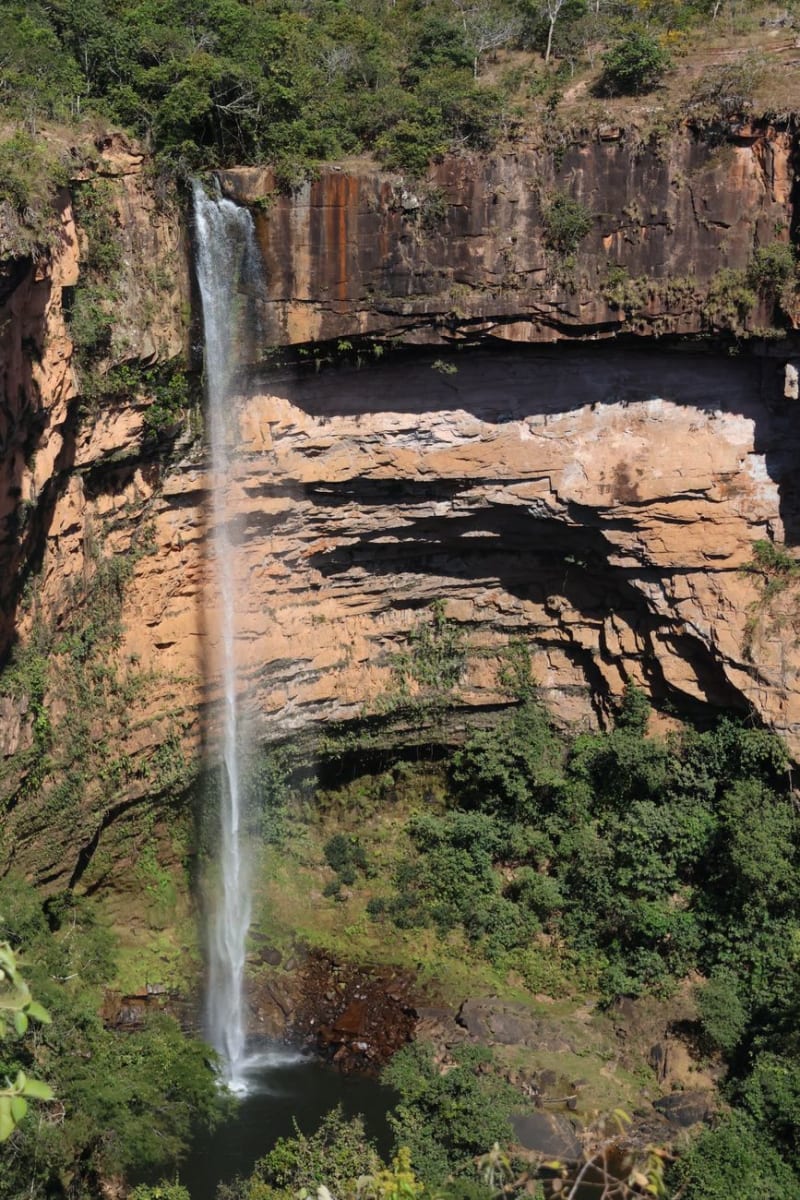
Two enormous waterfalls inside the national park, one plunging some 120 metres off a cerrado cliff into a canyon you reach only on foot.
Explore chapada-veadeiros
 São Jorge
A village of 800 people at the park's edge where the Wi-Fi is poor and the pace of life feels like an actual argument against urgency.
Explore chapada-veadeiros
 Vale da Lua
A riverbed carved into smooth lunar formations by 1.8 billion years of water — best walked barefoot at low season.
Explore chapada-veadeiros
 Vão de Almas
A remote Kalunga quilombo settlement tucked into a river valley, reachable only by a long, rough drive from Alto Paraíso.
Explore chapada-veadeiros
 Alto Paraíso de Goiás
The Chapada's gateway town where New Age crystal shops and cerrado cattle farmers share the same dusty main street without apparent conflict.
Explore chapada-veadeiros
 Cachoeiras Almécegas
Twin waterfalls near Alto Paraíso that local guides call the Chapada's best-kept secret — and that most guidebooks haven't caught up to yet.
Explore