
Tibesti Mountains
"Emi Koussi doesn't look like the highest peak in the Sahara. It looks like the place where the Sahara began."
The most remote highland on earth — volcanic craters, Toubou nomads, and a silence so total it functions like a presence.

Getting to the Tibesti is the kind of undertaking that requires you to make peace with uncertainty before you leave. There are no paved roads beyond Faya-Largeau. There are no fuel stations in the mountains themselves. The tracks that exist are known to guides and military patrols and to the Toubou people who have moved across this terrain for centuries, and to essentially no one else. I traveled with a small group arranged through a Chadian expedition operator — two 4x4s, extra fuel in jerry cans strapped to the roof, food for twelve days, and a Toubou guide named Ibrahim who had done this route perhaps forty times and still consulted the sky before each day’s departure in a way that was not performative.

The mountains announce themselves gradually — the flat hammada gravel plain begins to fold upward, black basalt emerging through sand, the horizon acquiring weight. Emi Koussi, the shield volcano that tops out at 3415 meters and is the highest point in the Sahara, does not reveal itself dramatically. You are simply driving across increasingly high terrain, through thinner air that tastes different — cooler, cleaner, scrubbed of the particulate that hangs over everything below — and then you are near the summit and the caldera opens below you: a depression four kilometers wide, the floor streaked white with evaporite deposits, surrounded by walls of ancient lava. It is one of the most alien landscapes I have ever stood in. Not beautiful in any conventional sense. Beautiful in the way that things are beautiful when they are entirely beyond human scale.
The hot springs near Ounianga are one of the Tibesti’s stranger intimacies — water at 35 degrees bubbling from volcanic rock in the middle of desert so dry it parches your lips in minutes. Ibrahim boiled tea in the spring water and said it tasted different from the water we’d been carrying. He was right. It tasted mineral and old, like something the earth was reluctant to give up. The Toubou communities in the valleys below Bardaï keep goats and date palms and maintain a way of life that has changed less in two centuries than most places change in a decade. They receive visitors rarely and without particular ceremony — tea is offered, conversation happens through Ibrahim’s translation, and then you are released back into the landscape with the feeling that you have been granted access to something rather than sold an experience.

The rock art in the Tibesti predates even the Ennedi’s oldest panels in some locations. Cattle, elephants, hippos — painted by people who inhabited a green Sahara that existed before the climate shifted, before the land became this. Standing in front of a frieze of painted elephants at four thousand feet above what is now desert, I felt something I can only describe as temporal vertigo: the certainty that the world changes faster than any civilization is built to believe, and the strange comfort of knowing that people have always been painting walls in beautiful places.
When to go: The Tibesti is only accessible from November to February, and even then it requires serious advance logistics — permits from Chadian authorities, a licensed operator, and equipment rated for both extreme cold at altitude and extreme heat in the valleys. This is not a destination you improvise. It is one that rewards months of planning with an experience that is simply unavailable anywhere else on earth.
Keep exploring
More from Chad
 chad
Zakouma National Park
One of Central Africa's last intact savannas — where elephant herds of hundreds move through acacia woodland and conservation actually worked.
Explore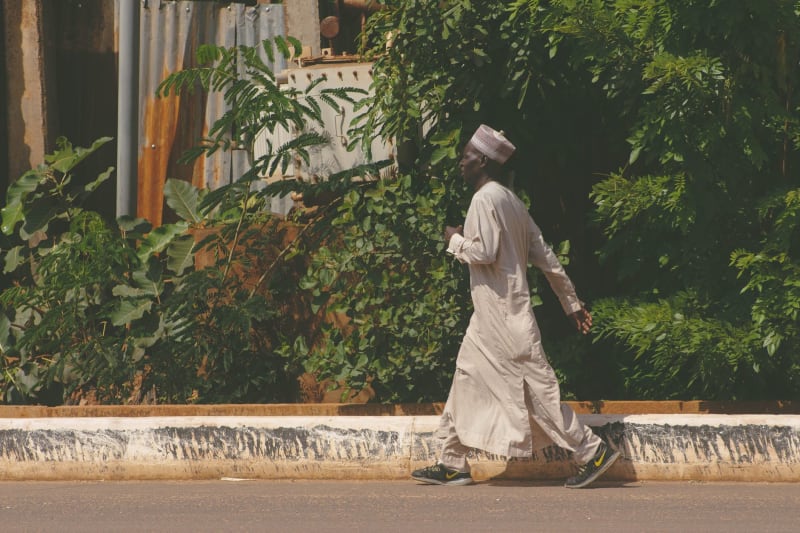 chad
Abéché
The ancient sultanate capital of the east — Arabic scripts on mud walls, incense in the souks, and seven centuries of Saharan trade history still breathing.
Explore chad
Bardaï
The only real settlement in the Tibesti — a date-palm oasis surrounded by volcanic peaks, home to the Toubou and almost no one else.
Explore chad
Ennedi Plateau
A sandstone labyrinth in the Sahara's heart where prehistoric painters left their hands on rock that no fence has ever touched.
Explore chad
Fada
A sand-blown outpost at the edge of the Ennedi — where the last paved road ends and every journey north becomes an act of faith.
Explore chad
Faya-Largeau
The largest oasis town in the northern Sahara, a sprawl of date palms and mudbrick on the edge of an ocean of sand where the desert stops pretending to be anything else.
Explore