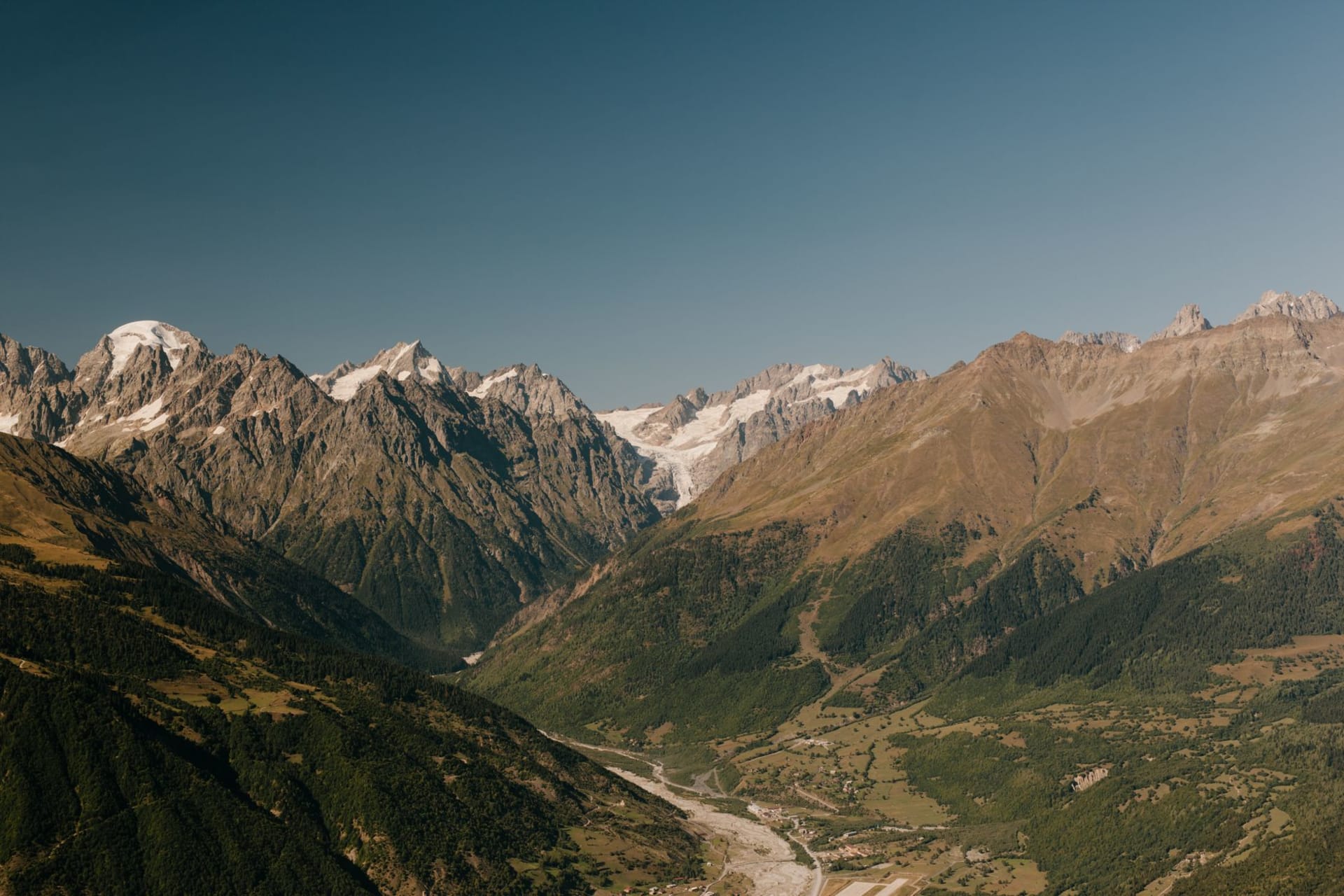
Ushguli
"A village that has been here longer than most nations and doesn't particularly care that you've noticed."
The minibus from Mestia drops you at the edge of Ushguli with a loud exhale of brakes, and then it’s just you and the towers. Forty-some of them, grey stone, rising from the slate rooftops of four hamlets strung together along a bend in the Enguri river. The sky above Shkhara — 5,068 meters of glacier and rock — is the color of a held breath. I had been in the Caucasus for two weeks before I made it here and I remember the specific feeling of stopping midway across the mud track between the parking area and the nearest cluster of houses: that this was the destination the whole range had been building toward.
Ushguli is not a museum town. The UNESCO inscription is on a wooden board near the church and seems to mean nothing in particular to anyone here. Chickens roam the lanes between the towers. A woman in rubber boots is carrying firewood past a doorway carved from stone that was already old when the Soviet Union was founded. The towers were built between the ninth and thirteenth centuries as family refuges during periods of inter-clan warfare, and each one still belongs to the family whose ancestors built it. They are not attractions. They are architecture that got tall enough to outlast everything.

I walked up toward the Shkhara glacier on my second morning, following a track that becomes a path that becomes a suggestion. The ice came into clarity gradually — what had looked from the village like permanent cloud resolved into the actual glacier face, striated and blue-grey where the crevasses opened. Somewhere near the tongue of the glacier I sat on a rock and ate the kubdari I had bought from a woman at a table near the church — bread stuffed with spiced pork and pressed flat on a cast-iron pan, the fat still running. The glacier made sounds. Not dramatic sounds but structural ones, the low creak of ice accommodating itself. It felt like being let in on something.
The food in Ushguli is the food of people who spend winters at 2,200 meters: dense, fatty, warming, with flavors that lean toward wild garlic and dried herbs and smoked things. The amber wine — skin-contact, bone-dry, poured from a clay jug without comment — tastes like something that has been sitting in a cool cellar since before you were born, which it essentially has been. Evenings in the guesthouses involve long tables, Georgian toasts that stretch on for twenty minutes before anyone drinks, and at some point an old man appearing with a panduri and singing something that doesn’t require a translation.

The Lamaria church, on its hill above the main cluster of towers, is worth an early morning. Small, ancient, with frescoes that have been accumulating candlesmoke for centuries, it still functions as a working church — something I was reminded of when I arrived to find a service in progress and stood outside listening to the harmonics of Georgian polyphonic chant coming through the stone walls. The sound carries across the valley. On a still morning you can hear it all the way at the riverbank.
When to go: June through September is the only reliable window — the road from Mestia is frequently impassable between November and April. Late June brings wildflower meadows at elevation; September offers the clearest skies and the village nearly to itself. July and August see the most visitors, though “most visitors” in Ushguli still means a very manageable number.