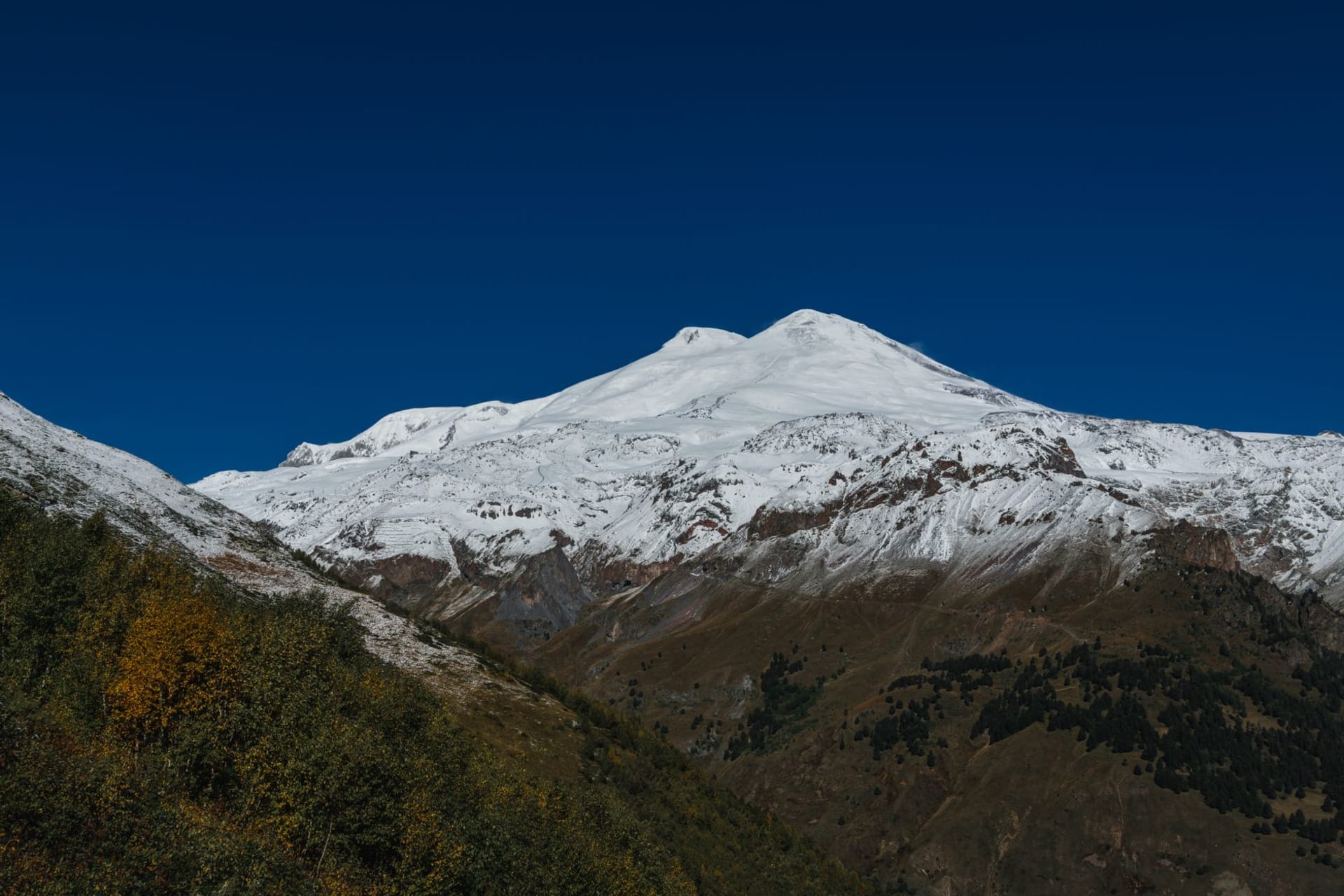
Mount Elbrus
"I stood at 3,800 metres eating a meat pie from a hut while the highest mountain in Europe ignored me completely."
I did not climb Mount Elbrus. I want to be honest about that from the start, because the internet is full of people who summited it and want you to know, and I am not one of them. What Lia and I did was ride a series of increasingly geriatric cable cars from the Baksan Valley up to the snow line, drink tea in a hut at nearly four thousand metres, and stare up at the two white domes of the highest mountain in Europe with the specific humility of people who know their limits. It was one of the most extraordinary half-days of the whole Caucasus trip, and it required no ice axe whatsoever.
The valley and the cable cars
Elbrus sits at the western end of the Greater Caucasus, in the Russian republic of Kabardino-Balkaria, and it is a volcano — dormant, twin-coned, 5,642 metres at its higher western summit. You reach the mountain through the Baksan Valley, a long green corridor of stone villages, grazing horses, and the constant white wall of the range closing off the southern sky toward Georgia. The base for everything is the cluster of guesthouses at Azau, at the foot of the cable-car system. The lower stages are modern gondolas; the upper stage is a wonderfully alarming old Soviet pendulum car that swings up to the Garabashi station, at around 3,800 metres, where the snowcats wait to take real climbers higher.

Stepping out at Garabashi is a physical event. You go from a warm car to thin, brilliant, freezing air in about four seconds, and the altitude announces itself immediately — a slight ringing, a shortness of breath when you walk up even a gentle slope. The famous “Barrels” huts sit here, repurposed fuel cylinders that climbers sleep in to acclimatise, and there is a small café where a stoic woman sells khychiny — the local Balkar flatbreads stuffed with cheese and potato — and sweet black tea. Lia and I ate ours sitting on a snowbank, looking down on a sea of cloud filling the valley below and up at the summit cones, which from here look both very close and completely unreachable.
Knowing your limits, and the weather
Elbrus has a deceptive reputation. Technically it is not a difficult climb — no vertical rock, no famous knife-edge ridges — and this is exactly why it kills people. The altitude is serious, the weather changes with brutal speed, and the gentle white slopes give no purchase and no landmarks in a whiteout. The guides we spoke to were blunt about it: more people die on Elbrus than on far more “dangerous”-looking peaks, almost all of them from a combination of altitude, exposure, and overconfidence. Watching a sudden cloud erase the entire upper mountain in about ninety seconds while we sipped our tea, I felt entirely at peace with my decision to stay below.

For non-climbers, the cable-car day is reward enough, and you can extend it with hikes lower down — to the Azau glacier tongue, or up the Cheget side opposite, which gives the classic head-on view of both summits. If you do intend to climb, treat the acclimatisation seriously, build in spare days for weather, and go with a guide. The mountain does not care about your itinerary.
When to go
The climbing season runs roughly June to September, with July and August the most stable. The cable cars run year-round and the winter turns the area into a ski resort, but for the clearest summit views and walkable trails, come in summer. Bring real cold-weather layers even for the cable-car trip — it can be high-twenties Celsius in Azau and below freezing at the top station within the same hour.