Mestia
"The kind of town where you go to sleep to the sound of a river and wake up to the sight of glaciers."
I arrived in Mestia on a shared marshrutka from Zugdidi that took four hours, which the driver spent making phone calls with one hand and navigating hairpin turns above the Enguri gorge with the other. When we finally descended into the valley and the town materialized between two ridges — towers visible above the rooftops, peaks visible above the towers — I had the distinct feeling that the journey itself had been a kind of initiation. Mestia earns its arrival. You do not stumble upon it.
The town is small enough to walk across in twenty minutes, but it is dense with a kind of mountain-town energy that surprised me. There is a covered market where women sell churchkhela — those walnuts on a string dipped in grape must until they form a chewy, dark candy — alongside dried beans and fresh cheese so white it hurts to look at in the morning sun. There is a museum that holds artifacts from the Bronze Age through the medieval period, staffed by a woman who speaks no English but communicates the entire history of Svaneti through tone of voice and the angle at which she holds photographs.

The towers here are the same Svan towers that define Ushguli further up the valley, but in Mestia they coexist with cafes, a ski rental shop, a small airport that receives flights from Tbilisi on clear days, and guesthouses where the hosts serve breakfast at a long table and ask where you are going today with the proprietary interest of people who know every trail in the area. The town functions as a base and the mountains make clear immediately what they expect you to do with it.
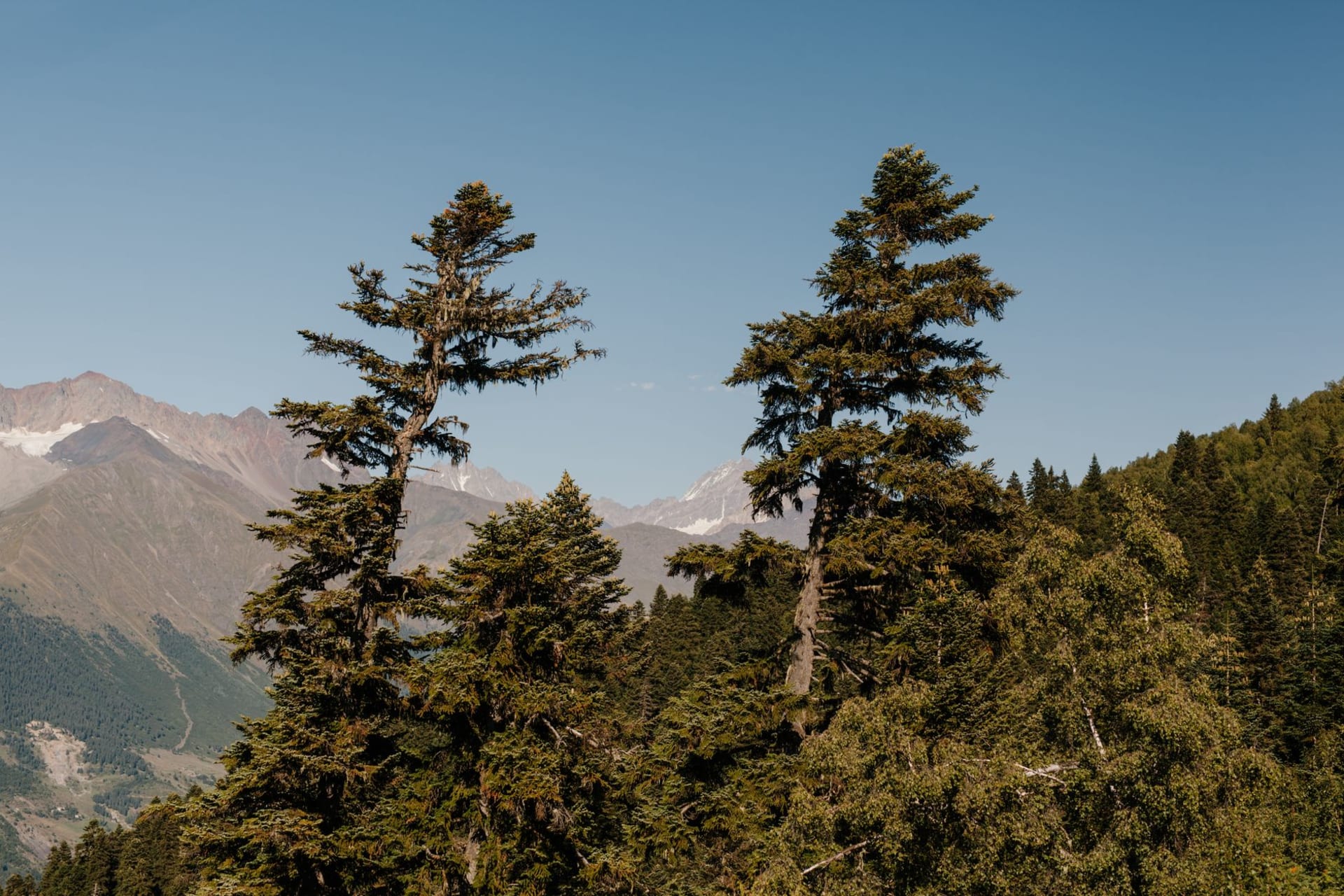
I walked the Koruldi Lakes trail on my second day — a steady climb through pine forest that breaks onto an alpine plateau with views of Ushba, the double-peaked mountain that the Svans have long regarded as a malevolent presence. Ushba does not look friendly. It looks like something drawn by a child who was told to make a mountain as frightening as possible. From the lakes, on a clear morning, the whole chain of greater Caucasus peaks spreads west to east in a silence so complete that the distant roar of meltwater far below registers as ambient music.

Evenings in Mestia are for the guesthouses. The host families here have been accommodating travelers — first Soviet hikers and alpinists, more recently a trickle of international visitors — long enough to have developed a certain ease about it. Dinner appears at the table unbidden: plates of pkhali (spinach and walnut paste pressed into small rounds), slabs of sulguni cheese, bowls of bean soup with a knob of fat floating on top. The wine is local and extraordinary in the way that things are extraordinary when they are made by someone for their own consumption rather than for sale. You drink it slowly because it is the kind of thing you want to remember the taste of.
When to go: June through October for hiking, with July and August bringing the warmest temperatures and the Koruldi Lakes trail in full bloom. Mestia also operates as a ski destination from December through March, with lifts serving slopes above the town — a fact that seems improbable until you see the vertical drop behind the guesthouses.