Khinalig
"The language here is spoken by about two thousand people. The view is spoken by no one because no one has found the words."
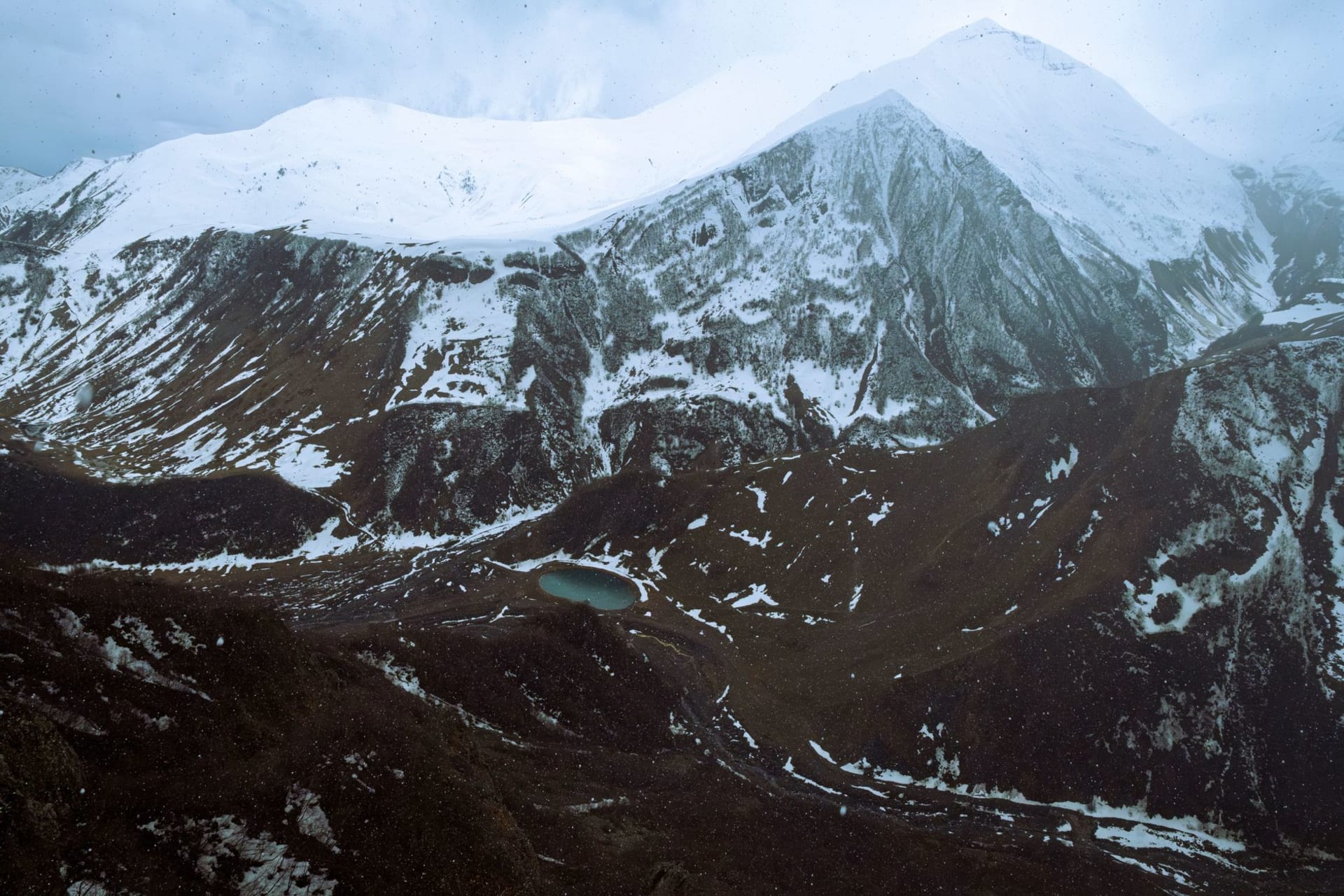
The road to Khinalig from Quba is forty kilometers of increasingly improbable switchbacks that end at a village perched on a saddle between two ridges at about 2,200 meters. The Azerbaijani guidebook I had consulted called it “one of the oldest villages in the Caucasus.” The man sitting next to me in the shared taxi — who turned out to be a linguist from Baku making his fourth trip — called it something more precise: “the only place on earth where you can hear Khinalig being spoken.” The language is a Caucasian isolate, related to nothing else in the world’s linguistic inventory, spoken by roughly two thousand people in this one village. You can study it. You cannot go anywhere else and hear it.
Khinalig receives visitors mostly because of that linguistic fact, or because of the altitude and the views, or because of the age of the village — habitation here is documented to at least the second millennium BCE. When I arrived, the village was quiet in the middle-afternoon way of places where physical work starts very early and rest comes without guilt. A few children were playing in the lane between two houses whose walls shared a foundation. A woman was hanging laundry on a line strung between a satellite dish and a stone chimney. The juxtaposition seemed entirely natural.

The houses in Khinalig are built into and on top of each other in a way that makes the village look, from a distance, less like a collection of separate structures and more like a single organism that has been growing and subdividing since the Bronze Age. The rooftop of one house is the courtyard of the house above it. Interior walls often share the rock of the mountain itself. The architectural logic is pure function — insulation, windbreak, communal defense — expressed over two millennia of incremental addition.
The guesthouse where I stayed was run by a family who had hosted travelers since tourism to Khinalig became possible in the 1990s. Dinner was served at a low table with cushions on three sides: thick lamb broth with barley, boiled potatoes, local honey with a strong floral aftertaste, bread that had been baked in a tandoor in the courtyard that morning and was still faintly warm. The host’s father, who must have been in his eighties, sat in the corner with a small radio pressed to his ear tuned to something that crackled with distance. He was the only one who spoke Khinalig to me, knowing I couldn’t understand a word, apparently unconcerned.

The hiking above the village leads through summer pastures and eventually to ridge crossings that connect to other valleys. The shepherds who use these paths in summer months know every track; the few local guides who take visitors are generally the sons of those shepherds and navigate by memory and by the shape of rock outcroppings that have served as landmarks for generations. There is no GPS signal reliable enough to trust above the village. The old knowledge is still the working knowledge.
When to go: June through September. The road from Quba is sometimes impassable in winter due to snow and mud, and the village is occasionally cut off entirely. July and August are warmest but can bring afternoon cloud cover that obscures the views. Early September has the clearest light and the fewest other visitors.