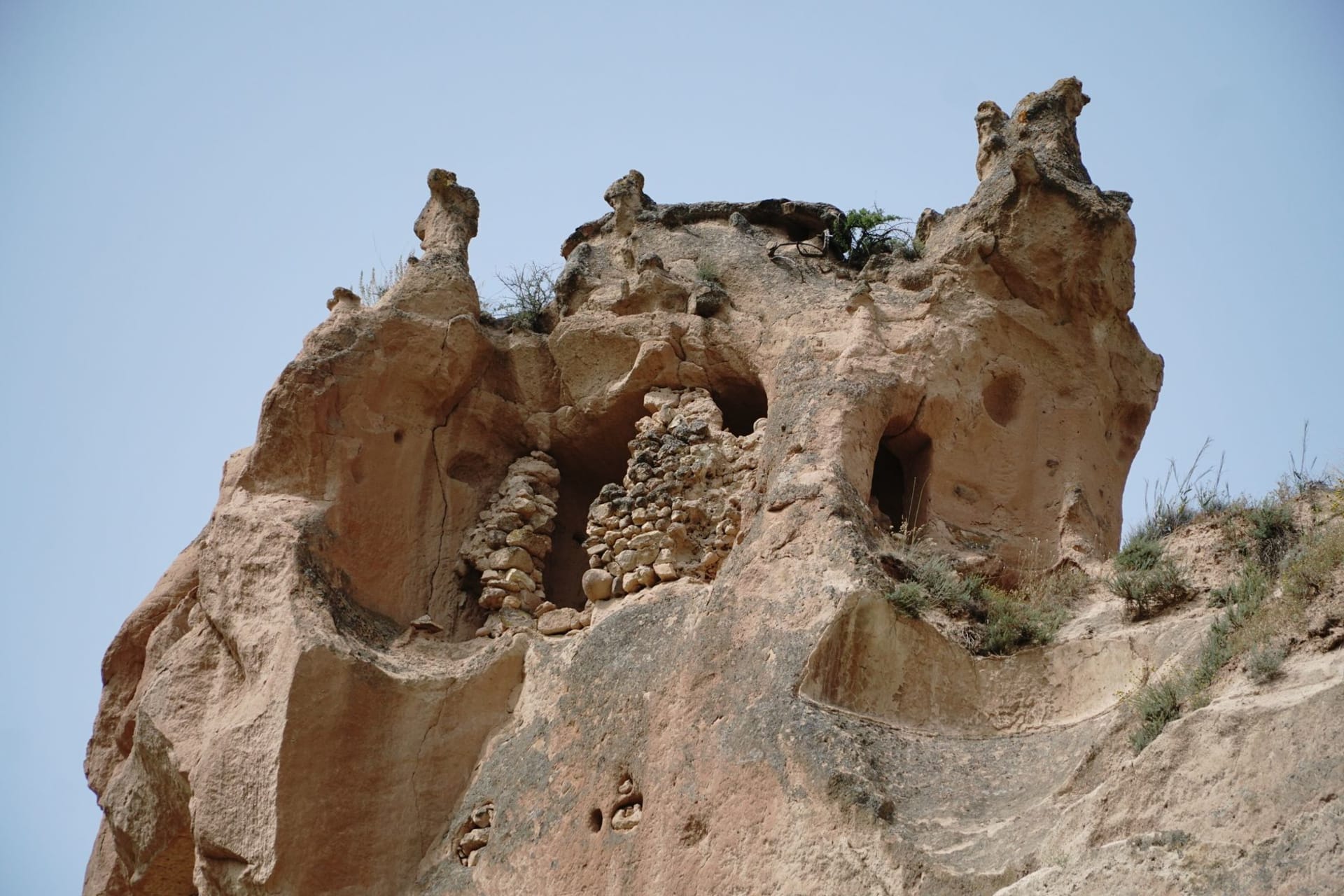
Zelve
"People lived here until 1952. The stone shelves are still cut into the walls where they put things."
Zelve is three valleys in one, connected by tunnels carved through the rock, and the whole complex was an inhabited village until the Turkish government relocated its residents in 1952 because the tufa was judged unsafe. The people of Zelve had been living in these caves — some of them for a thousand years, some newly carved — and one morning they gathered what they could carry and walked out. The pots, the sleeping platforms, the millstone pressed into one cave floor, the mosque minaret carved from a single fairy chimney: these stayed.
I spent a morning there in October, the only visitor for the first hour after opening. The path winds through the valleys on marked trails, though the temptation is to leave the trail and climb the footholds to upper cave levels, which the site technically discourages and which I mostly ignored when the rock looked stable. From the upper openings you look down onto the village spread below: dozens of cave doorways and windows cut into every available surface, pigeon holes carved in geometric patterns into the cliffs, the remains of a wine press cut into a ledge. The whole place smells of old dust and stone — a smell that is both ancient and strangely domestic.

What strikes me about Zelve, and what distinguishes it from Göreme’s Open Air Museum, is that this was not a monastic complex or a church but simply a village — people growing grapes and pressing them, raising pigeons for their droppings (a valued fertiliser), milling grain, sleeping and eating and raising children inside the rock. The cave church here is simple compared to Göreme’s decorated interiors — a few faded crosses, a niche for an altar — which makes it more moving to me, not less. Piety that didn’t have time for ornament.

The site connects, via a short walk on the main road, to Paşabağı — the fairy chimney grove where several formations have developed the distinctive mushroom cap that the landscape is famous for. These particular ones are enormous. One is three-headed. The scale only registers when a person stands next to one and becomes suddenly very small.
When to go: Zelve is open year-round and at its most atmospheric in the quieter months — October through April. The site is never as crowded as Göreme’s Open Air Museum, which is one of its quiet pleasures. Morning light falls directly into the valleys in spring and autumn, making the first two hours after opening particularly vivid. The short walk to Paşabağı makes a logical extension of any visit here.