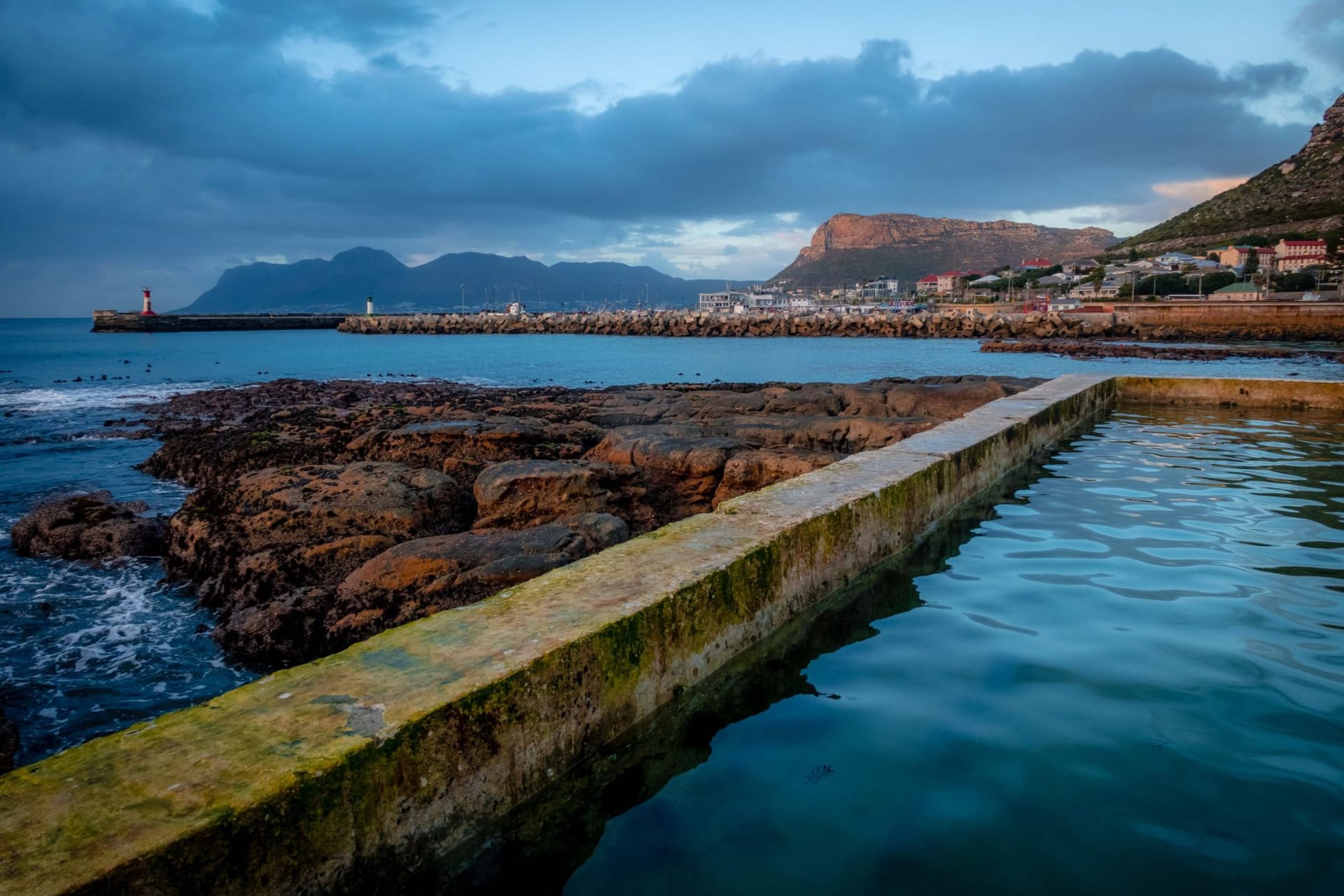
The train from Cape Town to Kalk Bay follows the False Bay shoreline so closely that in places the spray from the waves reaches the window. I have taken this line several times, always in a state of mild astonishment that such a journey exists as a commuter route — that people do this every day, that someone gets off at Muizenberg or St James or Kalk Bay and considers it entirely normal. Kalk Bay station sits right on the main road, and when you step off the platform you are immediately in the middle of the village: smell of coffee, smell of salt water, a bakery visible from the stairs, the harbor three minutes on foot.
The harbor is where the village makes sense. Kalk Bay has been a fishing community since the 1800s, and the working boats — colored orange and blue and rust-red, practical and weathered — still come in with catches of snoek and yellowtail. On Saturday mornings the fishermen sell directly from the harbor wall, and the snoek is sometimes still moving. Harbour House, with its glass-fronted deck directly above the water, serves these fish in the afternoon with views that should cost twice the price. I ate a yellowtail there in October and didn’t speak for twenty minutes.

Main Road — the commercial artery of the village — is crammed in the best way. Antique shops run deep into their premises, floor to ceiling with Cape Dutch furniture and old prints and things you didn’t know you wanted until you saw them. There are bookshops with cats inside. The Olympia Café, which has been serving eggs and good coffee and slightly chaotic service since before I was born, is always full and always worth the wait. Down a side passage, the Kalk Bay Theatre puts on productions that draw audiences from across Cape Town. This is not a quaint village preserved in amber — it is a place that is actually being lived in.

Above the village, the Kalk Bay Mountain trail climbs through fynbos to caves that once sheltered early inhabitants of the peninsula, and continues to the Silvermine plateau. I’ve done pieces of it in the early morning before the day heated up, and the views across False Bay from the fynbos above town are surprisingly removed from everything — the village small below, the mountain range running north to Cape Town, the ocean flat and enormous. On the mountain you could be anywhere in geological time.
The village rewards the absence of a plan. Walk the harbor. Sit at a cafe table. Watch the fishermen. Take the train back instead of driving. This is a place that gives more the slower you move through it, and the slower you move the more it reveals.
When to go: Year-round, though Kalk Bay is at its most atmospheric in winter — the southerly storms bring big swells against the harbor wall, the fishermen work in yellow oilskins, and the cafes are warm inside. Summer is busier and the weekend markets fill up early. The train from Cape Town runs daily and costs very little; it is the correct way to arrive.