
Montmorency Falls
"Thirty meters taller than Niagara and ten minutes from downtown Quebec City — nobody warns you how loud it is."
A waterfall taller than Niagara, roaring down a cliff just outside Quebec City, crossed by a cable car and, in winter, guarded by a frozen 'sugarloaf' cone of spray-ice.
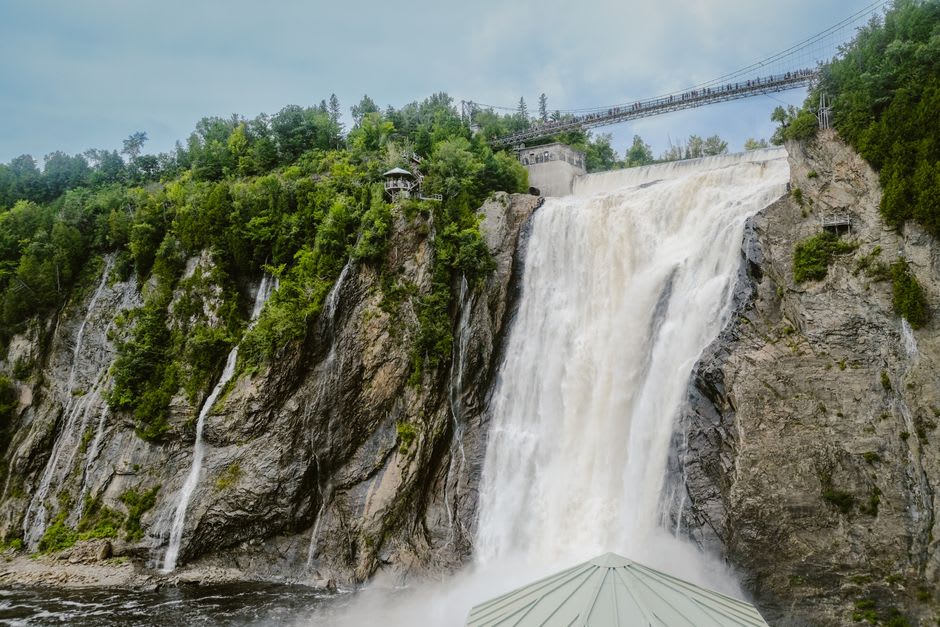
Nobody had warned me that Montmorency Falls would be loud enough to feel in my chest before I even reached the viewing platform. It’s a fifteen-minute drive from downtown Quebec City, tucked at the mouth of the Montmorency River where it meets the St. Lawrence, and the fact that it’s taller than Niagara Falls — 83 meters against Niagara’s 51 — gets mentioned so often by guides that it starts to sound defensive, like a younger sibling insisting on a technicality. It doesn’t need the comparison. Standing at the base, soaked in drifting spray on a day I hadn’t planned to get wet, watching the water fold over the cliff edge in a single unbroken sheet, the height was obvious enough without the footnote.
The Manoir Montmorency sits at the top of the falls, a rebuilt version of a nineteenth-century estate that burned down twice, and its terrace gives you the vertigo-inducing view straight down the gorge. I took the cable car up rather than the stairs, partly out of laziness and partly because the ride itself, suspended over the falling water with the St. Lawrence spreading out behind it, is worth the ticket price alone.
The Suspension Bridge and the Via Ferrata
A pedestrian suspension bridge crosses the river directly above the lip of the falls, which sounds terrifying and mostly is — the whole structure has a barely perceptible sway, and looking straight down through the railing at the exact moment the water commits to the drop gives you a very specific kind of vertigo that no photo prepares you for. For anyone wanting more than a viewing platform, there’s a via ferrata bolted into the cliff face beside the falls, and a zipline that fires you across the gorge at speed — I did the via ferrata on a whim, clipped in and edging along wet rock with the roar filling every gap in conversation, and it remains one of the more genuinely nerve-testing things I’ve done for a photo.
Winter’s Sugarloaf
The detail that stuck with me longest, though, came from a local who told me about winter here rather than from anything I saw myself in July: as temperatures drop, spray from the falls freezes at the base into an enormous cone of ice — the “pain de sucre,” or sugarloaf — sometimes rising thirty meters, and generations of Quebec City kids have used it as an improvised, slightly reckless toboggan hill. The falls never fully freeze, so you get this strange tableau of churning black water still crashing down behind a mountain of white ice. I’m already planning a January trip back just to see it.
When to go: Summer for full water volume and the via ferrata/zipline season; December through March to see the sugarloaf ice cone, though dress for genuine cold at the exposed viewing points.