Gitega
"The drums here don't perform for you. They just are, and that's what makes them extraordinary."
The road from Bujumbura to Gitega climbs steadily through hills that become more tangled and green the further you go. I took a minibus from the capital’s chaotic central gare, wedged between a woman with a live chicken in a cloth bag and a man carrying a car battery on his lap, and the two-hour journey went through landscapes that made me want to get off and walk — red clay roads cutting across hillsides terraced into impossible stairways of cassava and sorghum, valleys so dense with eucalyptus that the air through the window smelled like medicine.
Gitega itself is quieter than Bujumbura, more administrative than commercial, with a certain highland composure. The streets are wider, the buildings lower, and the pace slower in a way that doesn’t feel like deprivation but like a different calculation about time. The market here is smaller and smells more of earth and less of diesel — sweet potatoes in precarious pyramids, dried beans sorted by color into coffee-tin measures, elderly men selling hand-rolled tobacco from wooden cases balanced on their knees.

The National Museum is the reason most visitors come to Gitega, and it earns the trip. Inside, among the exhibits on Burundian history and culture, the royal drums occupy their own gravity. These are not museum pieces in the passive sense — they are ingoma, living objects associated with the mwami (the Burundian king), traditionally housed at specific sacred sites called ivyivyo. The museum holds specimens and displays the oral and ceremonial context, but the drums themselves feel weighted with something beyond documentation. The curator who showed me around spoke about them the way my grandfather spoke about certain old tools in his workshop — not with reverence exactly, but with the specific attention you give to things that have agency.
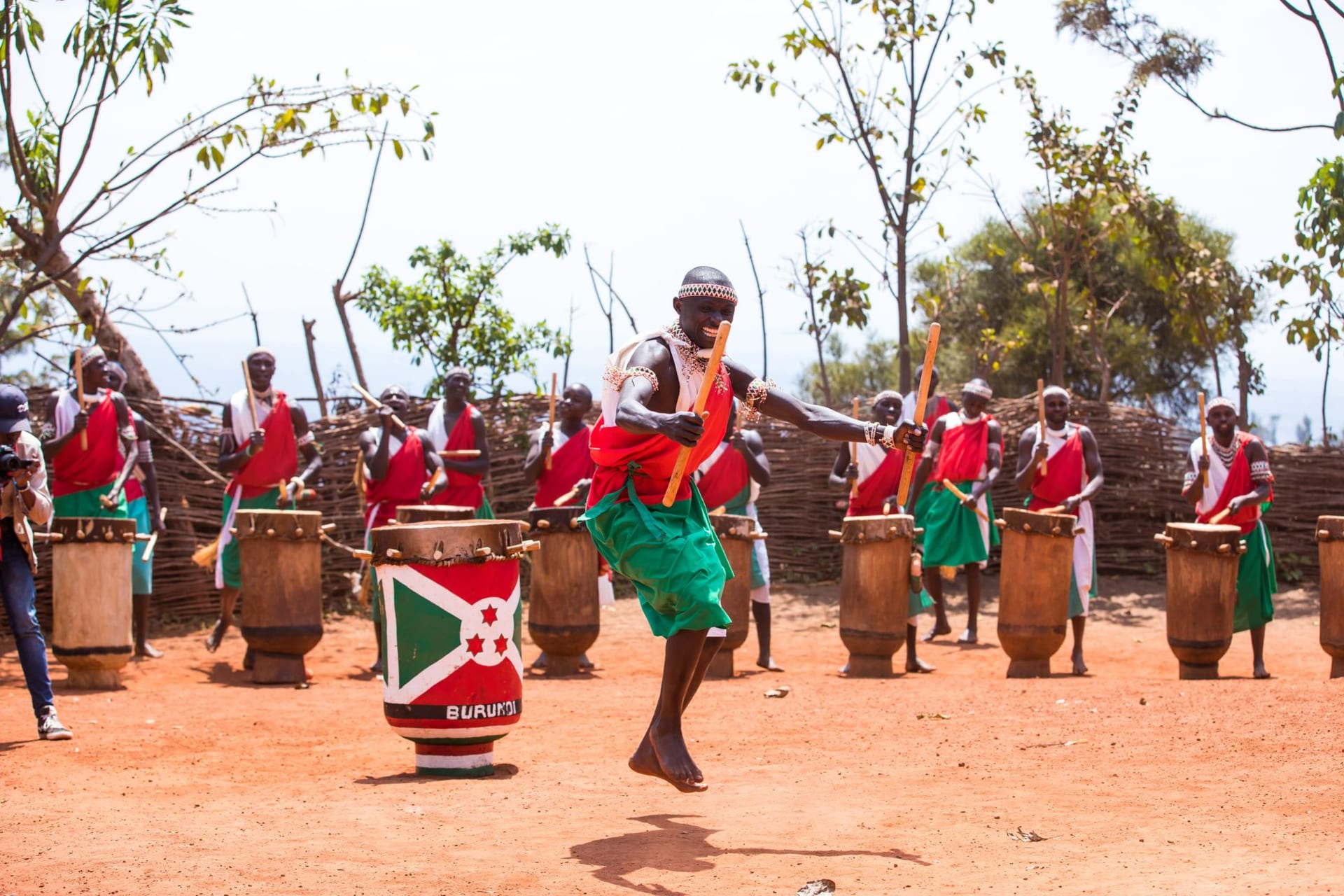
What moved me more was an encounter I wasn’t expecting: a drumming rehearsal happening in a courtyard near the museum, young men training in the tradition of the royal drummers. They played in formation, holding the tall drums vertically and striking them from above with both hands, dancing with the instruments rather than merely using them. The synchronization was total — not the mechanical synchronization of a rehearsed performance, but something more felt, more physical, where the bodies and the drums were one system. I stood watching for perhaps twenty minutes. No one asked me to stay or leave. The sound carried across the hillside.

In the evening I found a small restaurant near the main road where a woman served isombe — cassava leaves cooked with palm oil and peanuts until they become something dark, rich, and deeply savory — with ugali and a piece of tilapia. The restaurant had three plastic tables and a hand-written menu on a chalkboard, and a TV mounted on the wall playing a Kirundi-language game show at low volume. I was the only foreigner. Nobody made anything of it. I ordered a second helping of isombe and paid the equivalent of less than two euros for the whole meal.
When to go: Gitega sits at around 1,700 meters elevation, which keeps it cooler than Bujumbura year-round. The June to August dry season is the most comfortable for travel, with clear days and cool evenings. The National Museum is open most days but hours can be irregular — arriving before noon is safest.