Tatajuba
"Tatajuba is what Jericoacoara might have looked like thirty years ago, if thirty years ago had a Wi-Fi router in one restaurant."
A fishing village an hour past Jericoacoara where the dunes have swallowed part of the town, and a river crossing by raft is still the only way in.
We went to Tatajuba on the strength of a single sentence from a buggy driver in Jeri, who said, almost as an afterthought while we negotiated a price for something else entirely, that there was a village further up the coast where the dunes had actually buried half the houses. That sentence turned out to be barely an exaggeration.
A River You Cross on a Raft
Tatajuba sits about an hour east of Jericoacoara by buggy, past increasingly wild coastline, and the final approach requires crossing the Tatajuba river on a small hand-pulled raft — no bridge, no engine, just a rope strung bank to bank and a raft operator who hauls you across by hand while your buggy waits on a trailer alongside. It felt like a deliberate filter, the kind of minor inconvenience that keeps a place from becoming what Jeri has become.
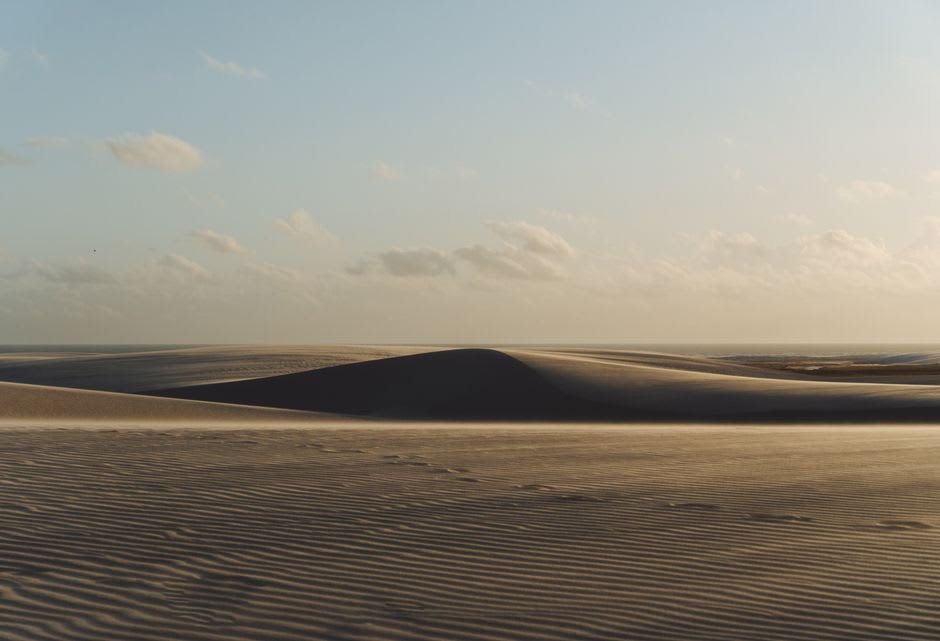
On the other side, the dunes are enormous and mobile, and the village has clearly lost a fight with a few of them — half-buried rooftops visible at odd angles where sand has crept over structures nobody bothered, or could afford, to keep excavating. It’s not derelict so much as in an active, visible negotiation with the desert next door, and the effect is stranger and more beautiful than anything staged could be.
Lagoons Without the Crowd
The lagoons here — Lagoa Tatajuba chief among them — have the same impossible turquoise as the ones near Jeri, but on the afternoon we visited there were perhaps a dozen other people in sight, total, compared to the hundreds that gather around Lagoa do Paraíso by midday. Lia swam out to the middle and just floated there for twenty minutes, saying nothing, which for her is the strongest possible endorsement a place can get.
We ate a late lunch at the only real restaurant in the village, a family operation serving whatever fish had come in that morning, grilled simply with lime and farofa, the owner’s kids running between tables while a single fan pushed hot air around the room. There is exactly one place in Tatajuba with reliable Wi-Fi, and it is that restaurant, a detail the owner mentioned with evident pride.
When to go: July through December for the strongest wind and clearest lagoon conditions, matching the dry season further along the coast. Arrive early in the day — the raft crossing stops running after dark.