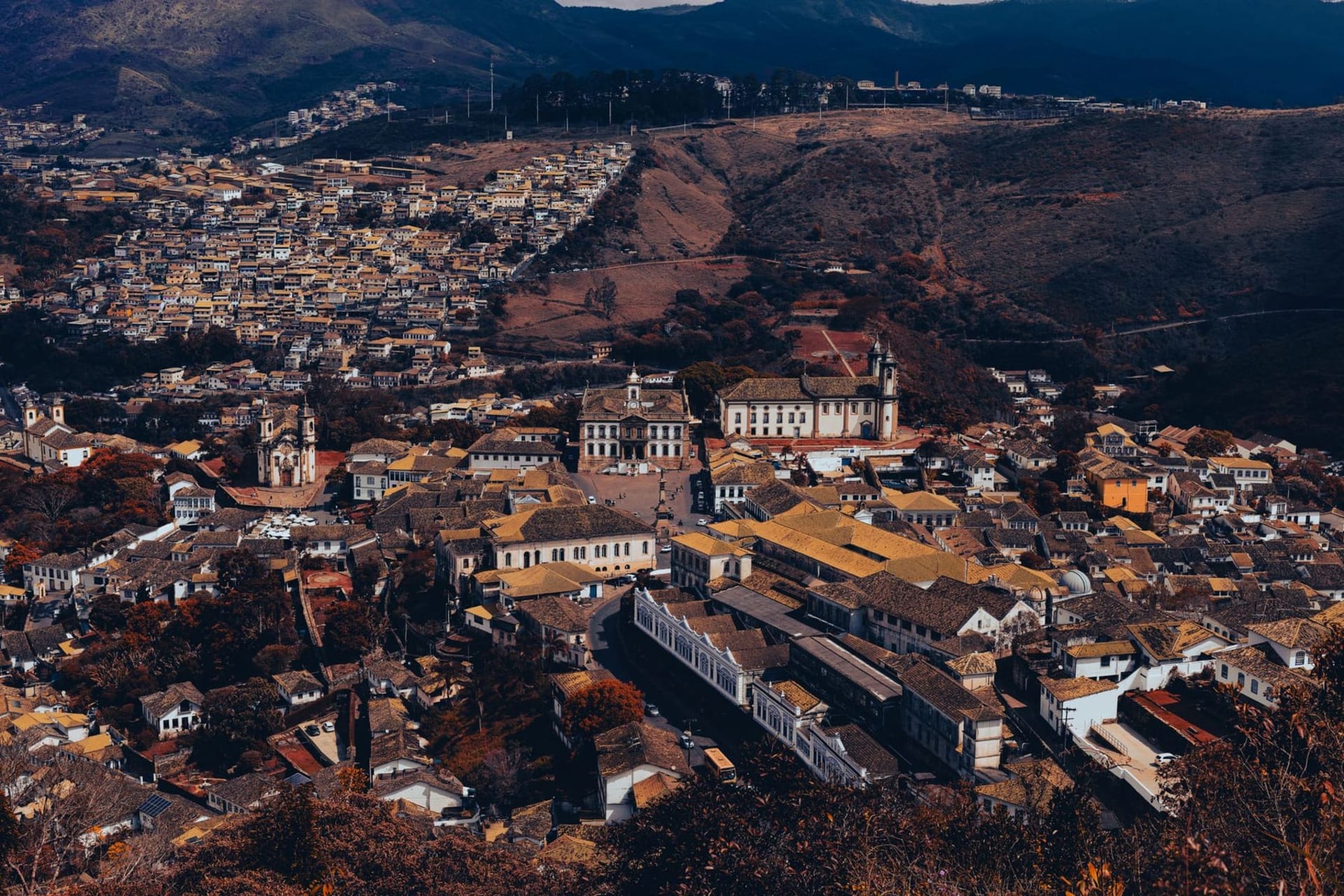
Ouro Preto
"Ouro Preto was built on gold but the real treasure is still standing on every corner."
A Baroque masterpiece of black stone churches and gold-rush opulence tumbling down Minas Gerais hillsides.
The first thing that strikes you — that strikes me — is the weight of the stone. Not metaphorically. I mean physically: the Igreja de São Francisco de Assis sits at the edge of the Praça Tiradentes like something that grew from the hillside itself, its dark soapstone facade almost black against an overcast Minas sky. I had read about Aleijadinho. I had seen the photographs. None of it prepares you for standing in front of his work and understanding that this man, losing his fingers one by one to disease, kept carving.
Lia grabbed my arm without saying anything. That seemed right.
Gold Under Every Cobblestone
Ouro Preto — Black Gold — took its name from the oxidized iron crust that coated the gold-bearing ore pulled from these hills in the eighteenth century. The Portuguese extracted something like half the world’s gold supply from Minas Gerais in under a hundred years. Then it ran out, and the city froze. What looks like preservation is partly accident: there was simply no money for demolition and reconstruction. The Baroque stayed because nobody could afford to replace it.
Walking the Rua Direita down toward the Casa dos Contos, I kept losing track of the century. The incline pitches steep enough that my calves ached by midmorning. The smell is woodsmoke and something mineral — that wet-stone smell of old walls after rain — undercut by coffee drifting from somewhere always just around the next corner. At a tiny counter on Rua São José, we ate pão de queijo still hot from the oven, cheese bread with a crust that cracked and a center that pulled like warm mozzarella, washed down with café com leite so sweet it was almost dessert.
The Museum Nobody Talks About
The surprise came on our second afternoon. We had detoured up past the Mina do Chico Rei — the gold mine you can walk through, low ceilings, headlamps, the smell of deep earth — when we stumbled onto the Museu de Ciência e Técnica da Escola de Minas. A natural history museum inside a colonial palace. I expected dusty cases. Instead: an entire room of meteorites, crystals the size of my torso, geological specimens arranged with quiet obsession. A schoolboy in a uniform stood with his nose six inches from a slice of agate, completely transfixed. I understood the feeling.
Sitting Still Long Enough
Evenings, after the tour groups retreat to their hotels, the Praça Tiradentes empties out and something older surfaces. The lamp-lit churches hold their ground. Street vendors pack up. A dog trots across the stones with complete authority. The gold is long gone from these hills but the architecture it bought — extravagant, excessive, astonishing — remains as proof that beauty built in extremity can outlast the reason it was built.
When to go: April through June and August through October offer dry, mild weather with clear light ideal for photographing the churches. The Semana Santa processions in March or April are extraordinary if the timing works, though accommodation books months in advance.