
Holambra
"Somewhere in interior São Paulo state, there is a town of windmills and tulip fields, and it took a Dutch friend to convince me it was real."
A Dutch farming town in the Brazilian interior, complete with windmills, tulip fields, and a festival I did not believe existed until I saw it.

A Dutch friend of Lia’s mentioned Holambra to us over dinner in São Paulo, describing windmills and tulip fields with a straight face, and I assumed she was exaggerating for effect until we actually drove the two hours out from the city and found ourselves surrounded by exactly that. The name itself is the giveaway once you know it: Holambra is a contraction of Holland, América, and Brasil, founded in the 1940s and 50s by Dutch immigrants, many of them Catholic farmers displaced after the Second World War, who chose this stretch of interior São Paulo state to rebuild their agricultural lives.
What they built was, essentially, a small piece of the Netherlands transplanted into red Brazilian soil. Windmills — some working, some purely decorative — punctuate a town of tidy brick buildings, canals, and a civic identity that leans hard into its origins: street signs sometimes carry Dutch names, and the town’s economy still runs substantially on flower production, which Holambra now dominates as Brazil’s floriculture capital.

The Expoflora festival, held every September, is the reason to actually plan a trip around Holambra rather than just pass through. For several weeks the town transforms into an enormous flower show — tulip fields in full bloom (grown in refrigerated soil to trick the bulbs into blooming outside their natural climate), orchid displays, and a parade atmosphere that draws visitors from across the state. I went specifically for it, and stood in a field of tulips at 1,300 metres closer to the equator than tulips have any business growing, feeling genuinely confused by my own senses.
Outside festival season, Holambra is quieter but still worth an afternoon — the central windmill and church square make for a pleasant wander, and the flower nurseries scattered around town welcome casual visitors even outside Expoflora. We had lunch at a small bakery serving stroopwafels alongside pão de queijo, a combination that should not have worked and somehow captured the entire town in one plate.

It remains one of the odder day trips available from São Paulo — not dramatic, not wild, just a genuinely strange and well-executed slice of transplanted culture that most guidebooks skip entirely.
When to go: September for the Expoflora festival and peak tulip bloom, though it is also the busiest month. Any weekend outside that window offers a calmer, cheaper version of the same charm.
Keep exploring
More from Brazil
 brazil
Igarassu
The oldest town in Brazil, a quiet colonial settlement north of Recife where the first church in the country still holds mass and almost nobody visits.
Explore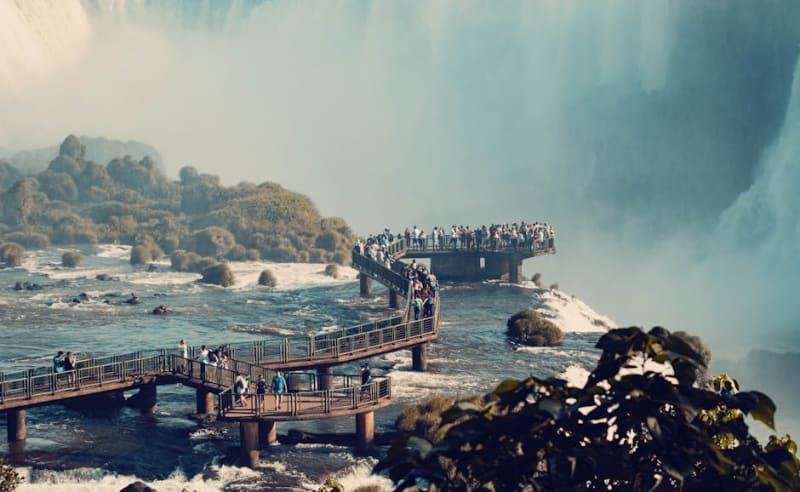 brazil
Iguazu Falls
Two hundred and seventy-five waterfalls crashing through subtropical forest — nature's most excessive spectacle.
Explore brazil
Ilha de Itaparica
A ferry ride from Salvador across the Bay of All Saints, Itaparica's colonial villages and mangrove-lined beaches move at a distinctly slower speed.
Explore brazil
Ilha de Marajó
The world's largest river-ocean island, where water buffalo outnumber cars and the Amazon delta dissolves into open sea.
Explore brazil
Ilha do Bananal
The world's largest river island, split between Tocantins and Araguaia — home to the Karajá people and wildlife that rivals the Pantanal.
Explore brazil
Ilha do Cardoso
No roads, no signal, no shortage of doubt about whether the boat will actually come back for you — the wildest island I have reached on this coast.
Explore