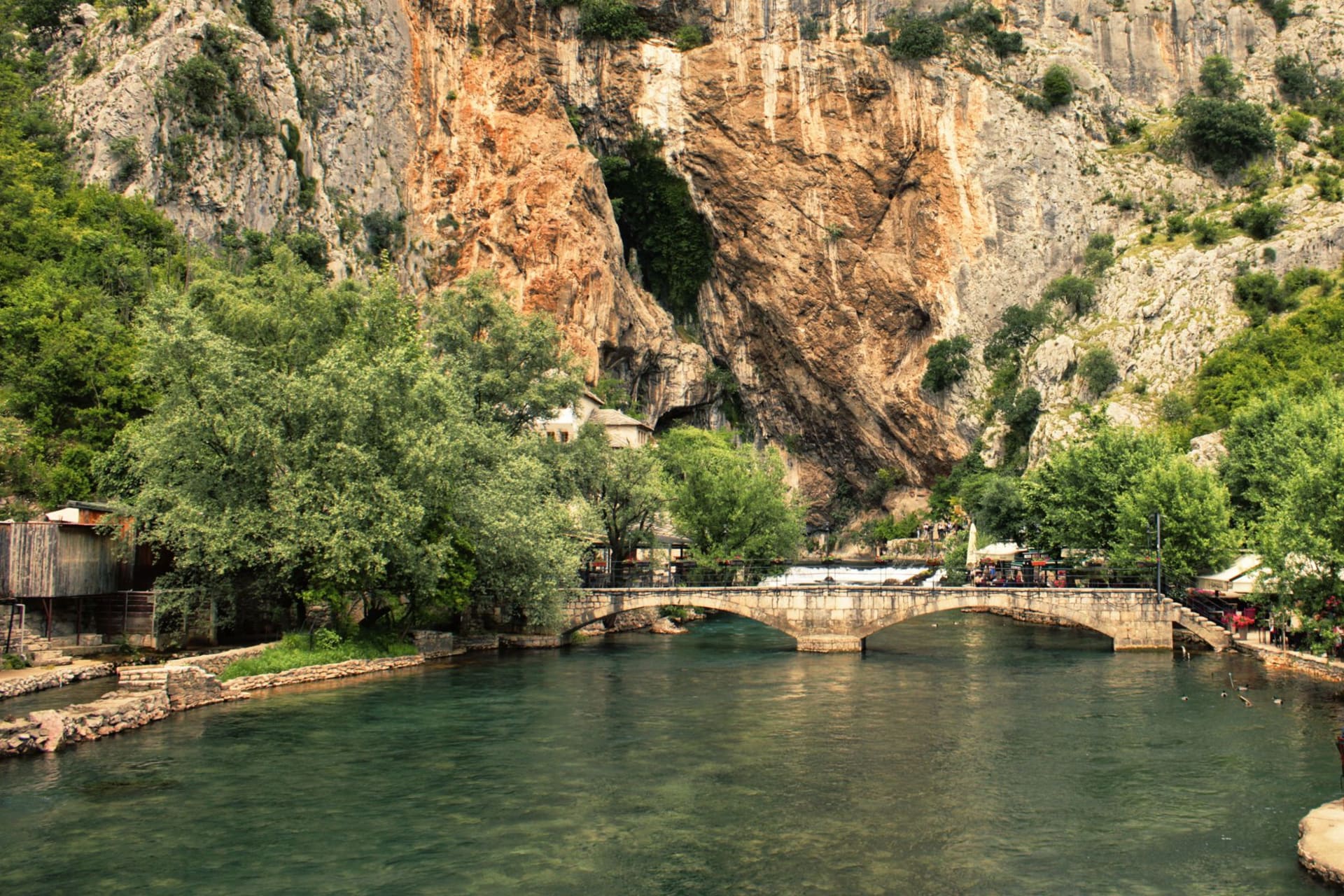
Blagaj
"The river just appears — full-width, full-speed, out of solid rock. I stood there trying to make sense of it for a long time."
The Buna river doesn’t build gradually the way rivers are supposed to. It erupts. One moment there is a cliff face of pale grey limestone rising maybe two hundred metres above a pool of water — and then the water is moving, a full river width of it, cold and green and carrying the river’s complete adult force before it has travelled fifty metres from its source. I had read that the Buna spring was impressive and assumed that was tourism language. Standing at it, I revised my assumption. The water comes out of the rock at a rate that makes the air above it permanently cool, and the colour — a blue-green somewhere between turquoise and jade — is so saturated it seems digitally enhanced. It is not.
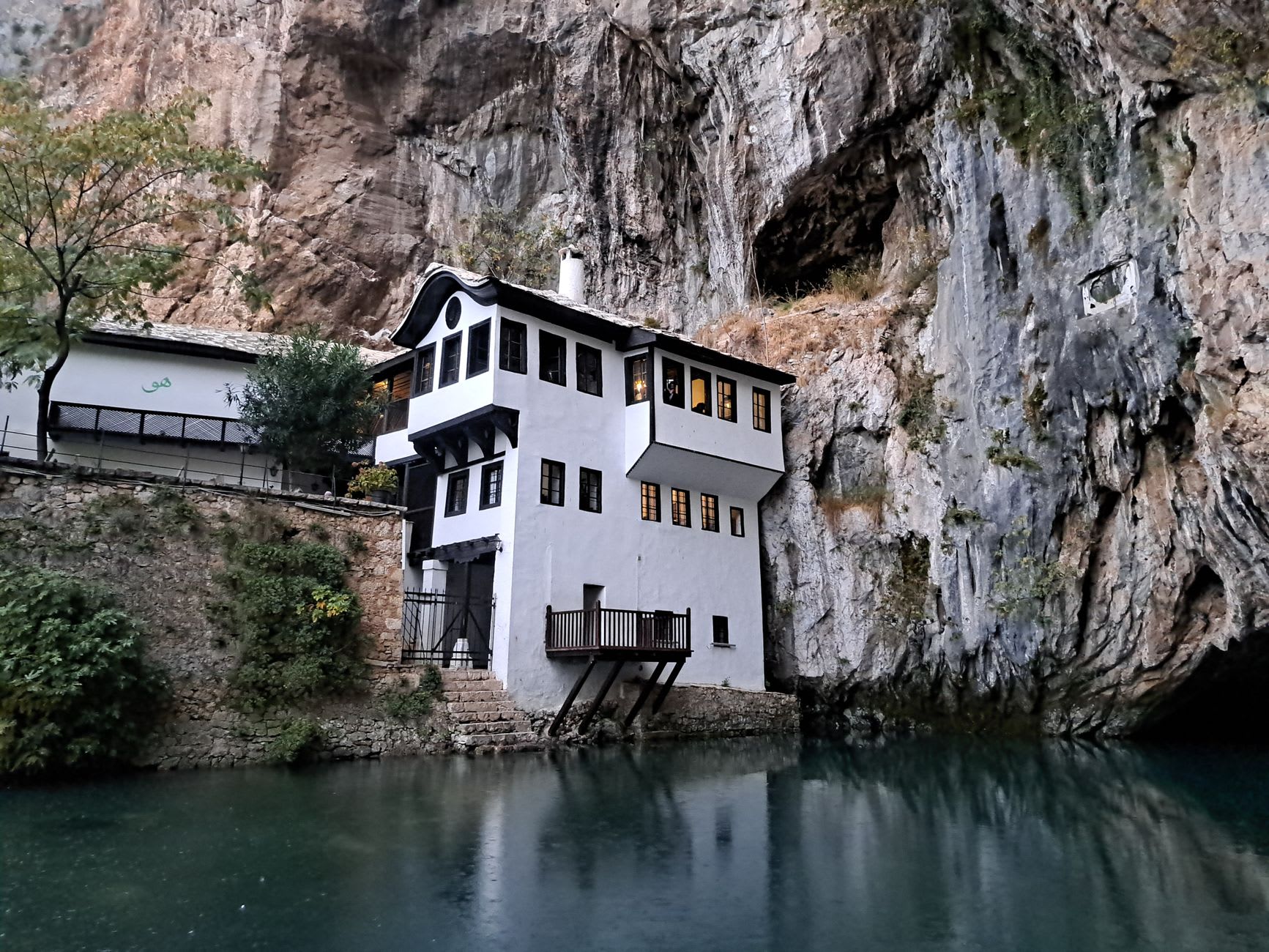
Perched directly at the source, against the base of the cliff, is the Blagaj Tekke — a Dervish monastery built in the sixteenth century on Ottoman foundations, its white plaster walls and wooden balconies cantilevered over the water. The building is still an active place of worship, still used by a small Sufi community. You remove your shoes at the entrance and walk through low rooms with carved wooden ceilings, the sound of the river entering through every window. In the inner room there are prayer rugs, green cloth, a quality of dense, quiet attention. Whatever you make of its religious content, the combination of this specific architecture in this specific geological setting is something I have not encountered anywhere else.
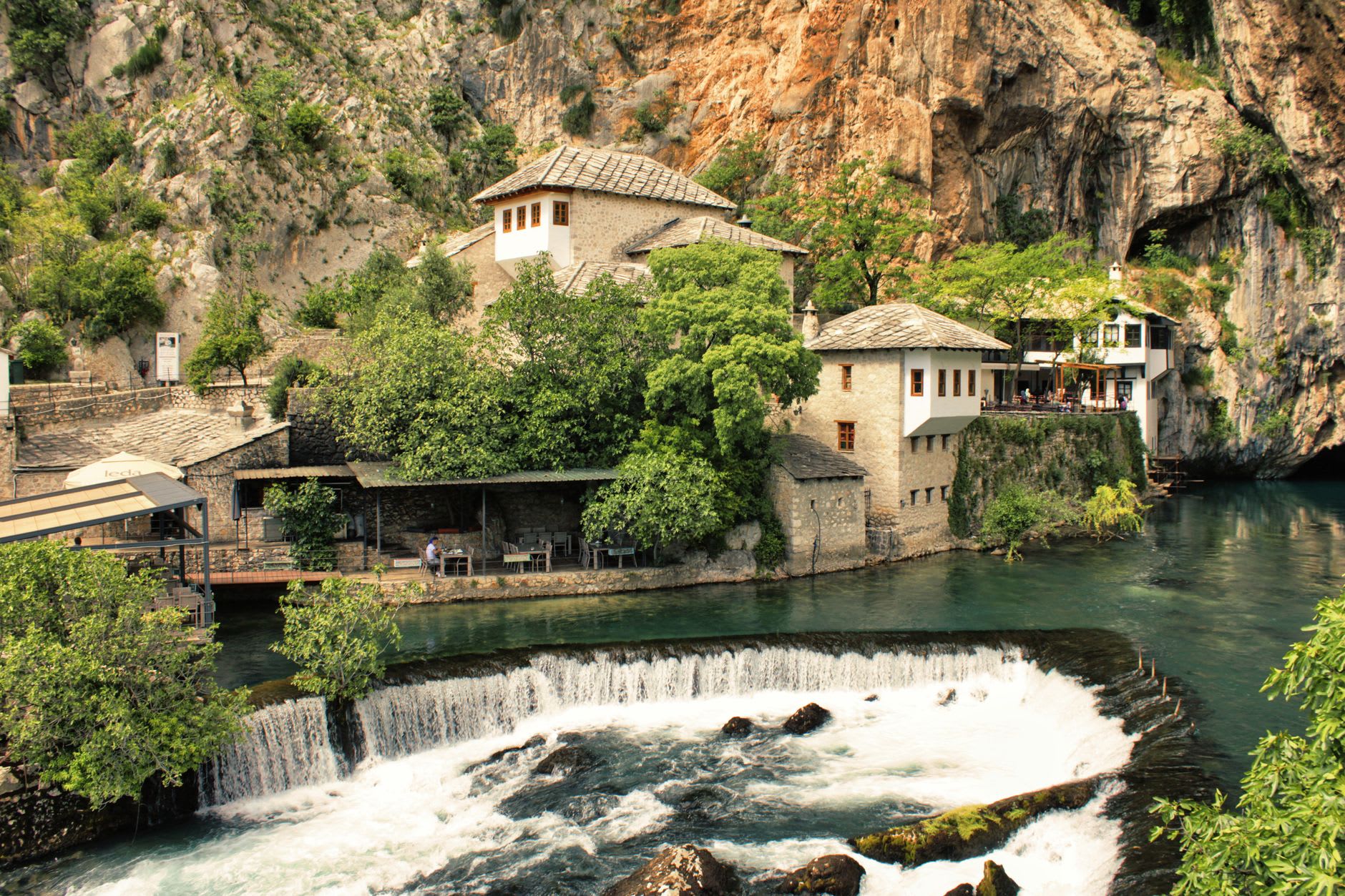
The village of Blagaj itself, upstream from the spring, is easy to underestimate. Its main attraction for most visitors is the tekke, but if you walk twenty minutes back toward the old Ottoman town, you find the remains of a medieval fortress on the ridge — Stjepan-grad, a Bosnian royal stronghold from the fifteenth century — and below it a scatter of Ottoman-era houses with the characteristic wooden bay windows that project over the narrow lanes. The architecture feels continuous with the landscape, built from the same limestone that composes the cliffs.
I had lunch at one of the restaurants on the Buna, a low terrace right at the water’s edge with tables set in dappled shade. The trout from this river is a regional staple and the reason most locals come here — farmed in the cold spring water, grilled simply with salt and lemon. I ordered two and sat there longer than I planned, watching the water move. The light on the Buna in the early afternoon has a particular quality: it comes through a gap in the canyon walls and hits the surface at an angle that makes the riverbed visible in astonishing detail through two metres of moving water.
Blagaj is eight kilometres from Mostar by road, and almost no one spends the night — they come for half a day from the city and go back. This means that after around five in the afternoon, the place empties dramatically, the temperature drops, and the river source takes on a different character: less spectacle, more presence. If you can arrange it, that is the version worth staying for.
When to go: April through October for pleasant temperatures at the spring. Spring has the highest water volume — the river runs fastest and the colour is most intense. Summer evenings after the day visitors leave are unexpectedly tranquil.