Europe
Bosnia and Herzegovina
"No country I've visited makes history feel this unfinished."
I arrived in Sarajevo on a night bus from Belgrade, stumbling out into a city that smelled of woodsmoke and burek grease at two in the morning. My first instinct was disorientation — the cityscape is a collision of Ottoman bazaar, Austro-Hungarian boulevard, and socialist-era concrete block, all compressed into a valley so steep the hills feel like walls closing in. By the time I found my guesthouse in Baščaršija, I’d already walked past a mosque, a Catholic cathedral, an Orthodox church, and a synagogue within five minutes of each other. That’s not a cliché — it’s just the actual urban fabric of the old quarter, and it’s genuinely unlike anywhere else I’ve been in Europe.
What caught me off guard was how raw everything still felt. I’d visited the Balkans before — Slovenia, Croatia — countries that have polished their stories into something tourist-ready. Bosnia hasn’t done that yet, or maybe it refuses to. The bullet-pocked facades in Sarajevo aren’t maintained as memorials; they’re just buildings that haven’t been repainted. You eat cevapi in a tiny restaurant where the owner’s father survived the siege. Nobody brings it up, and nobody pretends it didn’t happen. That tension — ordinary life layered directly over recent catastrophe — makes Bosnia one of the most morally serious travel destinations I know of.
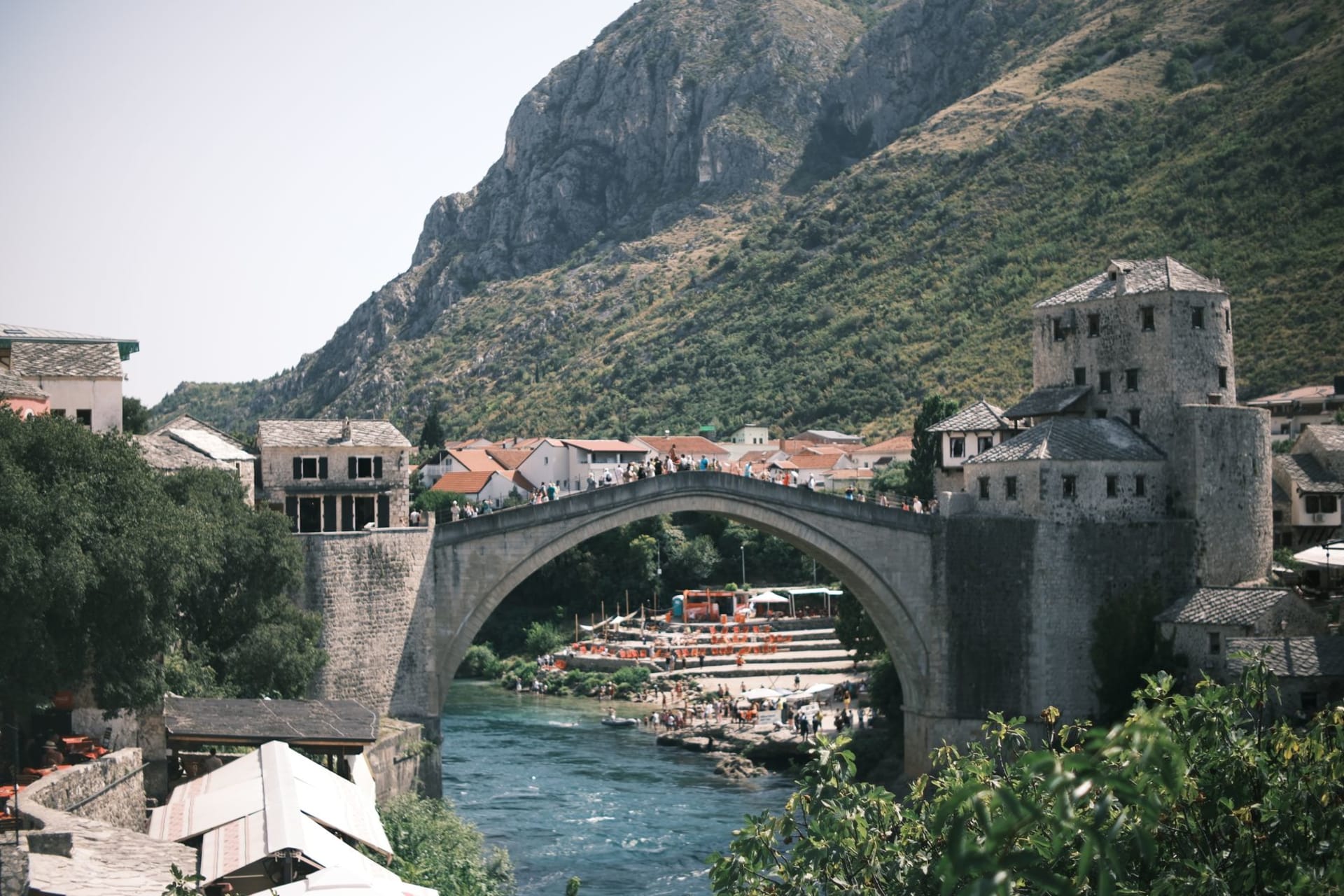
Mostar is the photogenic one, and yes, the Stari Most bridge is genuinely beautiful, a sixteenth-century Ottoman arch rebuilt stone by stone after it was destroyed in 1993. I went at dawn, before the tour groups arrived, and stood on it while a man swept the cobblestones and pigeons exploded from the rooftops across the Neretva. That moment was worth the trip. But I’d encourage spending time on the east bank too, in the quieter neighborhoods behind the souvenir stalls, where old men play cards and fig trees lean over crumbling courtyard walls. The real Mostar is that one, not the Instagram angle.
The food deserves its own paragraph. Bosnian cuisine is Middle Eastern and Central European simultaneously: slow-cooked lamb with cream, phyllo pastry stuffed with spinach or meat, sour cream on everything. I had the best grilled meat of my entire European travels at a roadside spot between Sarajevo and Mostar — no sign, two plastic tables, lamb that had been cooking since morning. That is the actual culinary culture here, and it costs almost nothing.
When to go: April to June for mild temperatures and green hills, or September to October for warm days and fewer tourists. Avoid August in Mostar — it’s overwhelmed. December in Sarajevo is atmospheric if you can handle the cold: snow on the minarets, glühwein at the winter market.
What most guides get wrong: They present Bosnia as a war tourism destination with a pretty bridge tacked on. The war is part of the context, not the product — treating it as an attraction flattens something that locals live with as ordinary grief. What’s actually worth your attention is how ordinary and generative life here is: a coffee culture that would embarrass Vienna, a music scene in Sarajevo that punches well above the city’s size, mountain hiking in Sutjeska National Park that rivals anything in the Alps. Bosnia is interesting because it’s complicated and alive, not because it’s a ruin.