Kuching
"Kuching is the only city I've been to where the question of what to eat for breakfast requires genuine strategic planning."
I ate Sarawak laksa at seven in the morning in a coffee shop that had been serving the same recipe since before my parents were born, and I understood immediately why Anthony Bourdain called it one of the best breakfasts in the world. It arrives as a deep bowl of coconut and lemongrass broth, layered with rice vermicelli, shrimp, shredded chicken, bean sprouts, and a boiled egg, with a squeeze of lime and a curl of sambal on the side. The heat builds slowly. The broth has a sourness that cuts through the richness at exactly the right moment. I ate it too fast, ordered another, and sat watching the ceiling fan turn while the shop filled around me.
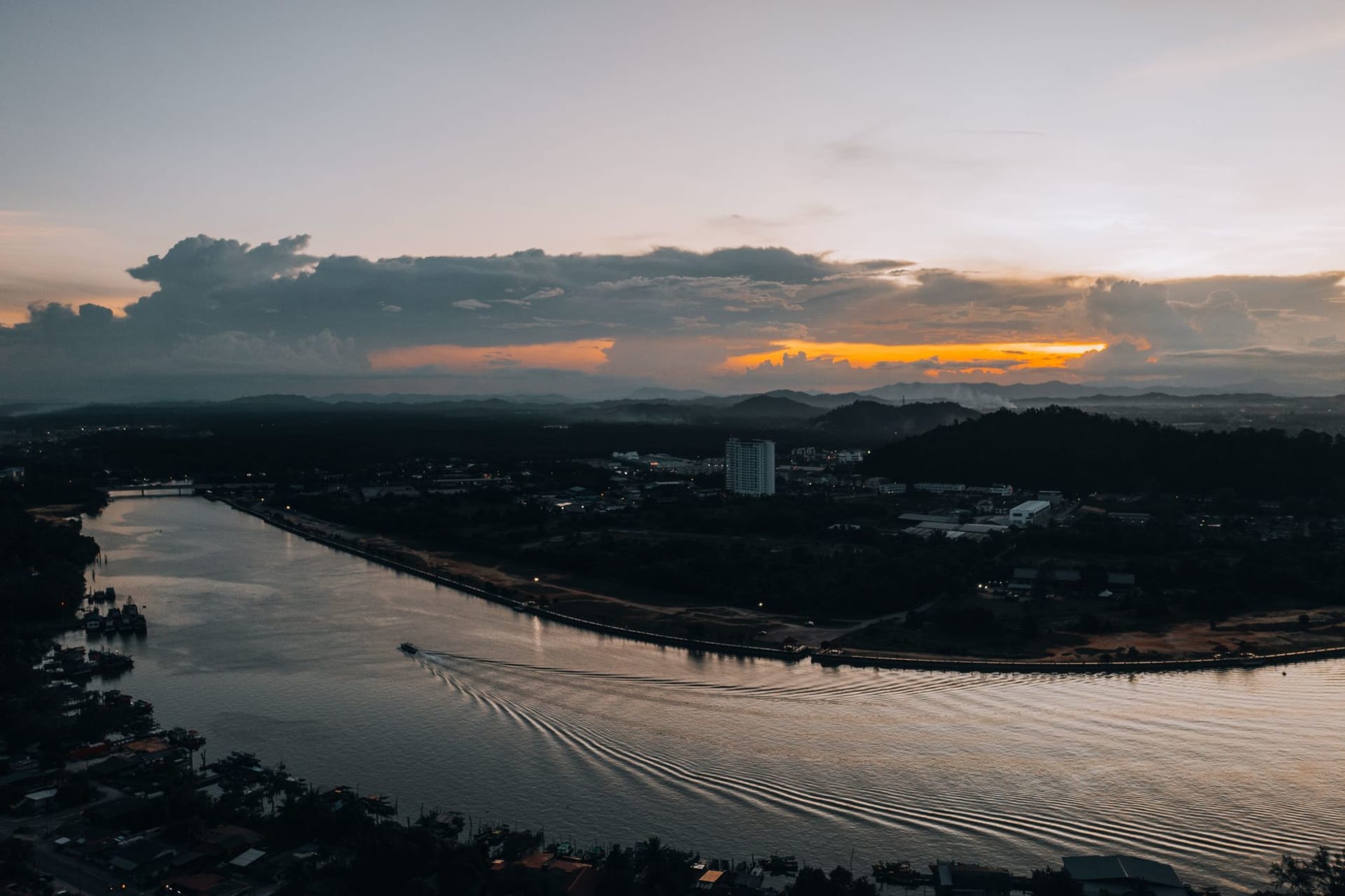
Kuching is the capital of Sarawak, the larger of the two Malaysian states on Borneo, and it is a genuinely surprising city. Its waterfront — the Esplanade, curving along the southern bank of the Sarawak River — is one of the more elegant colonial promenades in Southeast Asia, lined with rain trees and facing a row of whitewashed government buildings and the round tower of Fort Margherita across the water. The old town behind it is a dense weave of shophouses in yellows and ochres, covered five-foot walkways, provision shops selling dried seafood and jungle produce, and a surprising number of excellent places to eat.

The ethnicity of the city is layered in a way that takes a few days to start reading: Malay, Iban, Bidayuh, Orang Ulu, Chinese Hokkien and Cantonese communities, with a Rajah Brooke colonial past visible in the architecture and the civic institutions. The Sarawak Museum is one of the better natural history and ethnographic collections in the region — Iban warrior shields, ceremonial beadwork, the taxonomic legacy of Alfred Russel Wallace, who spent years in Sarawak developing the theory of evolution by natural selection before Darwin published. The museum has a dusty, serious quality that I find reassuring.
What keeps me thinking about Kuching is the food. Kolo mee — egg noodles in a light pork lard and shallot dressing, topped with minced pork and char siu — for lunch. Midin ferns, stir-fried with garlic and belacan, a wild fiddlehead variety found only in Sarawak’s jungle, at dinner. Ikan bakar — grilled river fish wrapped in banana leaf with sambal — at a stall near the waterfront at ten at night. And the kueh: layered rice flour sweets in blues and greens and pink, sold from plastic trays at morning markets, each one a different configuration of palm sugar, pandan, and coconut that requires its own attention.

The cat statues, of which there are several large ones at roundabouts around the city — Kuching means cat in Malay — are either charming or bewildering depending on your relationship with civic sculpture. I found them charming. The city is small enough to walk, well enough organised for a two-to-three day stay that doesn’t feel rushed, and genuinely good as a base for day trips to Bako National Park and the Iban longhouses of the Skrang River.
When to go: May through September is the drier stretch, but Kuching functions year-round as a city. The Rainforest World Music Festival in July draws musicians from across Borneo and beyond for an event on the grounds of the Sarawak Cultural Village that is worth planning a trip around. The wettest months are October through January, which affects day trips but rarely the city itself.