Onima
"I put my hand near a spiral someone painted centuries before Columbus and felt very, very small."
A wind-scoured limestone terrace on Bonaire's northeastern coast where red ochre spirals painted by the Caquetío still cover the cave walls.
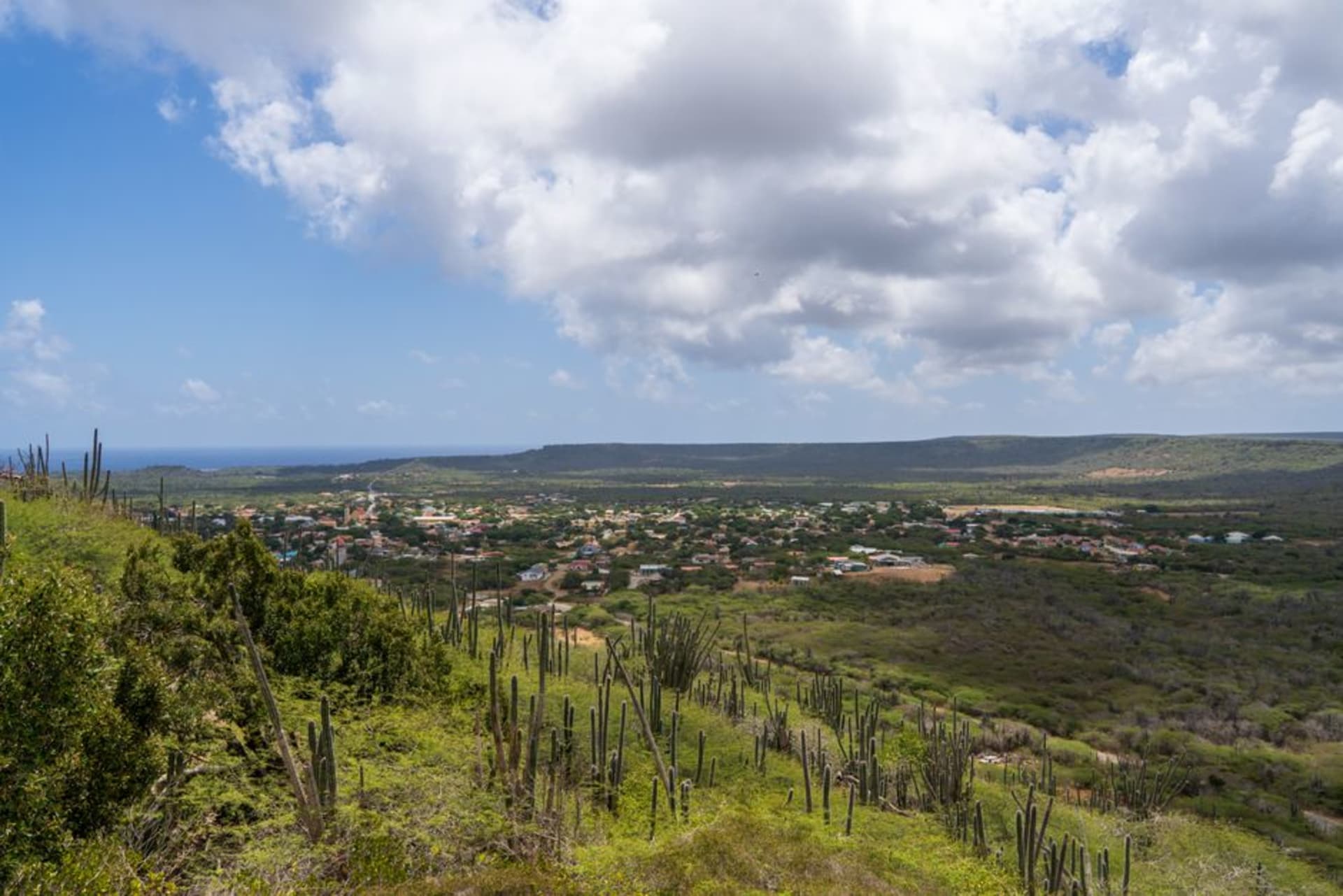
Lia found Onima on a map before I did, a tiny dot on Bonaire’s windward coast with no beach icon next to it, which is usually how she picks the good places. We drove out early, past the flamingo pans and the scrubby cactus fields, until the road just stopped being a road and became a track of crushed coral leading to a limestone terrace above the sea. There was nobody else there. No gift shop, no ticket booth, just an overhang of rock with a low iron fence and, underneath it, red ochre pictographs that the Caquetío people painted long before the Dutch ever anchored a ship off this island.
I’ve seen a lot of ruins by now, and there’s a particular kind of quiet that comes over me at the ones that haven’t been polished for tourism. Onima has that quiet. The spirals and geometric shapes are still a rust-red against the pale stone, faded but stubbornly legible, and nobody can tell you with certainty what they mean. Archaeologists argue about it. Some say celestial markers, some say clan symbols, some just shrug. I liked that nobody pretended to know. Lia crouched under the overhang for a long time tracing the outline of one shape in the air, never touching it, and I photographed her silhouette against the marks without really planning to.
What stayed with me more than the paintings themselves was the setting. The terrace sits above the sea on Bonaire’s rougher, wilder eastern side, where the surf doesn’t invite you in the way it does on the leeward coast — it just crashes against the limestone, loud and constant, while you’re standing a few feet from art that’s older than most European cathedrals. We sat on the rock for a while after looking at the caves, not saying much, watching the water throw itself against the shore. I ate a mango I’d shoved in my bag that morning, juice running down my wrist, feeling a bit absurd doing something so ordinary in a place like that.
We left before the heat really set in, which turned out to be the right call — there’s zero shade up there, and by mid-morning the white rock was already throwing heat back at us. Onima isn’t a place you spend hours at. It’s a place you stop at, look closely, and carry with you for longer than the visit itself lasted.
When to go: Aim for the dry season, roughly January through September, and get there in the morning — the site has no shade at all, and the limestone turns brutal under a midday sun.