Samaipata
"You climb to El Fuerte not sure what you're looking at and leave still working it out."
Two hours west of Santa Cruz, the road climbs out of the lowland heat and into cloud forest. The temperature drops incrementally with the altitude. The vegetation thickens and goes green in a specific way — wet, layered, slightly mossy at the margins. By the time you reach Samaipata at 1,650 meters, you’re somewhere else entirely: a small village of cobblestone streets and terracotta rooftops surrounded by forested hillsides, with a Saturday market that fills the plaza and a general air of people who came for a weekend and never quite left.
El Fuerte
The archaeological site is the reason most people come, and it earns the drive. El Fuerte — a UNESCO World Heritage Site — is a sandstone outcropping that ancient peoples carved over centuries into a ceremonial complex of channels, pools, niches, geometric patterns, and zoomorphic figures. The site was used by several cultures sequentially, including the Inca, who added their own layered on top of earlier work that nobody has fully decoded.
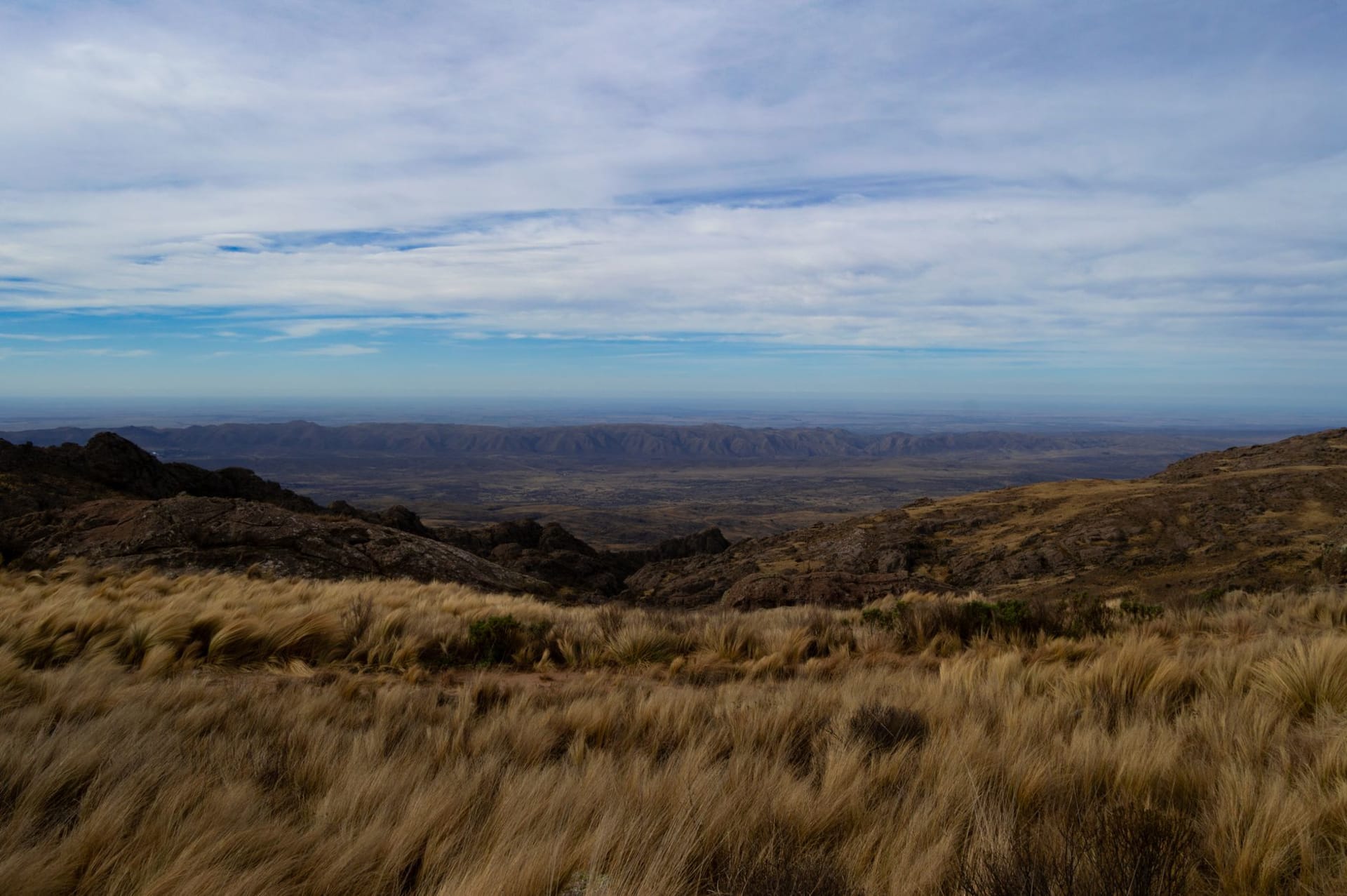
Standing on the rock, what strikes you is the scale of the carving and the mystery of its purpose. Some channels clearly directed water. Some niches may have held offerings. The large carved figures — pumas, serpents — are visible once a guide points them out, then impossible to unsee. The surrounding landscape of forested ridges and open valleys is the kind that makes ceremony feel like a logical response.
I went in the late morning when the site was nearly empty. The light was bright but diffuse, filtered through thin cloud. The stone was warm underfoot. A guide explained three competing theories about the site’s primary function, and I had the impression she found all three equally plausible.
The Village
Samaipata village has a quality common to places where altitude and remoteness have attracted a community of people who wanted to slow down — European expats, Bolivian artists, small-farm practitioners — without losing the underlying Bolivian character. The market on Saturday is genuinely local: cheese, honey, herbs, produce from the surrounding hillsides. There are also two or three good restaurants that seem to be cooking seriously rather than just covering the tourist obligation.
Lia found a ceramics workshop off one of the side streets where a woman sold hand-painted plates in the kind of colors that photograph badly and look exactly right in person. We walked back to the plaza through the late afternoon with the light going golden and the temperature dropping pleasantly toward evening.
The Cloud Forest Around Town
Several hiking trails head into the surrounding hills: some through private reserves, some through community-managed land. The forest smells of damp earth and flowering things and has a sound track of birds I couldn’t identify but whose names the guide provided with a naturalist’s precision. The trails range from easy ridge walks with views toward Santa Cruz in the distance to steeper routes that enter the forest properly and require several hours.
The bird density is high enough that even a casual morning walk with minimal effort yields a list worth keeping.
When to go: Samaipata is accessible year-round but most pleasant from April to October — dry, clear, warm days and cool nights. The rainy season (November to March) brings mist and occasional road closures on the descent to Santa Cruz; the forest is lush and the site has almost no visitors, which has its own appeal. Weekends are noticeably livelier than weekdays, when the village settles into a very quiet version of itself.