
Baden-Baden
"Dostoevsky lost everything here twice. I spent three hours in the thermal baths and felt I understood the impulse."
I arrived in Baden-Baden on a train from Karlsruhe wearing the kind of clothing you wear when you’ve been hiking for three days, and the taxi driver looked at me with an expression that managed to be polite and eloquent at the same time. This is a place that has been receiving royalty, Russian aristocrats, and Parisian flaneurs since the nineteenth century, and it maintains certain standards — not aggressively, but as a persistent ambient fact, the way a house that was once a palace maintains a certain quality of light even after renovation. I found a guesthouse that accepted my appearance without comment and walked immediately to the Friedrichsbad.
The Friedrichsbad is a nineteenth-century thermal bath in the Roman-Irish style — a circuit of rooms at different temperatures and functions that you move through in a prescribed order, surrendering your clothing and sense of schedule at the entrance. The building is extraordinary: a series of vaulted halls and tiled pools beneath painted domes, built between 1869 and 1877 as an expression of civic confidence in Badisches healing waters. The Roman stage — a pool of mineral-rich water in a space that smells of something warm and slightly sulphurous and deeply ancient — produces a particular looseness in the body that I have not replicated since. You are required to be silent. You are required to have no phone. For seventeen stages and about two hours, you exist only as a body in hot water in a beautiful room, and this turns out to be remarkable.
Dostoevsky came here and lost everything at the casino — which is how we got The Gambler, dictated in a fever of deadline desperation to his stenographer Anna Grigoryevna, who became his wife. The casino itself is still operating, still the Kurhaus, still with its white neoclassical facade and the Lichtentaler Allee running alongside it, a two-kilometre promenade of old beeches and chestnuts where the Russian aristocracy once promenaded and where, on a Thursday morning, I found elderly German couples walking very slowly and purposefully, dogs of impressive grooming trotting alongside. The casino lets you in to look during the day for a small fee, and the gaming rooms are heavy with red velvet and gilded plasterwork and the kind of nineteenth-century maximalism that makes you understand why people found it intoxicating.

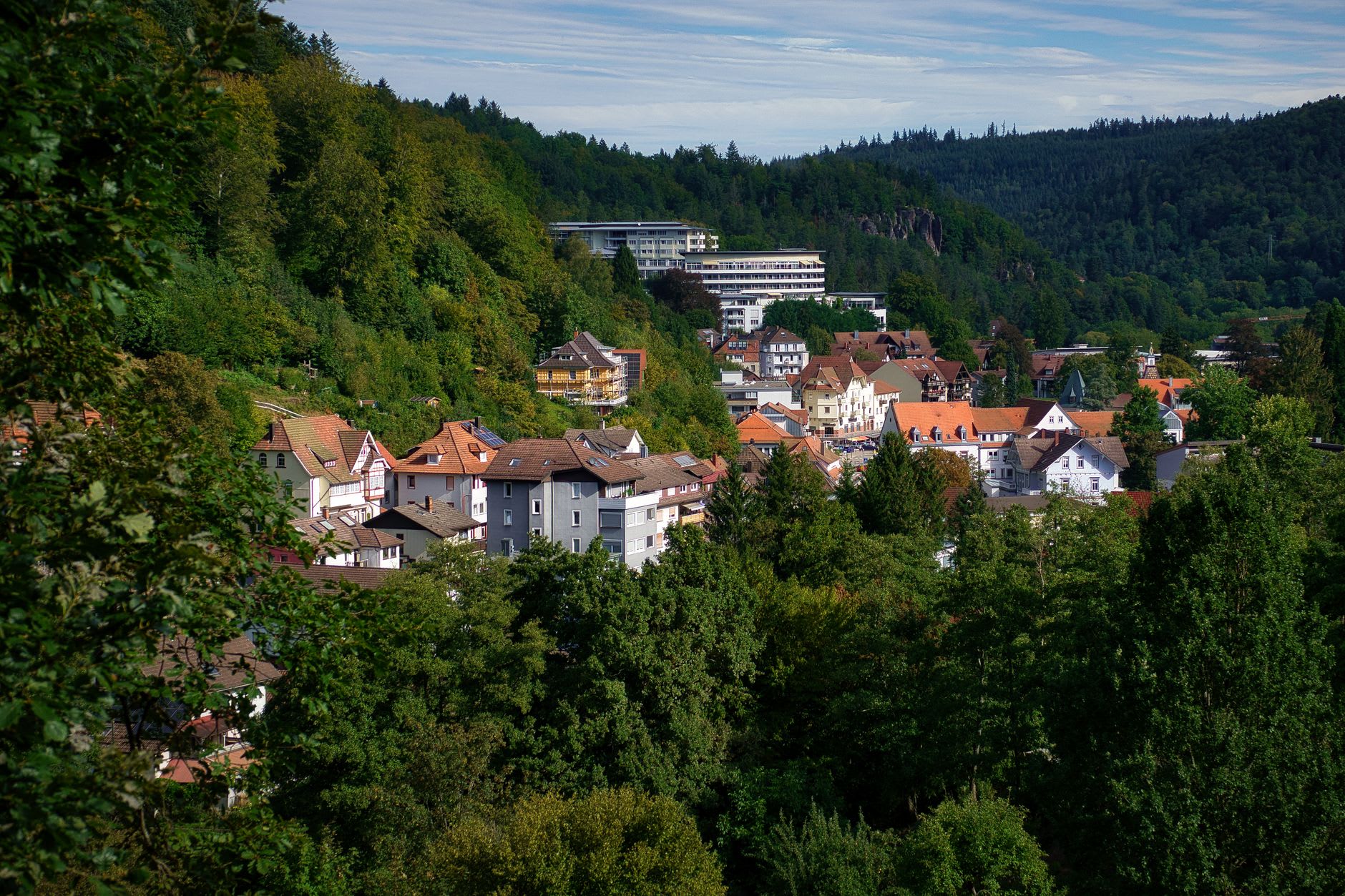
The Caracalla spa, newer and more democratic than the Friedrichsbad, offers outdoor thermal pools where you can sit in warm sulphurous water in the open air and look at the forested hills above the town. I did this in early evening when the light was going and the steam from the pools was catching the last of it, and the only sounds were water and the distant soft percussion of the forest in wind. Baden-Baden positions itself as luxury, and it is, but what it actually offers — warm mineral water, old trees, the particular quiet of a town that has been dedicated to doing nothing strenuous for a very long time — is available at all price points if you choose the right entrance.
When to go: Spring and autumn are the most pleasant — May for the Lichtentaler Allee in bloom, October for the beeches turning gold. The thermal baths work year-round and are especially valuable on cold grey days. The Kurhaus hosts concerts through the summer season.