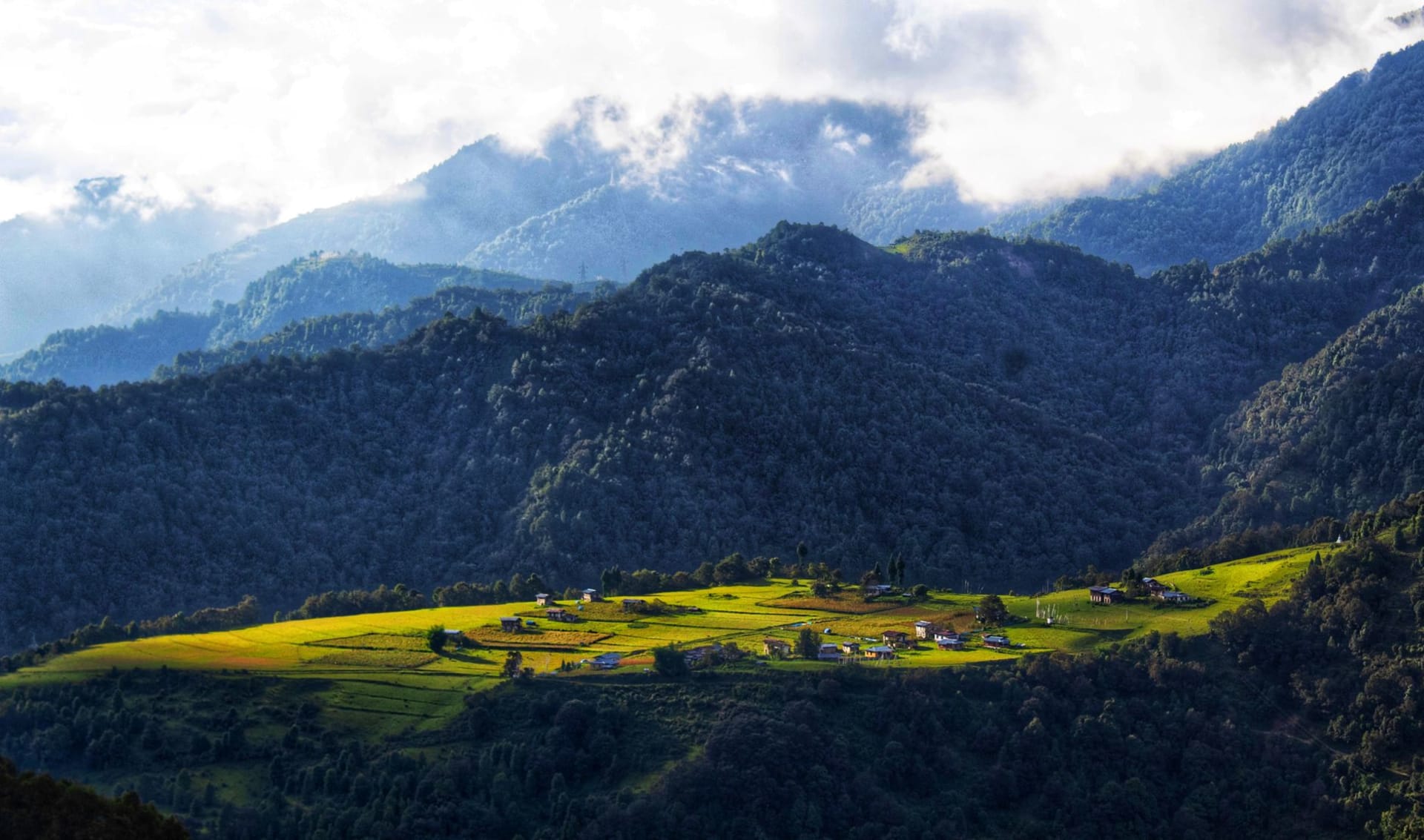
Trashigang
"Eight hours of mountain road from Thimphu and you're somewhere that feels, in the best possible way, like the world forgot to include it on the main circuit."
The road from Bumthang to Trashigang takes most of a day and crosses the Thrumshingla Pass at 3,800 metres, where the vegetation changes so abruptly from the broadleaf subtropical forest of central Bhutan to the alpine scrub of the east that you can almost mark the precise point of transition on the asphalt. The east of Bhutan — Sharchop country — is linguistically and ethnically distinct from the west, and the people here have the composed assurance of communities that were simply never on the way to anywhere important. Trashigang receives perhaps five percent of the tourists that Paro does. This is not a selling point so much as an explanation of what the town is actually like.
Trashigang town clusters around a bazaar at the junction of two roads — one continuing east toward the Indian border at Samdrup Jongkhar, one heading north into the deep Merak-Sakteng area. The market is small and direct: fresh produce from the valley gardens, chilies and ginger and small sour oranges, a stall selling bootleg DVDs alongside prayer flags and butter lamp oil. I ate grilled pork with rice at a table outside a restaurant where the other customers were local government workers and a monk studying his phone with intense concentration. The pork was charred and fatty and served with a chili paste that made me want to lie down.

Trashigang Dzong commands a forested promontory above the confluence of the Drangme Chhu and Gamri rivers — not as dramatically positioned as Trongsa or as famous as Paro, but with a quality of weathered authority that comes from being the administrative centre of eastern Bhutan for four centuries. I walked the dzong’s courtyard early in the morning when mist was filling the gorge below and the monks were chanting a morning liturgy that carried through the walls. On the far bank of the river, which I could see from the dzong’s upper terrace, a narrow trail disappeared into forest. My guide said it was the old trade route into Arunachal Pradesh — a path that traders had used for centuries before the current border arrangements made it theoretical.
The real reason to base yourself in Trashigang is to reach the country beyond it. The Merak-Sakteng trek leads northeast into restricted territory where the Brokpa people — nomadic yak herders of Tibetan descent — live in villages accessible only on foot. The Brokpa are distinguishable by their traditional dress, particularly the raven feather hats worn by both men and women that are unlike anything else in Bhutan. The Sakteng Wildlife Sanctuary, through which the trek passes, was established partly to protect snow leopards and red pandas, but also — uniquely in the world — to protect the habitat of the migoi, the Bhutanese yeti. Whether you read this as ecology or as cosmology probably depends on where you are standing when you hear it.

The road from Trashigang east to Samdrup Jongkhar winds through warm subtropical valleys very different from the high mountain landscapes of the rest of the country — banana trees and jackfruit and cascades of orange marigolds over low stone walls. I drove it one afternoon just to see where it went, and stopped at a waterfall where the road came so close to the cascade that the spray wet the windshield. A woman washing clothes in the pool below waved at me with one arm while continuing to scrub with the other. Nothing here is performing its own significance.
When to go: October through December is the best window — clear air, comfortable temperatures in the lower valleys, and the Merak-Sakteng area accessible without the monsoon conditions that close the higher trails from June to September. March and April are also viable, with wildflowers on the upper slopes. The Merak Tsechu festival in spring is one of the most remote and least-visited in Bhutan.