Punakha
"Nothing I had read about Punakha prepared me for what it looks like when the morning mist lifts off those two rivers."
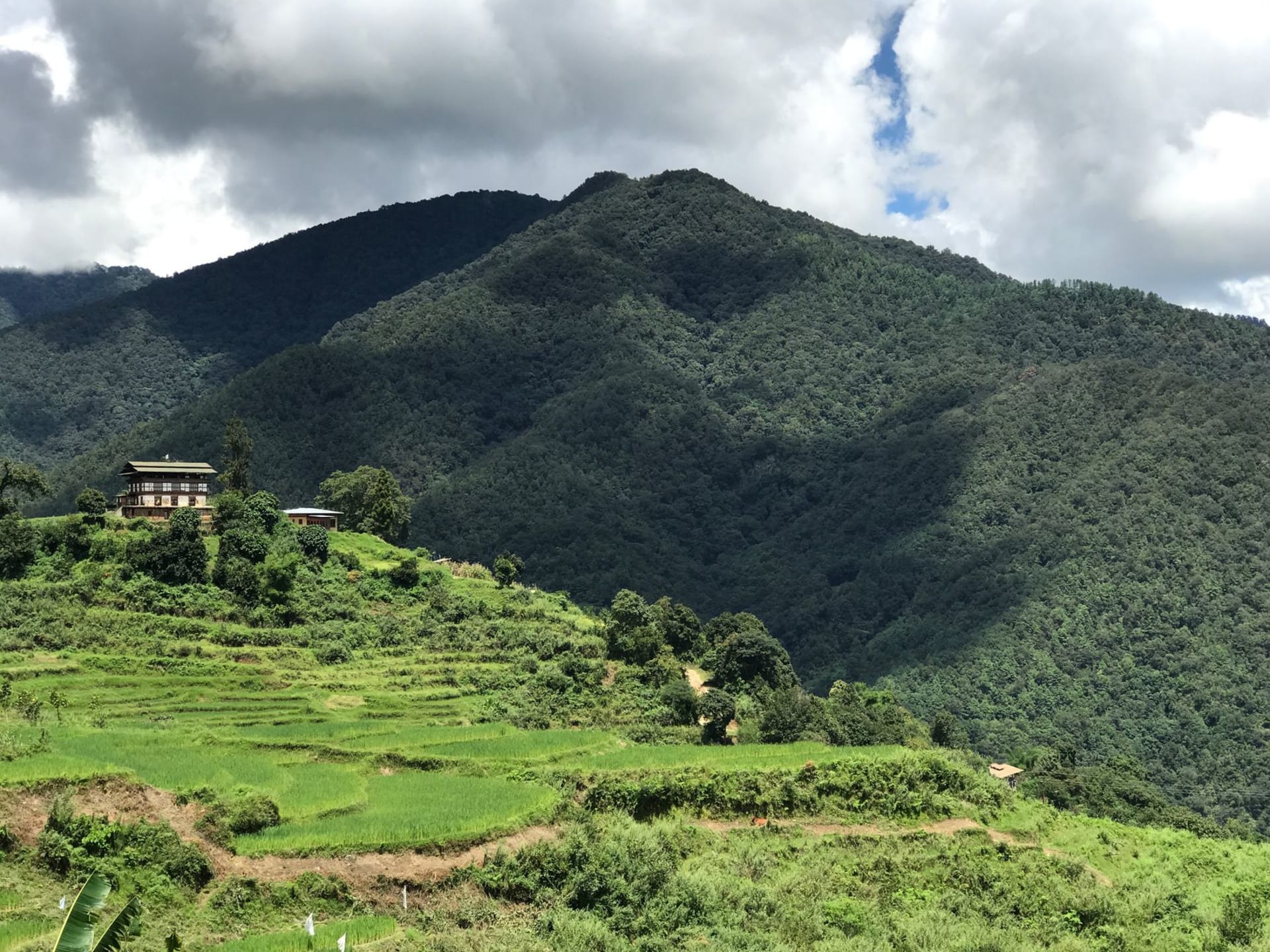
The road from Thimphu climbs to the Dochula Pass at 3,100 metres, where 108 chortens stand in a field of prayer flags and the entire arc of the Himalayan high peaks — Masagang, Tsendagang, Terigang — stretches across the northern horizon on clear days, white and improbably sharp. Then the road drops again, fast and winding, and the temperature rises ten degrees as you descend. Mandarin oranges appear at the roadside, for sale in string bags. The vegetation thickens. By the time you reach Punakha, you are in a subtropical valley that feels like a different country from Paro entirely.
The Punakha Dzong stands on a narrow tongue of land between the Mo Chhu — Mother River — and the Pho Chhu — Father River — at their confluence. I arrived in the blue hour just before sunrise, when the mist was still lying flat across both rivers, and the dzong’s white walls rose out of it like something imagined. It is the second largest dzong in Bhutan and, by most accounts, the most beautiful. In spring the jacaranda trees around it turn the entire scene a deep purple, and photographs of that particular combination — white fortress, purple trees, two rivers, high peaks behind — circulate widely enough that they seem like inventions. They are not.

The interior of the dzong is organized around two main courtyards. The outer one is administrative — used by the district government offices that share the building with the religious community. The inner one is the sacred heart: monks in burgundy sat in rows in the assembly hall, chanting the morning liturgy over bowls of butter tea brought in by younger novices. The walls of the assembly hall are covered in painted murals of a quality that stops you mid-step — seated Buddhas and wrathful deities rendered in blues and golds so saturated they appear to generate their own light. I stood too long and a monk smiled at me from across the hall with the patient amusement of someone used to visitors forgetting they have places to be.
The suspension bridge at Punakha is the longest traditional bridge in Bhutan — nearly 180 metres of wooden planks and prayer flags swaying over the Father River, connecting the dzong to the rice paddies on the far bank. I crossed it twice, once in each direction, watching the turbulent green water pass far below. On the far side, a farmer was tending a field of red rice, the variety particular to this valley, with a hand tool that looked older than the dzong. He nodded without looking up. A gang of children in school uniforms ran past me and onto the bridge at full speed, making it sway in a way that caused me to grip the side ropes.

Punakha was the winter capital of Bhutan until 1955, and the Je Khenpo — chief abbot — still moves his court here each October, when the monks migrate from Thimphu for six months. This winter migration means the dzong is always inhabited, always active, never merely a monument. Punakha feels like a place where the medieval and the contemporary coexist without self-consciousness: the farmer with the ancient tool, the monks with their smartphones, the dzong that still governs.
When to go: February and March bring the Punakha Drubchen and Punakha Tsechu festivals, coinciding with the rhododendron bloom on the hills and occasionally with early wildflowers in the rice fields. October through December offers crisp air and the best mountain views from the Dochula Pass above. The valley is warm year-round compared to the rest of Bhutan — even in January temperatures hover around fifteen degrees.