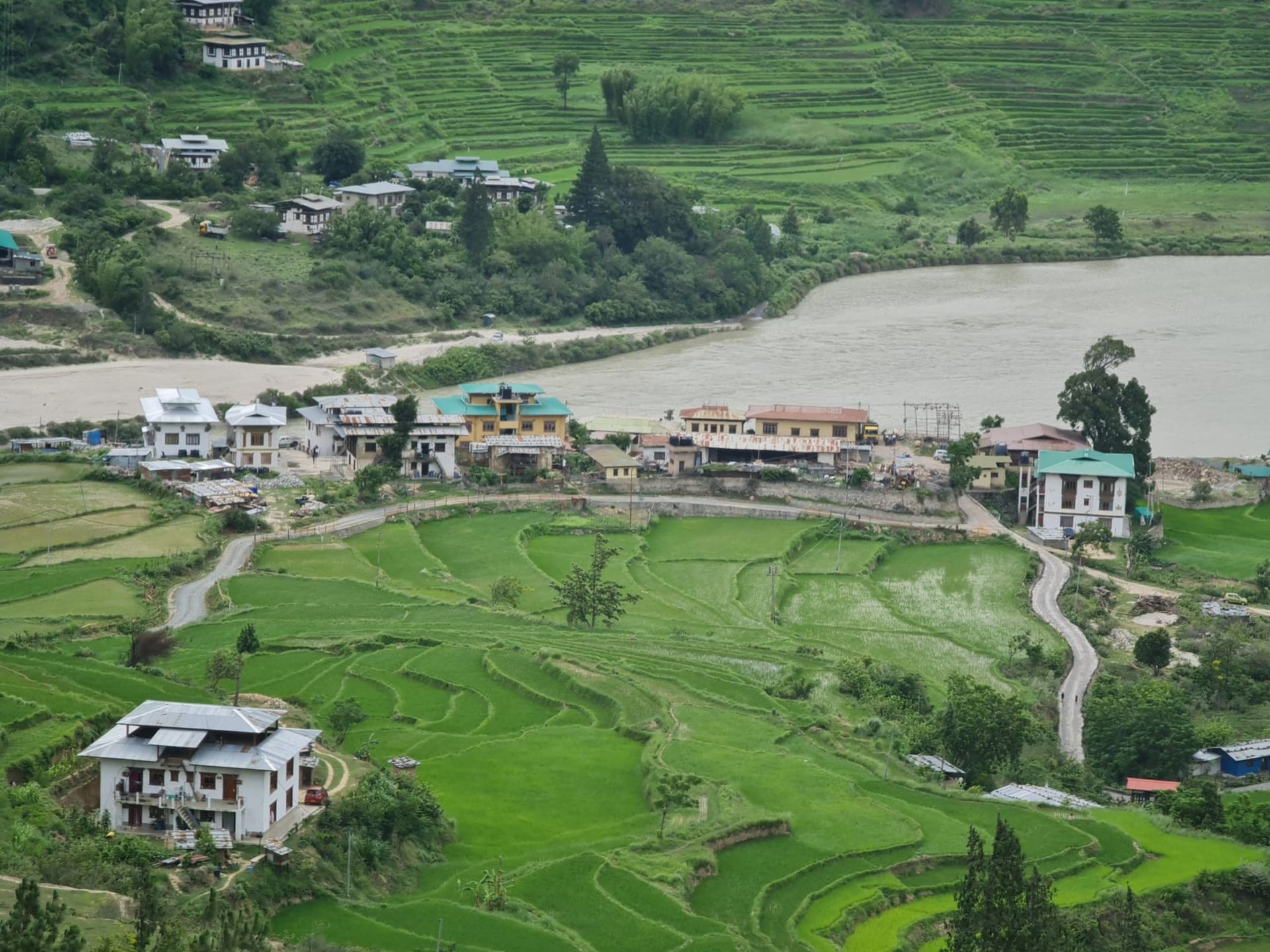
Phobjikha Valley
"The cranes arrive at dusk in a long ragged line, and the locals watching from the road don't say anything at all."
I almost missed the cranes. I had timed my arrival for November, when they come down from Tibet and the Tibetan Plateau to winter at lower altitude, but the turnoff for Phobjikha is easy to pass without noticing, and I spent an extra hour on the wrong road before my guide redirected us. By the time we reached the valley rim and I looked down into it for the first time, the light had already turned amber with late afternoon. The valley is shaped like a bowl — wide, flat, and marshy at its centre, ringed by forested hills — and in the floor of the bowl, moving with the slow deliberate stride of birds that know exactly how important they are, were perhaps two hundred black-necked cranes.
The black-necked crane is sacred in Bhutan. It appears in folk songs, in thangka paintings, in the architectural decorations of the Gangtey Monastery that watches over the valley from a low ridge on the western side. The cranes winter here from October to March, drawn by the marshland and the relative warmth of the valley at 2,850 metres. At dusk they stop foraging and begin to move toward the centre of the marsh in a gathering that is less migration behaviour and more assembly — they cluster, they call, they settle. I watched from the road with a local farmer who had been watching cranes land here for sixty years and showed no signs of having become bored by it.

Gangtey Monastery — Gangtey Gompa — is the seat of the Pema Lingpa tradition, a lineage of Nyingma Buddhism tracing back to the fifteenth-century treasure-revealer Pema Lingpa. It is the only Nyingma monastery in western Bhutan, which gives it a distinct character from the Kagyu dzongs and monasteries that dominate Paro and Thimphu. The complex was rebuilt in the seventeenth century and again recently, and the painted murals in the main assembly hall feel fresh — not in the sense of new, but in the sense of vivid, full of intention. Monks in maroon were doing something that sounded like debate in the courtyard, their voices rising and falling in sharp bursts. A novice perhaps twelve years old offered me tea that was sweet and milky in the Tibetan style and then ran away laughing.
The village of Gangtey and the surrounding settlements feel preserved in a gentle stasis. Houses here are built in the traditional Bhutanese style — wooden-framed, with painted timber panels and wide eaves — and the farmyards hold stacks of winter firewood and baskets of turnips and dried corn cobs. The fields have been harvested but not ploughed under, and in the evening the cranes move into them, working their beaks through the stubble. The smell of the valley in November is woodsmoke and cold, wet grass and something vaguely sweet from the last of the harvest.

The Gangtey Nature Trail circles the valley in about two hours of easy walking, passing through forest and farmland and the edge of the marsh. I walked it alone one morning before breakfast, in a cold so sharp my breath was visible for the first kilometre. By the time the sun cleared the eastern ridge and the frost on the grass began to melt, the cranes were already calling — a sound I can only describe as somehow metallic and somehow ancient at the same time, a sound that has been in this valley every winter for longer than anyone can be certain.
When to go: October through February for the cranes — they arrive in October and depart for Tibet in February or early March. November is the sweet spot: the Crane Festival is usually held then, the cranes are settled in their winter routine, and the weather is cold but clear. The valley in spring and summer is beautiful in a different way — green and empty — but the cranes are the reason to come.