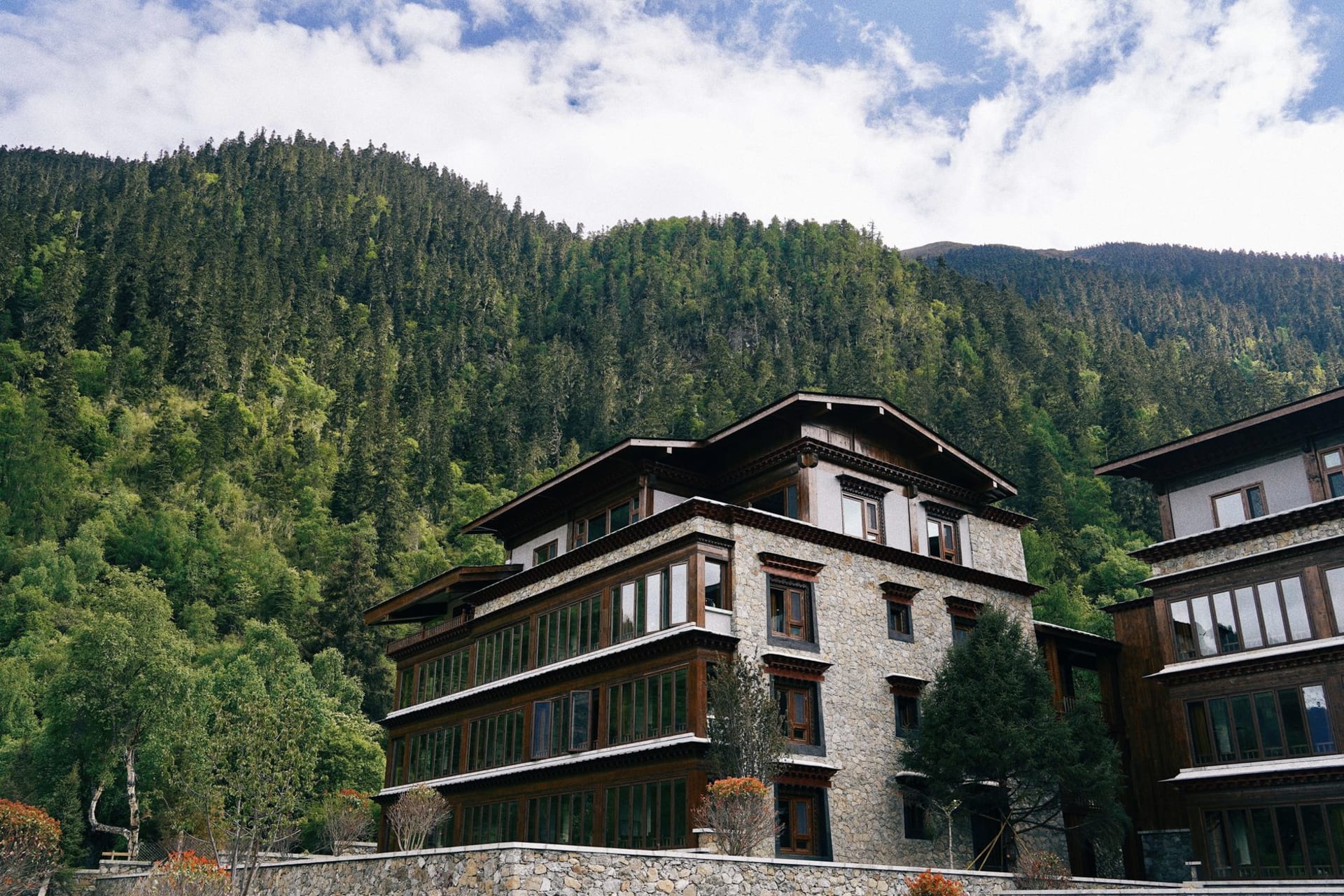
The road to Bumthang takes four hours from Trongsa over mountain passes that climb above the treeline into a world of tussock grass and prayer flags and yaks moving slowly across the skyline. When you descend into the Choekhor valley — the largest of Bumthang’s four sacred valleys — the air has a different quality than anywhere else in Bhutan. It is thinner, being at 2,800 metres, and it carries an edge of cold even in October. Juniper and apple orchards line the valley floor, and the buckwheat grows in fields so red in autumn they look like they have caught fire. I arrived in the late afternoon when the light was horizontal and gold, and the first thing I saw was an old man walking between the trees carrying a butter lamp as if it were the most natural thing in the world, which in Bumthang it is.
Bumthang is the spiritual heartland of Bhutan — the place where Guru Rinpoche, who brought tantric Buddhism to the Himalayas in the eighth century, performed many of his most significant acts. The temples here are not monuments; they are active, inhabited, continuously used. Jambay Lhakhang, said to be one of those 108 temples built in a single day by Songtsen Gampo, stands in a walled compound near the valley floor. I entered without ceremony, passed prayer wheels that someone had oiled recently so they spun with silent ease, and ducked through a low doorway into the interior, which smelled like decades of butter lamp smoke and the particular sweetness of old painted wood.

Kurjey Lhakhang, named for the body imprint Guru Rinpoche left in the rock of the cave inside it, is the holiest site in Bumthang and one of the most significant in all of Bhutan. I went at first light, before the tour groups arrived. A monk sat cross-legged in the entrance to the oldest temple, reciting mantras from a text balanced on his knees, paying no attention to me whatsoever. Inside, in the cave where the imprint is said to be preserved, butter lamps burned in ranks and the stone above them was black with centuries of smoke. The feeling was not of religion as an idea but of religion as an ongoing practice that had simply not stopped for thirteen hundred years.
The food in Bumthang is different from the rest of Bhutan. The altitude and the cold encourage heartiness: buckwheat pancakes called khule, fried in yak butter and eaten with local honey; red rice cooked until it is almost a porridge and served with dried pork and ema datshi; and the local Swiss-influenced cheese, introduced by a Swiss development project in the 1970s, which now turns up at breakfast in small hotels that feel like mountain guesthouses from another century. The Bumthang valley also produces a honey so dark it is almost black, from bees that work the buckwheat flowers, and apple brandy that a woman pressed into my hand from a clay jug in the market at Jakar and which tasted, in the cold mountain air, absolutely correct.

Jakar town, the administrative centre of Bumthang, is small enough to walk across in fifteen minutes. The dzong above it — Jakar Dzong, the Castle of the White Bird — was built where a white bird alighted to indicate the auspicious site of a new monastery. These days it is staffed by young monks who play volleyball in the outer courtyard in the late afternoon, and the sight of that — medieval walls, saffron robes, a volleyball — is one of those collisions of time that Bhutan produces without apparent effort.
When to go: October and November bring the Jambay Lhakhang Drup festival, with its famous naked flame dance performed after midnight — one of the most extraordinary spectacles in Bhutan. The autumn air is sharp and clear, ideal for walking between the four valleys. Spring, from March to May, is warmer and the apple orchards bloom white against the pine slopes.