Minsk
"Stalin razed it and rebuilt it as a monument to ambition — and somehow that turned out to be an act of strange beauty."
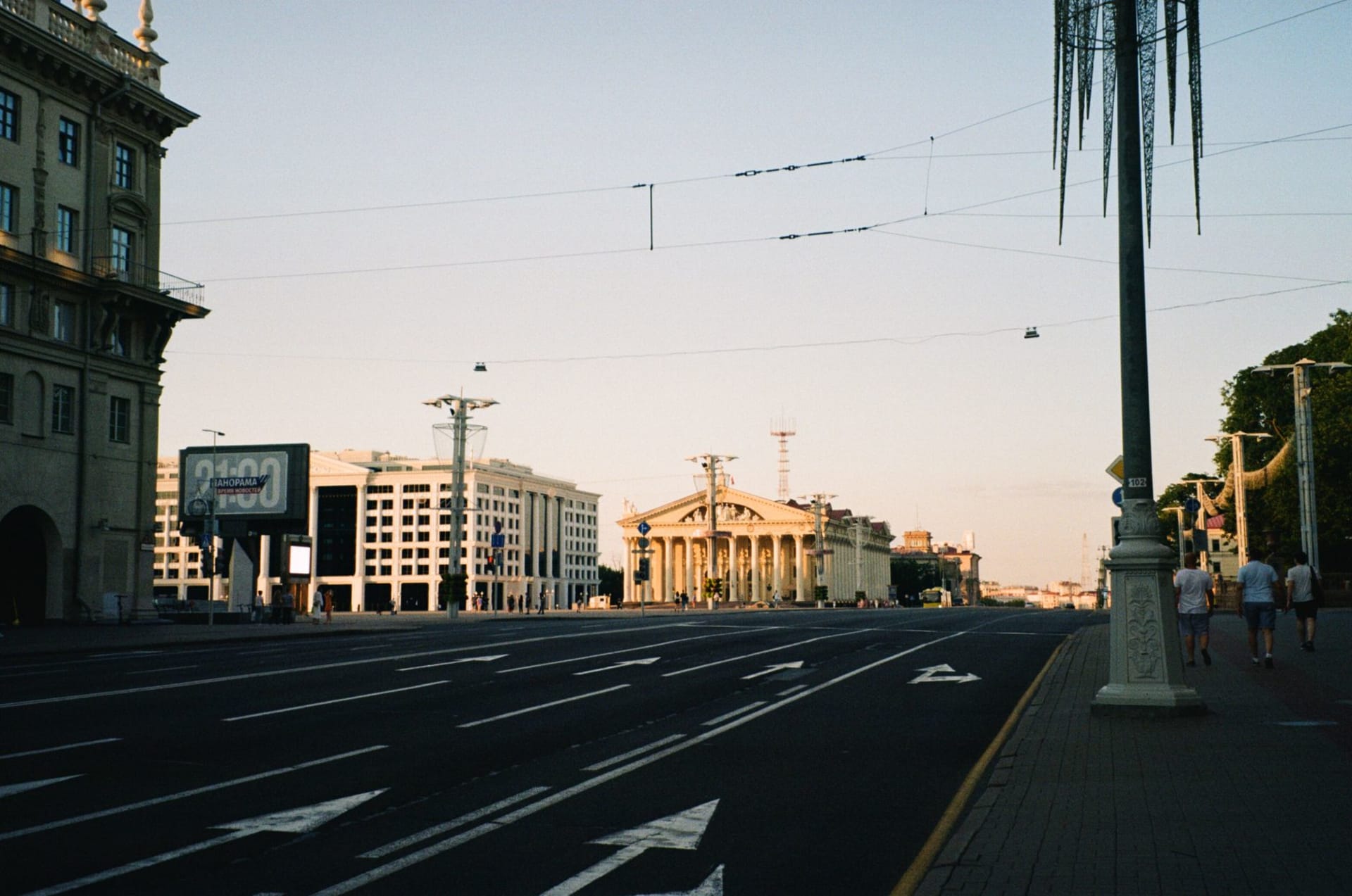
I came to Minsk expecting a grey city and got a city of extraordinary light. The evening I arrived, Prospekt Nezavisimosti — Independence Avenue, the vast Soviet boulevard that runs straight through the heart of the capital — was illuminated in a way that made the socialist-realist buildings glow warm and creamy, like wedding cakes made of granite. I stood at the top of the steps leading from the train station and tried to understand what I was looking at. The scale was enormous. The conviction was absolute. And somewhere in that conviction was something I hadn’t expected: beauty.
Minsk was almost completely destroyed in the Second World War — eighty percent of it gone, either bombed or burned. Stalin rebuilt it according to a vision of what a great Soviet capital should look like: monumental, symmetrical, carved from marble and stone, with boulevards wide enough to march an army down. The result is a city that does not apologise for its own grandiosity. The Government House on Independence Square. The Academy of Sciences with its Stalinist spire. The enormous GUM department store, whose food hall in the basement still sells pickled vegetables in enormous jars, slabs of smoked pork, and jars of honey lined up by colour from pale yellow to almost black. I bought a jar of dark buckwheat honey and ate half of it with the draniki I found at a small café two streets away — potato pancakes crisped at the edges, heavy in the middle, served with sour cream by a woman who regarded my enthusiasm with the careful neutrality of someone who has seen tourists have feelings about potato pancakes before.

The river Svislach curves through the city, and along its banks the reconstructed old quarter of Troitskoye Predmestye offers a different texture — lower, older-looking, with painted wooden buildings and cobblestones that seem almost defiant against the surrounding grandeur. It is a little too tidy, a little museum-like, but the café terraces that spill onto the riverbank on warm evenings feel genuinely alive. Local couples walk the embankment. Teenagers sit on the stone walls. Somewhere nearby a busker plays something that sounds like Belarusian folk melody through a synthesiser. It should feel incongruous and somehow doesn’t.
What I kept returning to, in Minsk, was the parks. The city has an enormous amount of green space — partly by design, partly because the scale of the boulevards required breathing room between them. Gorky Park on a Sunday afternoon was crowded with families, grandmothers sitting on benches watching children on the rides, young men playing chess in the afternoon sun. The Botanical Garden, further east, was nearly empty when I visited, and I spent an hour there just walking under old linden trees, watching the bees work.

The food scene has shifted considerably in recent years. Alongside the Soviet-era staples — and the draniki, which you should eat at every opportunity — a generation of small restaurants and bars has opened in the courtyard buildings of the city centre. Natural wine, craft beer, izakaya-style small plates: Minsk has that in a way that surprises visitors who haven’t been since the mid-2000s. The night is quieter than Warsaw or Vilnius, but it is not silent, and the quality of the coffee has improved dramatically.
When to go: May and June are ideal — the linden trees bloom along the boulevards and their scent drifts through the city on warm evenings. September brings clear, angled light and the sense that the city has returned to itself after the summer crowds thin out.