Zugspitze
"There is snow up there in July that has been there since before anyone I know was born."
The Bayerische Zugspitzbahn — the cogwheel mountain railway — departs from the Garmisch-Partenkirchen station on a standard track and then, somewhere in the valley floor, begins its conversion into something else. The grade steepens, the train slows, the tunnels lengthen, and by the time you reach the intermediate station at Grainau you have crossed an invisible threshold. The final tunnel through the mountain’s interior takes roughly forty minutes in near-darkness, the train grinding upward with a patience that seems mechanical but feels almost deliberate, as though the mountain is taking its time deciding whether to let you through. And then the tunnel ends and you are at 2,600 meters and the world outside the windows is white.
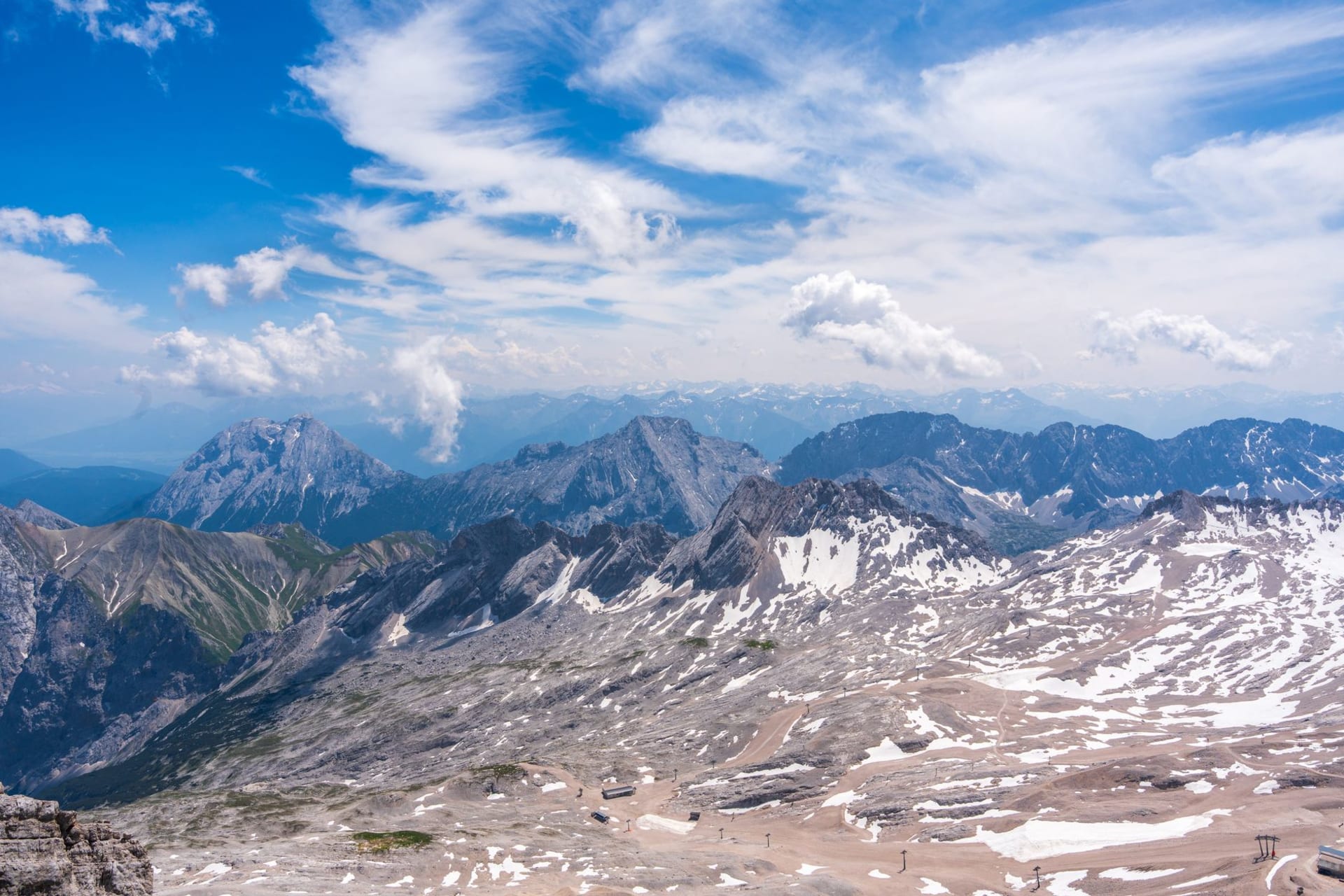
I took the train on a clear day in early July, when the Zugspitze’s permanent snowfields held ice accumulated over decades, and the contrast between the valley temperature I had left two hours earlier — warm, humid, smelling of cut grass — and the summit air was so complete it required a moment to register as real. The air at 2,962 meters has a quality that I can only compare to very cold water: you feel it going down, and it feels cleaner than anything else. The Hochwanner and the Zugspitzplatt ski runs spread below the summit in their summer state — closed, yes, but present, the cables and pylons maintaining their positions like an argument made in winter that summer hasn’t yet rebutted.

The summit is tripartite: the cogwheel train arrives at one station, the Austrian aerial tram from Ehrwald arrives at another, and the German Zugspitzbahn cable car from the Eibsee arrives at a third. The effect is of a small high-altitude transit hub, with multiple nationalities arriving by different means at the same cold, bright point. The border between Germany and Austria runs across the summit ridge — there are markers in the snow, and at one point I stepped between two countries in a single stride, which seemed both significant and absurd. From the top, on the day I was there, you could see into Switzerland to the southwest and into Italy on the clearest section of the horizon.
The summit cross was erected in 1851 by soldiers of the Austrian military surveying department, and it has been replaced and restored multiple times since. It sits at the highest reachable point, and people photograph it with an intensity that seems to be about more than the view — something about reaching a defined high point, the oldest narrative in human travel. I photographed it too. From there, looking south, the Inn Valley was visible, a thin line of civilization running between ranges that continued southward into Austria without apparent end.

Coming down by the Eibsee cable car — the newer aerial tram that descends in a single dramatic span to the glacial lake below — takes about ten minutes and involves a verticality that the mountain railway obscures. The Eibsee spreads out below as you descend, emerald-green and improbably clear, a lakeside resort that exists in another climate entirely from the summit above it. I walked around the Eibsee afterward, a circuit that takes about ninety minutes, and kept looking up at the summit I had just left and trying to reconcile it with where I was standing. Mountains always do this — they contain more than their visible shape implies — but the Zugspitze does it with unusual emphasis.
When to go: June through October for the clearest summit views and access to the hiking trails on the Zugspitzplatt plateau. The cogwheel train runs year-round, but January through April brings ski season crowds at the summit station. For solitude at altitude, early morning departures in September or October offer the summit with manageable numbers and the light at its most architectural.