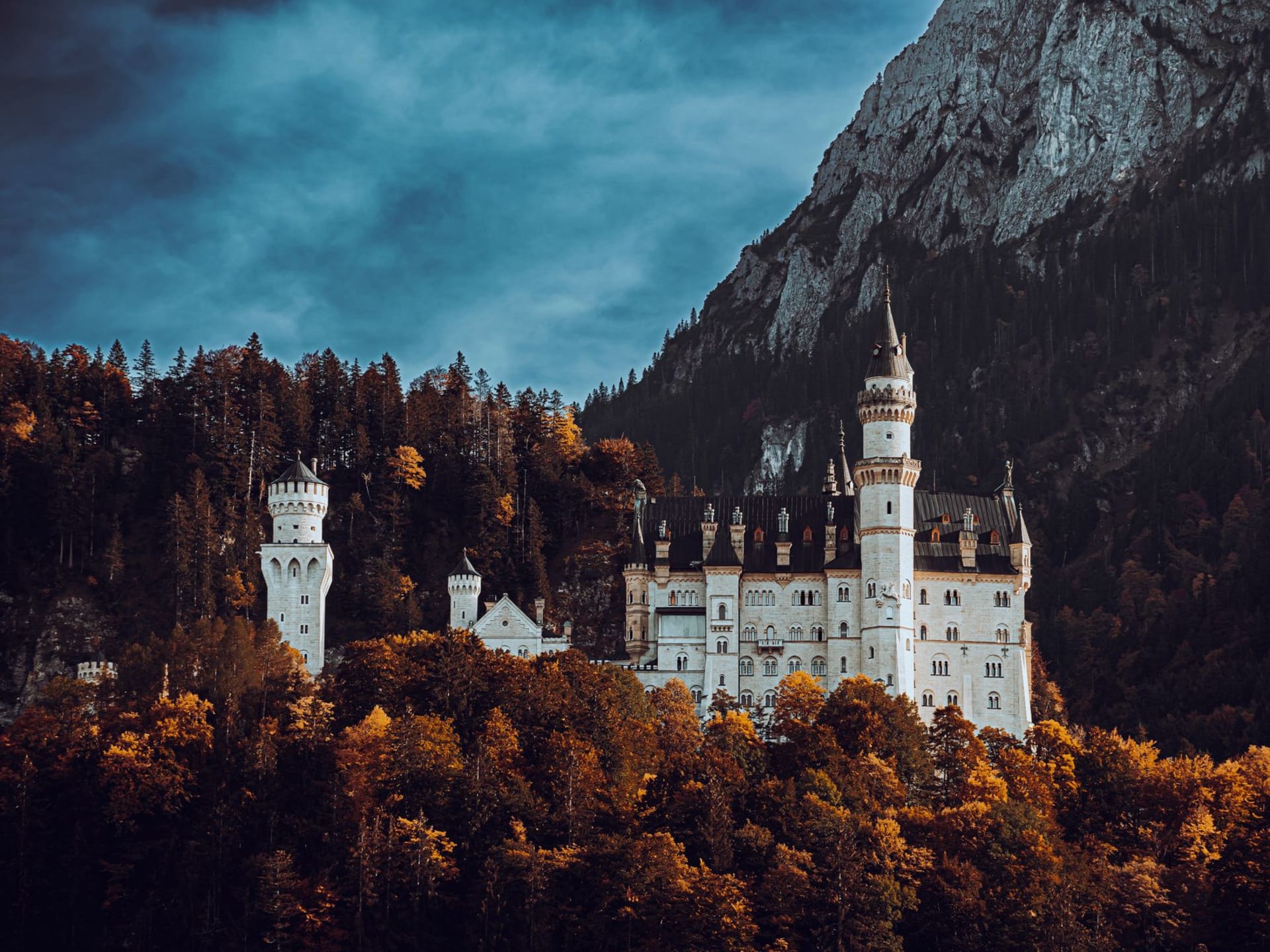
Linderhof
"Versailles dreamed itself into a German mountain valley and came out smaller, stranger, and somehow more honest about what palaces are for."
Linderhof is the palace Ludwig II actually finished, and standing in the garden in front of it I spent some time thinking about what that says. Neuschwanstein — the famous one, the castle on the postcard — was still under construction when Ludwig drowned in the Starnberger See in 1886. Herrenchiemsee, his full-scale copy of Versailles on an island in the Chiemsee, was never completed. But Linderhof was finished, and lived in, and used. It is the smallest of his three major projects, and it is the one that tells you most about the man.
The palace sits at the end of the Graswang valley, an hour’s drive southwest of Garmisch-Partenkirchen, in a narrowing between forested hillsides that gives it the compressed, theatrical quality of a stage set. The formal gardens — French baroque in conception, with a cascading fountain that rises thirty meters on the hour, a Neptune basin, topiary and parterres that require constant human attention to maintain their geometry — press right up against the hillside forest on three sides. The effect is of European courtly culture trying to impose its logic on landscape that is actively, permanently indifferent to it. The Alps win, aesthetically. But the gardens make a compelling argument.

Inside the palace, the scale is intimate in a way that Versailles is not. The Royal Bedroom — which is the central and most elaborately decorated room, larger than the throne room, because Ludwig ranked sleep above governance — is paneled in carved and gilded wood, the ceiling painted with allegories of Dawn and Night, the chandelier containing 108 candles. The bed is separated from the room’s main space by a golden balustrade, as though even within his own private bedroom Ludwig maintained the distinction between the public presentation of the king and the private fact of the human. He dined alone, using a mechanical table that rose from the kitchen below so he wouldn’t have to interact with servants. He slept through the day and worked — or wandered — through the night.
The Venus Grotto is in the hillside above the palace, and it is the thing I think about most when I think about Linderhof. An artificial stalactite cave, built on Ludwig’s commission in the 1870s, with a subterranean lake, a shell-shaped boat, and the first electric lighting system in Bavaria — the king wanted colored light effects on the water, and Edison’s technology arrived just in time. The grotto reproduces the first act of Wagner’s Tannhäuser, the scene in the Venusberg, as a physical environment. Ludwig would be rowed across the lake in his gilded boat, with the walls lit blue or pink or gold depending on his mood, and presumably feel himself inside the opera rather than merely watching it.

There is something about Linderhof that the word “eccentric” fails to capture. Ludwig was not eccentric — eccentric implies a comfortable deviation from a norm that was actually available. He was a man who found the 19th century genuinely incompatible with whatever he required from existence, and who used his royal budget to build pockets of alternative reality within it. The grotto, the mechanical dining table, the nighttime rides through the park in a golden sleigh, the letters to Wagner written in the register of a courtly lover — these are not the habits of someone who found the world slightly insufficient. They are the habits of someone for whom reality as available was not a workable proposition.
When to go: May through October for the gardens in their intended state, with the Neptune fountain running on the hour at peak times. The Venus Grotto requires a guided tour and has timed entry — book in advance in July and August. April can be beautiful, when the surrounding forest is still in early leaf and the palace grounds are quieter than they will be until October.