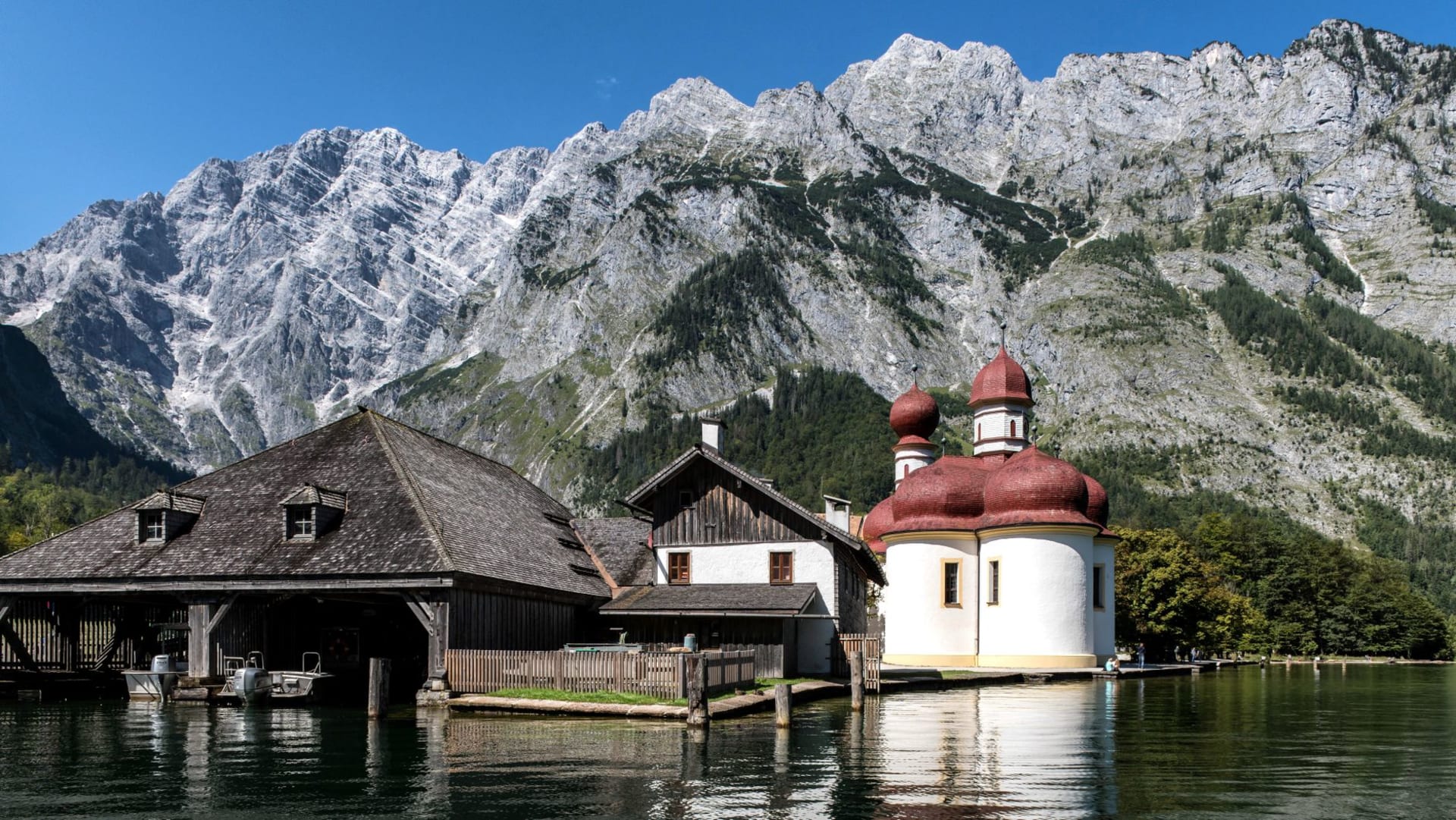
Königssee
"When the echo came back off the Watzmann, perfectly clean, I understood why people have been making the trip for centuries."
The boat is electric. This is the first thing they tell you, and the reason is conservation — no fuel, no exhaust, no noise beyond the gentle motor and the water parting along the hull. I boarded at Schönau am Königssee on a Tuesday morning in late September when the mist was still sitting on the water, and the effect of that silent engine in those still conditions was that the lake seemed to produce its own weather. The Watzmann’s east face — a 2,000-meter limestone cliff that drops almost directly into the water on the western shore — appeared slowly as we moved south, first as a gray shape in the mist and then as something absolute and final, the kind of scale that makes human categories feel approximate.
The boat stops briefly at St. Bartholomew’s Church, a 12th-century pilgrimage chapel on a small peninsula that is the only buildable land along the lake’s entire eastern shore. The church is painted in the red-and-white dome style that reads as Bavarian-baroque, and it sits against the cliffs with the composure of something that has been exactly where it belongs for eight hundred years. The restaurant next to the church — technically a Gasthaus that was once a royal hunting lodge — serves smoked char that have been caught in the lake that morning, and the char from the Königssee are famously flavored by the spring water that feeds the lake, cold and clean to a degree that produces flesh of particular delicacy.

But it is the trumpet that most people remember. At some point during the crossing — the boatmen have their preferred spots, the places where the echo geometry is most reliable — the driver stops the motor, picks up a flugelhorn or trumpet, and plays a short phrase toward the cliff face. The echo returns clean and complete, the mountains giving back exactly what was given to them. I have read that this demonstration has been performed since at least the 18th century, that it was a fixed part of the tourist experience before tourism had that name. Standing on the boat when it happened, on still water with mist still threading through the pines above, I found that the historical context made no difference whatsoever. The echo was still astonishing.
The full boat service runs to the southern end of the lake at Salet, and from there a short walk leads to the Obersee — a smaller, shallower lake that receives even fewer visitors. The path follows the flat shore through forest and comes out at a meadow that is, in terms of proportions between water and cliff and sky, closer to Norway than to Bavaria. I sat at the edge of the Obersee for a while on a fallen log with my lunch — bread and cheese bought in Berchtesgaden that morning — and thought about the strange relationship between famous places and the feeling of solitude. The Königssee gets a million visitors a year. On a Tuesday in late September, at the Obersee, with the electric boat gone back north, there was simply nobody.

The return journey, with the afternoon sun working its way across the west wall of the Watzmann, produced completely different light from the morning crossing. The lake changed color three times in an hour — gray-green, deep blue, turquoise — as the cloud moved and the angle shifted. I arrived back at Schönau in early afternoon, and the town’s souvenir shops and ice cream stands registered as mild intrusions on something the boat had established. I walked through them quickly and found a bench above the lake’s north shore and sat there until the light went.
When to go: May through October for the full boat service to Salet and the Obersee walk. September is the sweet spot — mist on morning crossings, warm enough for the terrace at St. Bartholomew’s, the autumn color starting in the forest. Avoid August weekends when queues for the boat can reach two hours. The lake does not freeze, and winter crossings run a reduced service — the mountains above hold snow and the atmosphere becomes something else entirely.