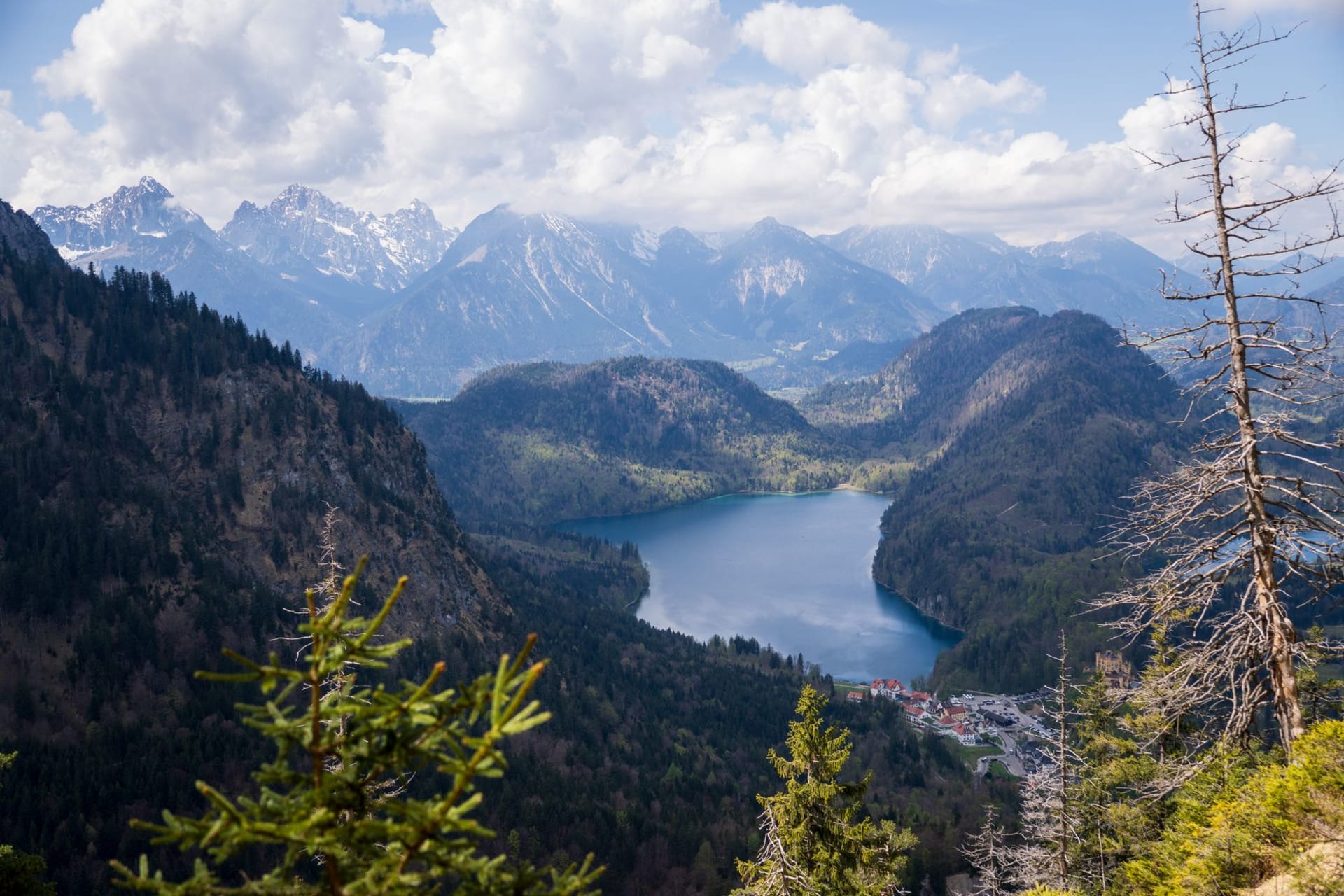
Füssen
"Everyone uses Füssen as a starting line. I used it as a destination, which made all the difference."
The tourist logic around Füssen is clear and understandable and almost entirely wrong. You arrive by train, you get on a bus to Neuschwanstein, you spend your allotted time at the castle, you get back on the bus, you get back on the train, and Bavaria’s most visited destination has been administered. I understand this logic — I followed it on my first visit. What I discovered on my second visit, when I stayed three nights and spent most of one full day in the town itself, is that Füssen has been quietly operating as a medieval market town and musicians’ residence and Alpine gateway for roughly fifteen hundred years, and it is not particularly bothered that most people are looking at it through a bus window.
The Hohes Schloss — the High Castle — sits above the old town proper and was a summer residence of the Augsburg bishops from the 14th century onward. The inner courtyard is painted with trompe-l’oeil windows and architectural details that are so convincingly three-dimensional that I stood in the middle of it for a long moment convincing myself that the arched windows were real before accepting they were painted. The State Galleries inside are a secondary pleasure — mostly altarpieces and devotional painting from the Swabian Gothic and early Renaissance — but the courtyard alone is worth the climb.

The Lech river runs through and below the town in a series of turquoise channels, fed by glacial meltwater from the Lechtal Alps to the south, and its color is so improbably vivid — the specific aquamarine of glacial flour suspended in water — that the first time I stood on the bridge above it I thought something must be wrong. Nothing was wrong. The Lech simply runs this color here, at this elevation, in this light, and the weir that redirects part of the flow has created a series of pools at the base of the old town walls that catch the color and multiply it. On warm evenings, locals sit on the stone embankment above these pools with their shoes off. I sat there for an hour on my second evening and watched the light change on the water.
The old town itself — the Reichenstrasse and the streets that branch from it — is better preserved than it has any right to be, given the tourist throughput. The St.-Mang-Kloster, a Benedictine monastery whose origins run back to the 8th century, anchors the southern end. The church contains the Chapel of the Holy Grave, a 17th-century reproduction of the Holy Sepulchre in Jerusalem, built with such earnest fidelity to the original dimensions that it feels compressed and fervent, the smell of old incense thick in the low-ceilinged space.

Füssen was, for several centuries, one of the centers of lute and violin manufacturing in Europe — the instrument-making tradition that eventually migrated to Mittenwald. The Via Claudia Augusta, the Roman trade route from the Adriatic to the Danube, passed through here, and the town accumulated the particular density of history that comes with being on the road between two important places for a very long time. There is a Roman-era fort at the base of the castle hill and a museum in the monastery that presents this layering without dramatization, letting the artifacts carry the argument.
When to go: September and October are ideal — the castle queues have shortened, the town functions without crush, and the Lech runs with particular clarity in the early autumn light. Avoid midsummer weekends entirely: the Neuschwanstein effect makes Füssen feel like a transit hub rather than a town. January and February bring snow to the streets and a quiet that makes the medieval architecture feel inhabited rather than preserved.