Paharpur
"Eight hundred monks once lived here. Now it's me, a goat, and twelve hundred years of terracotta."
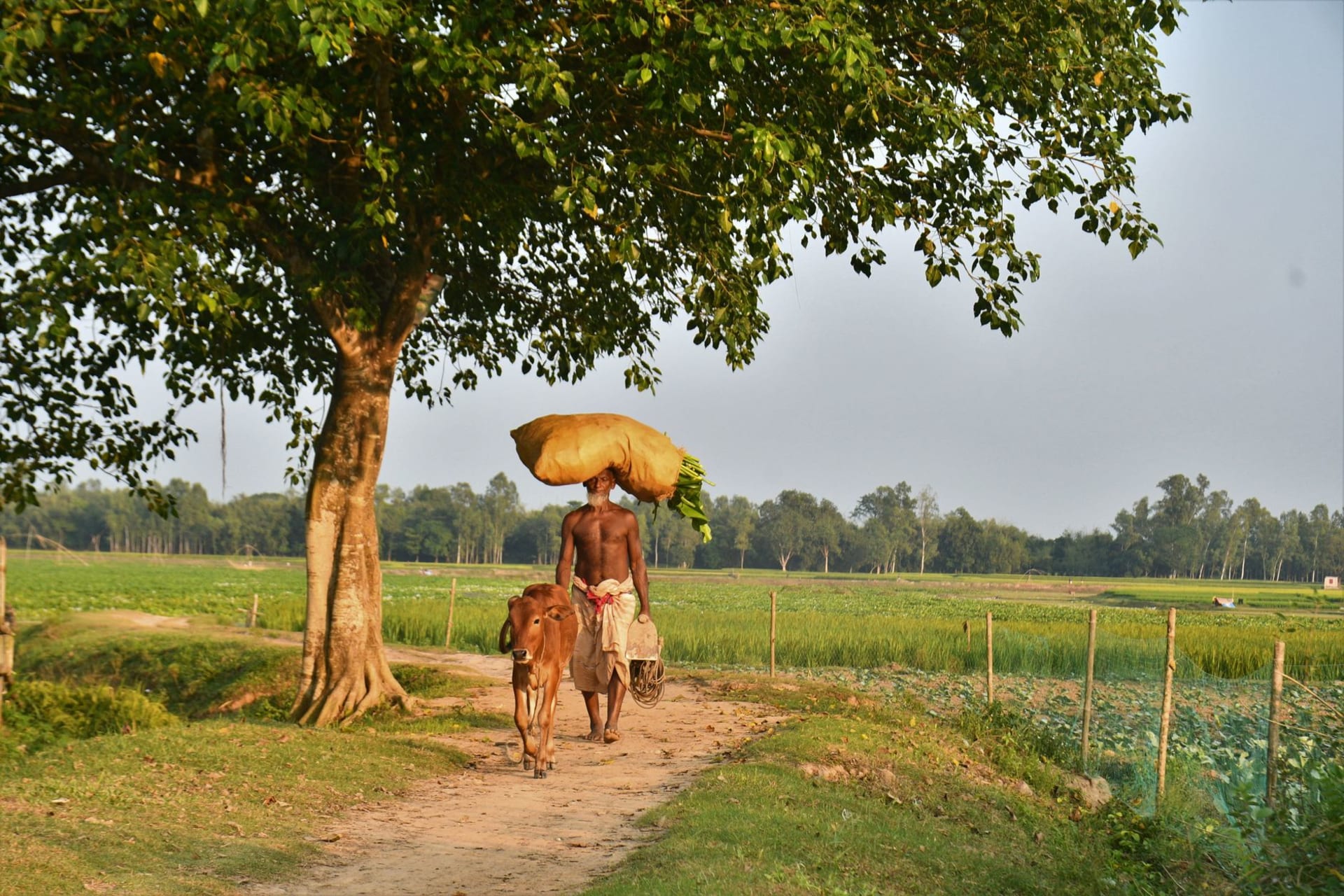
The road from Joypurhat runs through paddy fields so flat that the horizon becomes a philosophical statement. Nothing interrupts it for kilometers at a time — not a hill, not a significant building, barely even a tree of height. Then, at a bend in the road near the village of Paharpur, something rises from the plain that has no right being there: a stepped pyramid of dark brick, surrounded by the low walls of what was once the largest monastic complex in South Asia south of the Himalayas. The shock of it is real. I actually stopped the rickshaw.
Somapura Mahavihara
Built in the late eighth or early ninth century under the Pala kings — the last great Buddhist dynasty of Bengal — Somapura Mahavihara was home to roughly eight hundred monks at its height. Pilgrims came from Tibet, China, and Southeast Asia; the monastery maintained a library and attracted scholars across the Buddhist world for four centuries. Then it burned, probably in a twelfth-century Sena dynasty raid, and was slowly covered by six meters of soil and the forgetfulness of many governments until systematic excavation began in the 1920s.
What’s visible now is the cruciform central stupa — reconstructed to waist height in some places, original and crumbling in others — and the outline of 177 individual monk cells arranged in a perfect square around it. Walking the perimeter takes about twenty minutes. The geometry is so precise that it feels mathematical rather than architectural, a square mandala built in brick.
The Friezes
This is the detail that makes Paharpur worth the journey: along the base of the central stupa and scattered through the site museum, thousands of terracotta plaques survive from the original structure. They show musicians and dancers, elephants and horses, lotus scrollwork, scenes from everyday ninth-century life — a woman braiding her hair, a man fishing, an acrobat bending backward. The craftsmanship is extraordinary and the variety almost inexhaustible. The site museum is badly lit and poorly labeled, but it contains some of the finest decorative terracotta I’ve seen anywhere.
I spent forty minutes in the museum with a flashlight on my phone, leaning close to individual plaques, trying to figure out what I was looking at. A caretaker eventually materialized and explained several of the pieces with quiet authority. He seemed surprised that anyone was taking notes.
Getting There and Being Alone
Paharpur is genuinely off the tourist trail. The nearest town with accommodation is Joypurhat or Rajshahi, both several hours away. I came by bus from Bogura, then a CNG auto-rickshaw on a road that is optimistic about its own smoothness. There were two other visitors during the three hours I spent on the site. One was a Bangladeshi archaeology student writing her thesis. The other was the goat, which belongs to no one and everyone, as goats do.
The emptiness is part of the experience. UNESCO listed Paharpur in 1985 and it remains absurdly undervisited — which is either a shame or a gift, depending on your priorities.
When to go: November through February. The northwest is hot and dry in summer (March–June) and flooded in monsoon (July–September). December mornings at the site are cool, golden, and quiet in a way that’s difficult to overstate.