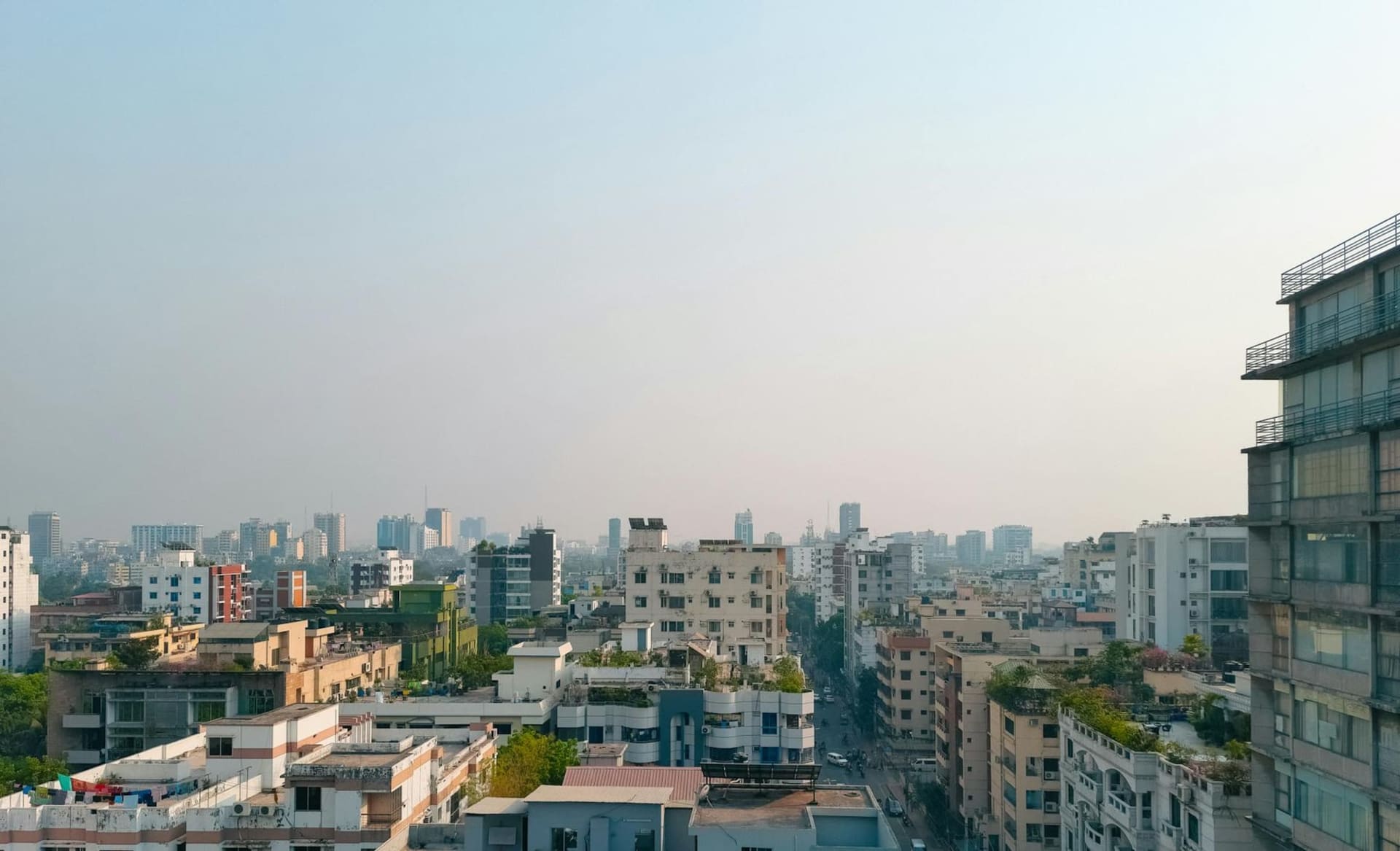
Dhaka Old City
"Old Dhaka at rush hour is organised chaos so dense it becomes its own form of beauty."
Ten million rickshaws and Mughal mosques in Puran Dhaka, the most chaotically alive city in South Asia.
I arrived in Puran Dhaka from the north of the city, crossing the invisible boundary somewhere near Chawkbazar, and the air itself changed register. Diesel, fried mustard oil, river mud from the Buriganga, something sweet and faintly rotten I never managed to identify. The noise rose to meet me like a physical wall — horns, bells, the metallic shriek of rickshaw axles, a call to prayer unspooling from somewhere inside the tangle of lanes. Nothing I’d read had prepared me for the sheer metabolic intensity of the place.
Shakhari Bazaar and the Geometry of Congestion
The conch-shell artisans of Shakhari Bazaar still work in the same narrow lane their families have occupied for centuries. I edged sideways through it with my bag pressed flat against my chest, watching a man split a conch with a single mallet blow, his concentration absolute and somehow serene inside the surrounding riot. The lane is perhaps a metre and a half wide; the buildings lean toward each other overhead so that the sky is reduced to a pale seam. Rickshaws that have no business fitting through attempt it anyway and, through some collective negotiation I couldn’t decode, usually succeed.
Lia and I ate at a street stall near the mouth of the lane — biryani heavy with ghee and whole spices, served on a banana leaf with a wedge of lime so sharp it made my eyes water. It cost less than a coffee in Mexico City and tasted of a hundred years of the same recipe.
Lalbagh Fort and the Quiet Inside the Storm
The Mughal fort at Lalbagh is not quiet exactly, but it offers a different quality of noise — birds, wind in the tamarind trees, the distant pressure of the city held momentarily at bay by seventeenth-century walls. I sat on the steps of the unfinished mosque inside and watched pigeons work the cornices. The fort was begun in 1678 and never completed; the death of a Mughal princess during its construction was considered an ill omen and the work stopped. That suspended quality hangs over it still. Something beautifully unresolved.
What genuinely surprised me was the sadarghat launch terminal just south of the fort — not the ferry terminal itself, which every itinerary mentions, but the rocket ships. Actual paddle-wheel river steamers from the 1920s still making their runs down to Barisal, listed and rust-streaked and improbably operational, loading live chickens and steel drums and motorcycle parts in the same hold.
When to go: November through February, when the monsoon heat has broken and the air over the Buriganga turns a bearable grey-gold. Avoid March to October if humidity is a concern — Dhaka in July is a different city entirely, and not a forgiving one.