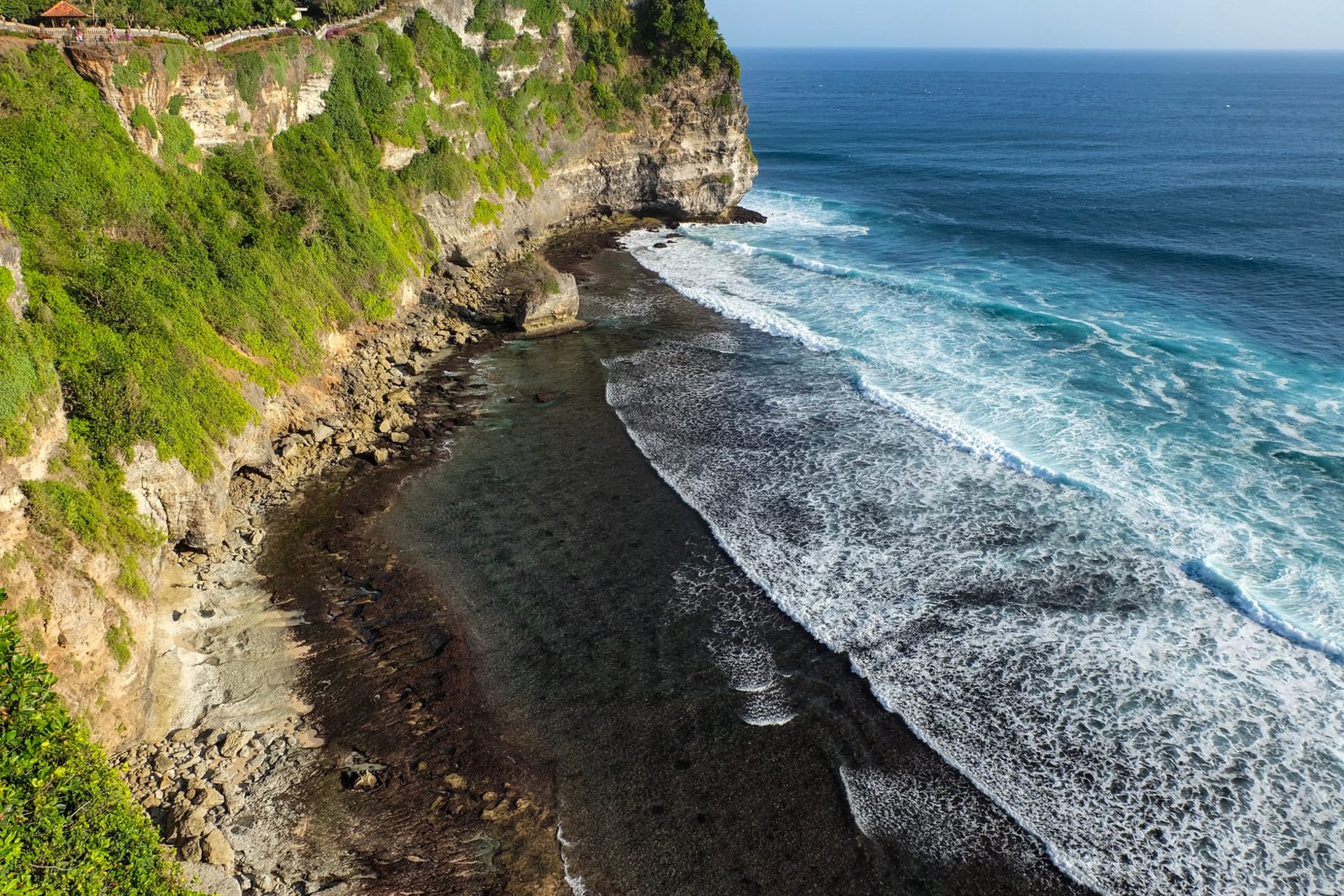
Uluwatu
"Standing at the Uluwatu clifftop, the ocean fills your entire field of vision. It is one of those moments when the earth's scale becomes briefly legible."
The path to Uluwatu temple runs along the clifftop through a monkey forest, and the monkeys have a studied interest in anything you are carrying. My sunglasses disappeared in under three seconds — snatched from my head by a large male who retreated to a tree and regarded me with what I can only describe as mild contempt. I had been warned. I had not been fast enough. The temple staff sell snacks near the entrance specifically to bribe returned stolen items out of monkey hands, a small local economy built on simian kleptomania. I bought a banana, retrieved my glasses, and walked on, which is exactly the transaction they had designed.
Pura Luhur Uluwatu sits at the southwestern edge of the Bukit Peninsula, the limestone plateau that forms the southern foot of Bali. The peninsula itself is a different ecosystem from the tropical humidity of the north — drier, more Mediterranean in feel, the vegetation lower and more scrubby, the light hitting the white limestone at angles that make the landscape intensely photogenic. The temple occupies the highest point of a cliff that drops seventy metres to the Indian Ocean, and when you walk through the entrance gate and reach the outer terrace of the complex, the ocean appears below you with a suddenness that catches the breath. It is not the size of it — you know the Indian Ocean is large. It is the angle, the way it fills the entire visual field from left to right and horizon to foot, that makes the scale briefly, genuinely legible.
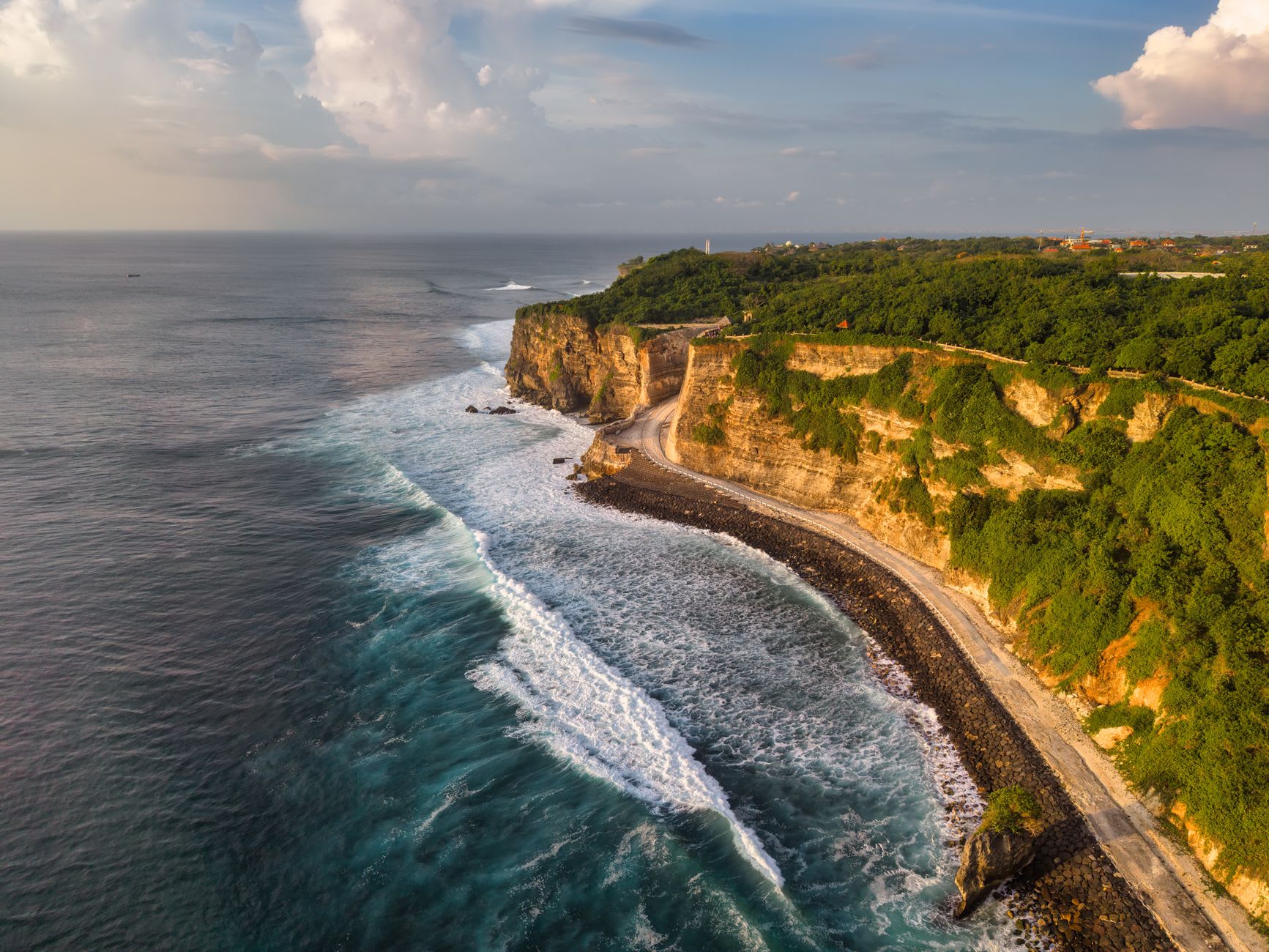
The temple is one of Bali’s six spiritual pillars — Pura Sad Kahyangan — and its position on the southwestern point of the island is understood as a guardian role, the temple holding back malevolent forces from the sea. Priests in white perform morning rituals in the inner courtyard, the incense smoke caught by the sea wind and sent north over the cliff edge. The architecture is coral stone and black volcanic rock, the carvings worn by centuries of salt air into something smoother and more elemental than the temples inland. This is a working temple, not a monument, and the distinction shows.
Below the cliffs, accessed by steep concrete steps or by road from around the peninsula, Uluwatu’s surf breaks are among the best in Southeast Asia. Uluwatu proper, Padang Padang, Dreamland, Bingin — each break has its own character, its own community of devotees, its own section of cliff-face warungs where you can eat noodles and watch the lineup below. I spent an afternoon at Bingin, sitting on the cliff steps with a cold soda, watching a rotating cast of surfers catch waves that peeled perfectly across a shallow reef for fifty metres before closing out in white water. A Balinese surfer in his mid-thirties surfed for two hours without stopping, making it look like a conservation of energy rather than an expenditure of it.
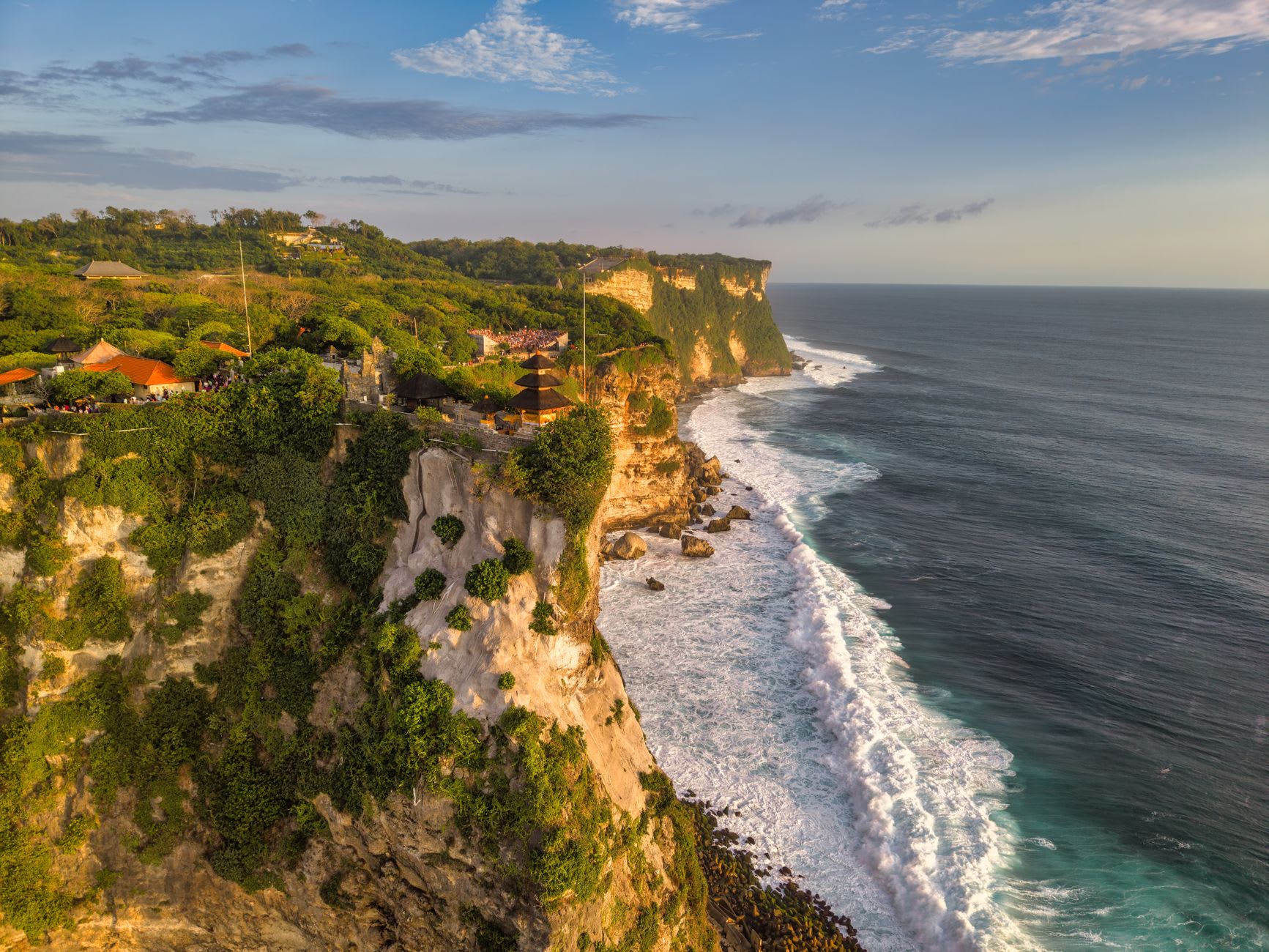
The kecak dance at sunset in the open-air amphitheatre cut into the clifftop at Uluwatu is a performance that could easily be a tourist trap and is frequently both — a spectacle and something more than a spectacle simultaneously. Sixty or more bare-chested men arranged in concentric circles, their voices producing that interlocking rhythmic chant that gives the dance its name. The story — the Ramayana episode in which the monkey king Hanuman assists in rescuing Sita — played out against the backdrop of the cliff and the setting sun with a theatrical grandeur that was clearly calculated and somehow still landed as genuine.
When to go: April through October for surfing, when the southwest swell consistently hits the breaks along the Bukit Peninsula. The kecak dance runs nightly year-round; arrive thirty minutes before to secure a seat on the outer rim of the amphitheatre with the cliff view behind the performers. The temple and clifftops are worth visiting any morning before ten AM when the tour buses from Seminyak have not yet arrived.