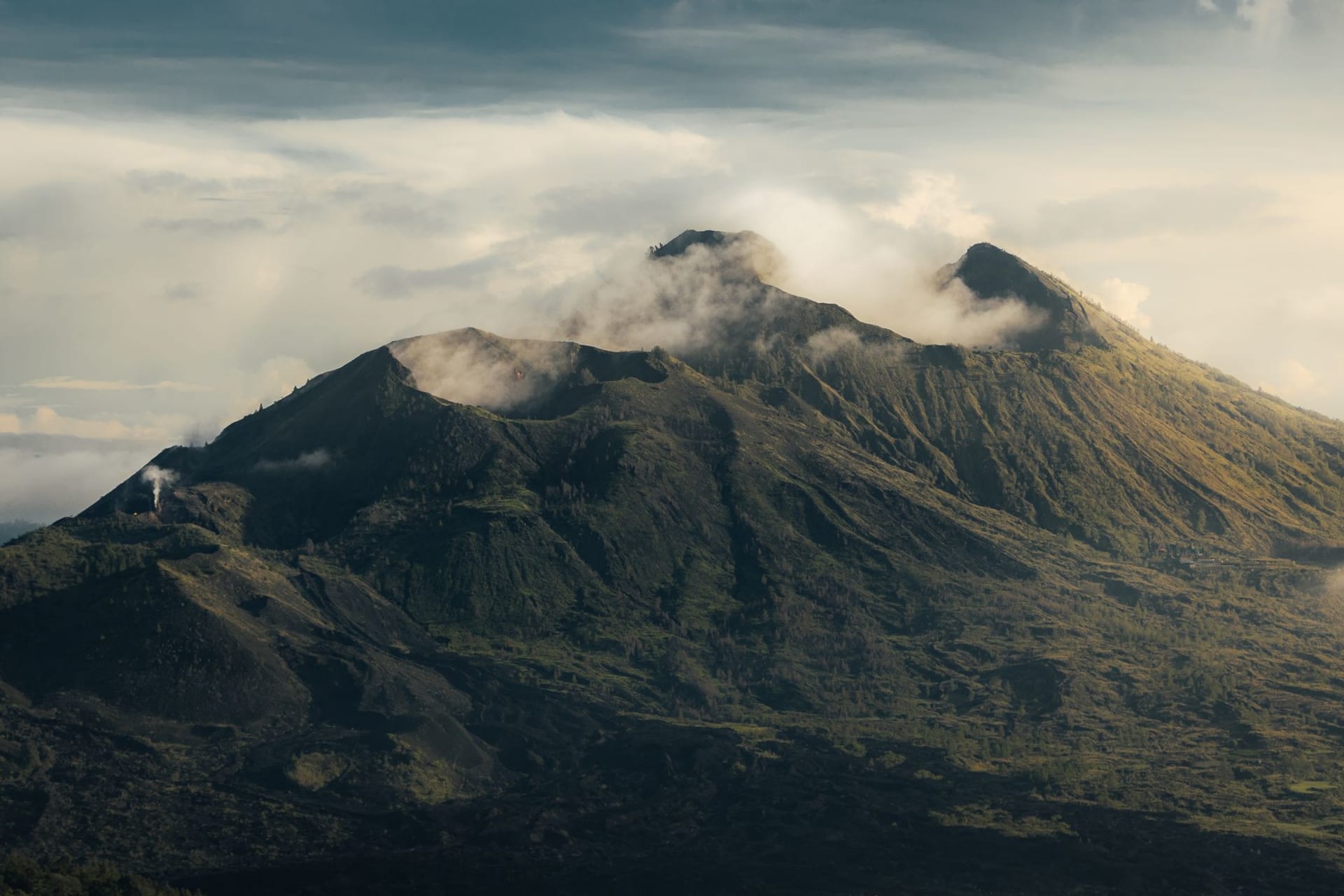
Mount Batur
"At the top of Batur, the clouds are below you. That particular reversal of the world is not something you forget quickly."
My guide woke me at two in the morning with a knock on the door and the words “time to go” delivered in a tone that suggested he had done this several hundred times and was comfortable with whatever emotional state I might be in. I was in the state of a person who had agreed to a volcano trek the previous afternoon over a second coffee and was now experiencing the full weight of that decision. The road from Kintamani to the trailhead was dark and cold — cold in a way I had not expected from a tropical island, the highland air thin and sharp — and the car’s headlights picked out mist moving between the trees.
Mount Batur sits at 1,717 metres in the Kintamani highlands of north-central Bali, rising from the rim of an ancient caldera of enormous scale — twelve kilometres across, a landscape so vast it takes the eye a moment to compute what it is looking at. The caldera holds Lake Batur, the island’s largest lake, and the flanks of the outer rim are draped in coffee, vegetables, and clove plantations that the Bali Aga communities have farmed for centuries. The climb from the base of the active cone begins in darkness and takes between ninety minutes and two hours depending on pace, the trail underfoot ranging from loose volcanic scree to fixed rope sections near the top where the gradient becomes genuinely steep.

The summit arrived without drama. One moment I was climbing in near-total darkness, the next the ground flattened and my guide was pointing east and I turned to find the sky already separating into colour — deep indigo at the top, then blue, then a long band of orange growing at the horizon over what I realised was Lombok’s Rinjani, another volcano, visible sixty kilometres away across the strait. Below us to the west, Lake Batur was a sheet of steel-grey water, and beyond it the Batur caldera rim curved away like the wall of a planet-scale bowl. The sun came up over the Agung profile to the southeast — Agung, which I could see from here as just another peak in a volcanic archipelago — and the whole caldera flooded with amber light in about four minutes.
There is a warung at the summit. The owner has brought everything up by hand — gas canisters, cups, instant noodles, eggs and bananas. I paid an amount that felt fair for boiled eggs eaten at the rim of an active volcano at sunrise and did not question the economics. A small cluster of steam vents near the high point were producing thin columns of sulphurous smoke, warm when I held my hand over them, and the smell of rotten eggs mixed with the cold clean air of the altitude in a way that seemed appropriate for a place that is still technically deciding whether to erupt.

The descent, back in full light, revealed the landscape I had climbed through blindly: black and red volcanic rock, thin soil colonised by scrubby grasses and the occasional wildflower, the caldera wall dropping away below in all its geological enormity. The Kintamani village at the top of the outer rim, where I ate a bowl of bakso beef noodles for breakfast before the long drive back south, looked down over the whole scene with the casual familiarity of people who have lived beside an active volcano long enough to find it unremarkable.
When to go: The sunrise trek runs year-round, but the clearest views come in the dry season from May through October. June and September offer the best combination of clear skies and manageable numbers. July and August see the largest groups, which can make the summit feel crowded at sunrise. The rainy season clouding can be dramatic but often means you arrive at a summit above the clouds, which has its own otherworldly quality.