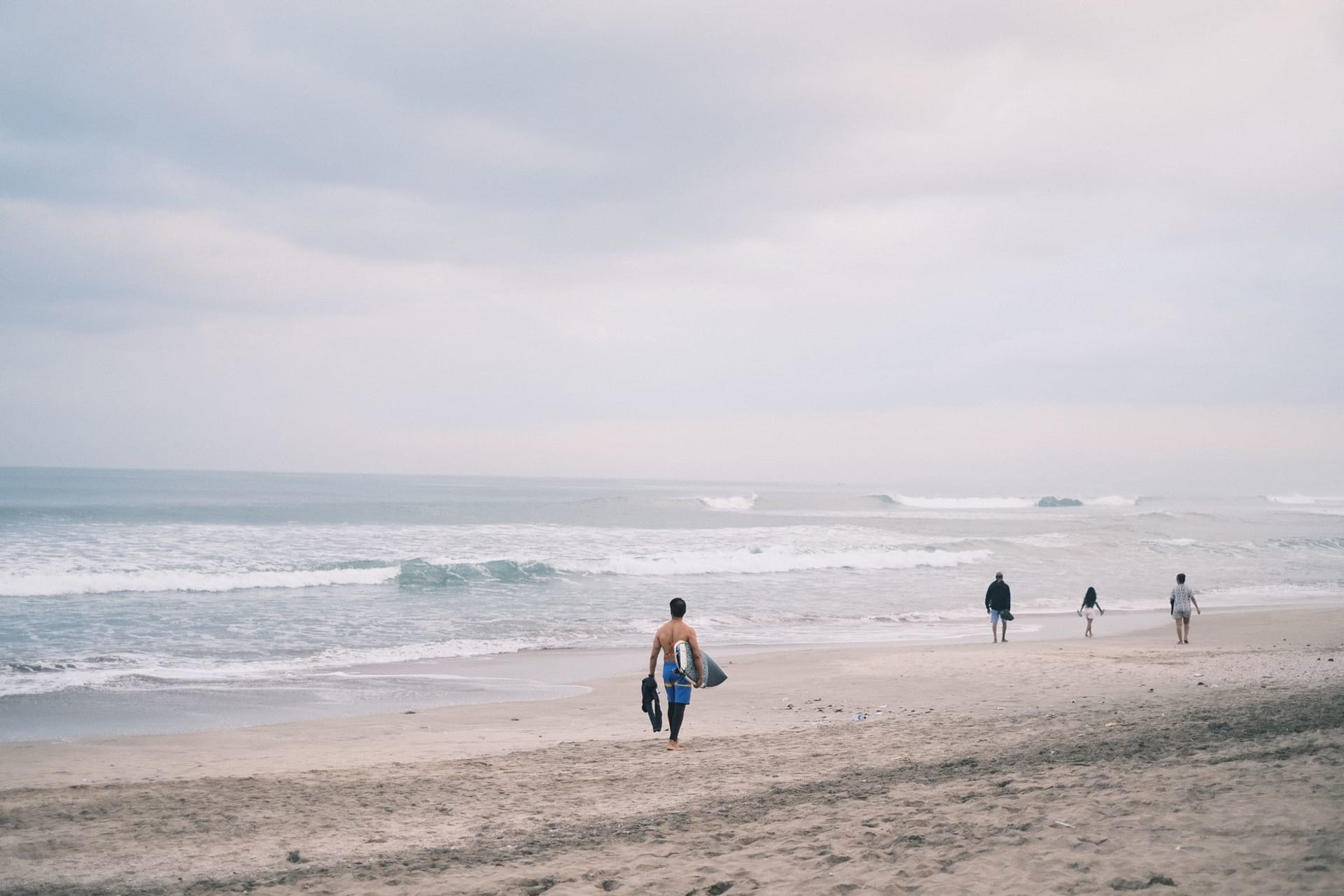
Canggu
"Canggu is what happens when surf culture and WiFi arrive at the same beach at the same time and neither one leaves."
I came to Canggu on a rented scooter from Seminyak, following the coast road north until the boutique hotels thinned out and the rice paddies appeared between the villas, and the road narrowed enough that I had to pull in for a truck bringing building materials to what looked like another guesthouse going up in a former field. That is Canggu in one moment: the construction and the paddies and the surf sound in the distance, everything overlapping at once, the new infrastructure and the old one sharing the same narrow lane.
Echo Beach, at the northern end of the Canggu strip, has been a surf break since long before the cafés arrived. The waves here are not for beginners — the black volcanic sand drops steeply into shore break that has a particular way of throwing surfers sideways — but the culture around the beach is relaxed in the way that serious surf communities often are when they have become comfortable in a place. I sat on the wall above the beach for an hour with a young guy from Lombok who had been surfing Canggu for four years. He pointed out the different sections of the break, named the regulars coming out of the water, and explained that the best conditions came in the early morning before the offshore wind shifted. I understood about half of it but the pleasure was in the watching.

The café culture here is genuine in a way I did not expect. Batu Bolong Street, the main artery of the village, holds an implausible density of coffee shops with cold brew and fast internet, smoothie bowls served in coconut shells, and working surfaces full of people staring at screens. I am aware this reads as a mild dystopia, and some mornings it felt like one. But I was also one of those people with a screen, and the coffee was excellent, and outside the window there was a rice paddy with an egret standing in it, and the rice paddy was being farmed by a woman in a conical hat who had no idea I existed, and somehow both realities seemed to coexist without either one destroying the other. For now, anyway.
The real discovery in Canggu was Berawa and Pererenan, the quieter northern stretches where the development thins and the village roads run between compound walls covered in moss. At a small warung off the main road I found babi guling that a woman had been slow-roasting since five in the morning — the spice paste pressed under the skin, the fat rendered gold, the crackling genuinely crisp. It was the best version of it I ate on the island, served on a banana leaf with rice and pork satay, eaten on a plastic stool with the temple gate visible from where I sat.

The tension in Canggu is real and worth acknowledging: this is a village undergoing a transformation so rapid that it barely resembles what it was a decade ago. Rice fields sell for villa plots. The farmers who worked them sometimes become the staff of the hotels that replaced the fields. Whether that is progress or loss depends on who you ask, and I asked enough people to know the answer is both at once.
When to go: April through October is surf season in Canggu, with consistent southwest swells hitting Echo Beach and Batu Bolong. May, June, and September are the sweet spot before the peak-season crowds of July and August. Avoid the wet season (November through March) if you are here primarily for surfing — the swells become inconsistent and the beach road floods.