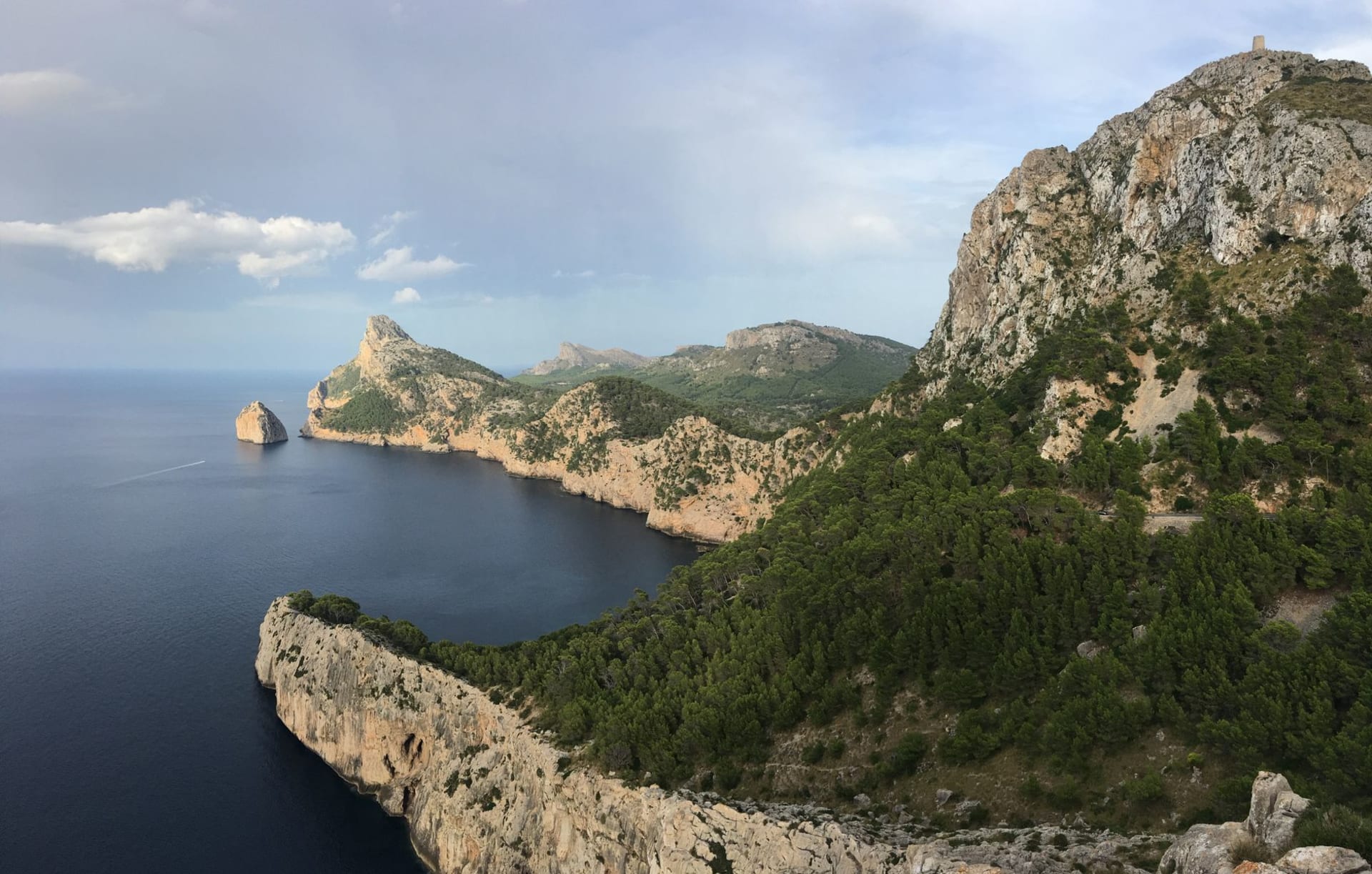
Cap de Formentor
"The road to Formentor tests your nerve and rewards it completely."
You have to go early. This is non-negotiable. The road to Cap de Formentor — the narrow two-lane route that runs nineteen kilometers from the Formentor beach along a ridge of limestone cliffs — closes to private traffic at certain hours in summer and fills with tourist buses the moment it opens. I drove it at six-thirty in the morning in late September, when the light was still arriving in horizontal bars through the Tramuntana pines and the road was empty of everything except two cyclists who were either very fit or slightly deranged. Probably both.
The drive itself is the experience, not just the destination. The road climbs out of the sheltered bay at Formentor beach and almost immediately begins behaving badly — clinging to cliff faces, disappearing around blind corners, offering views that open suddenly at gaps in the rock wall: the sea a hundred meters below, Pollença bay stretching south, the island of Menorca visible on clear days as a dark smudge on the horizon. The miradors — the official viewpoints — are built at the best spots, but the best spots are also everywhere, the whole road a continuous mirador if you’re willing to pull over every kilometer.

The lighthouse at the end has been operating since 1863 and sits at the very tip of the cape with the authority of something that has been necessary for a long time. Around it the landscape is stripped back to essentials: rock, scrub pine, wind, the wide Mediterranean in every direction. The day I was there a group of migratory birds was moving through, resting in the pine trees before crossing the sea — small warblers, mostly, the kind that look like they shouldn’t survive what they’re attempting. A birdwatcher from Germany had set up a telescope and was cataloguing with the focused happiness of someone whose hobby has brought him to exactly the right place at exactly the right moment.
The beach at Formentor, three kilometers back down the road, is the other reason people make this drive. It is a long curve of white sand backed by pine trees, sheltered enough that the water is almost always calm, and historically one of the most beautiful beaches on the island — a judgment with which I find it difficult to argue, even knowing that the adjacent Hotel Formentor has hosted the kind of famous guests whose presence tends to complicate a place. In September it was busy but not impossible, and the water was the particular shade of turquoise that makes you slightly suspicious, as if someone has been adjusting the color settings.

The mirador at Es Colomer — about halfway along the road — might be the single best viewpoint in Mallorca. A sea stack rises from the water directly below, the cliff face falls in striations of gray and rust, and on the morning I was there a peregrine falcon was working the thermals above the rock with the systematic confidence of an animal that has understood its location perfectly.
When to go: Early morning in any season. Summer brings crowds and traffic restrictions from 9am onward — the road is closed to private vehicles without hotel permits during peak hours. September and October offer the best combination of clear visibility and empty early roads. The cape is worth a visit even in winter, when Atlantic storms make the lighthouse itself a spectacle of spray and white water.