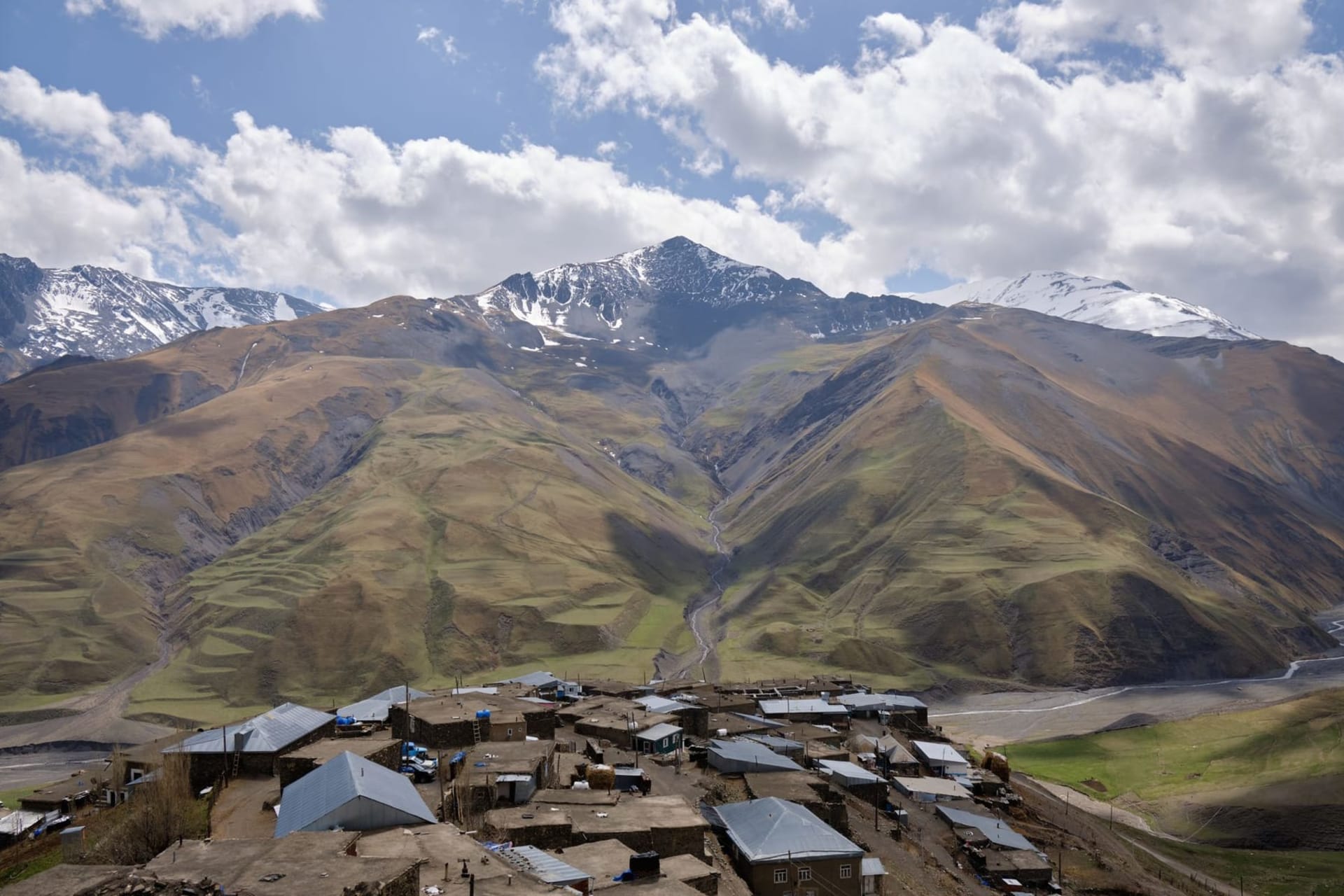
The marshrutka drops us at the edge of the gorge and drives away. There is no other vehicle in sight. Below, threaded along the Girdimanchay River, Lahij sits inside its own silence — until, a few seconds later, the silence cracks open. A high, clean ringing, then another, then a third from somewhere up the lane. Metal on metal, unhurried, perfectly timed. We start walking toward it.
The Street of Hammers
Lahij’s one real artery, Sənətkarlıq küçəsi — Craftsmen’s Street — is barely wide enough for two people and a loaded donkey, which is more or less how it has functioned since the fifteenth century. The cobblestones are the original ones: smooth, black-grey, worn into gentle bowls by eight hundred years of foot traffic and rain. On either side, workshops sit flush with the lane, their wooden shutters folded back to reveal interiors the color of old tea — walls hung with copper trays, pitchers, braziers, ladles, coffee pots with long curved spouts. The craftsmen work on low stools, a piece of copper sheet clamped between their knees, shaping it with a hammer the way a musician holds a beat: steady, almost meditative, then a sudden flick of the wrist for a detail.
I stopped in front of one man for twenty minutes without meaning to. He was raising the neck of a jug from a flat disc, the metal curling upward in slow increments with each strike. He did not acknowledge me. The smell coming from the workshop was particular — hot metal, linseed oil, the mineral cold of the river drifting up from below.
The Village That Time Refused
What surprised me, genuinely, was the water system. Lahij has a network of open stone channels — arxlar — cut directly into the cobblestones, running alongside the lane and branching off toward houses. Clean mountain water moves through them continuously, silently, drawing heat out of the stones in summer. Lia crouched down and ran her fingers in it and said it was cold enough to make her teeth hurt. The channels are still the village’s working water supply. No one seemed to think this was remarkable.
Up past the workshops, the village mosque sits beside a cemetery where the oldest headstones are carved in a script I could not read — pre-Arabic, possibly Albanian Caucasian. Behind it, the hillside breaks into terraced orchards. Late afternoon light comes in flat and amber over the western ridge and turns every copper surface in the village into a small fire.
We ate at a family house near the top of the lane — piti, the Azerbaijani lamb and chickpea stew cooked in individual clay pots, served with flatbread and a bowl of sour kaymak. No menu, no choice, no problem.
When to go: Late spring (May–June) or early autumn (September–October) for mild temperatures and clear mountain light — summer heat in the gorge can be intense, and the road up from Ismayilli is sometimes impassable after winter snowfall.