Hooiberg
"At the top you understand why every Aruban knows exactly where this hill is at all times — it's the only fixed point on a flat island."
Aruba’s flatness is its most disorienting quality. Flying in, you see it from the air: a narrow sliver of land barely elevated above the Caribbean, the resort towers on the western coast providing the only vertical reference on an otherwise horizontal geography. Then, in the island’s interior, rising from the cunucu scrubland with the abruptness of something dropped from altitude, Hooiberg. The name is Dutch for haystack, and the translation is visually accurate — a symmetrical cone, volcanic in origin, 165 meters high, with a concrete staircase of 562 steps ascending its eastern face.
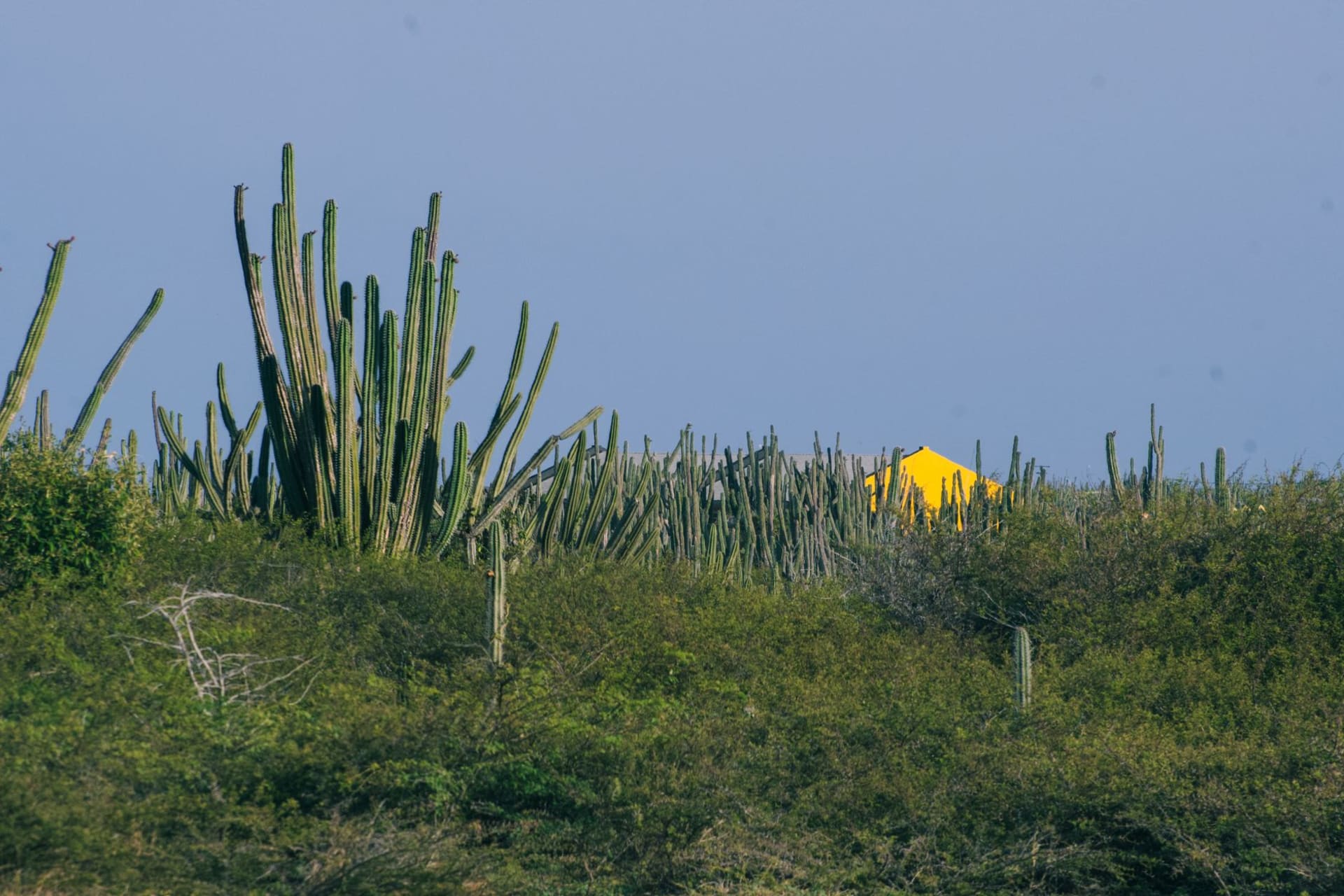
I drove there on an afternoon when I’d become vaguely sick of beauty — beach beauty specifically, the Caribbean-blue-water-and-white-sand variety that I’d been consuming for five days and that had started to feel like eating cake for every meal. I wanted altitude and effort. The parking area at the base has a small concrete shelter and nothing else. The stairs start immediately. They’re steep from the first step, traversing through the same low thorn scrub that covers the rest of the interior, and the trade wind that seems like a pleasant companion on the beach becomes purposeful at mid-height, pushing against your upper body on the exposed sections.

I reached the top in about twenty-five minutes. Not an achievement, just a pleasant physical fact. The view from the summit platform reorganizes everything. The whole island is suddenly comprehensible: the leeward western coast with its resort towers and the turquoise lens of the Caribbean beyond, the rough Atlantic east coast where the waves are visible as white lines on a darker sea, the salt pans in the south gone pink in the afternoon light, and — most affecting — the interior desert that you spend most of your Aruba time driving through without seeing from above. From here it’s a carpet of green-grey scrub interrupted by occasional red-roof farmhouses and, in the far north, the slight rise of the Hooiberg’s volcanic siblings.
On a clear day Venezuela is visible twenty-seven kilometers to the south, the coastal mountains floating just above the horizon. This was a clear day. The Venezuelan coast looked blue and substantial and entirely its own country, which of course it is, but from up here the Caribbean felt like a single shared thing with Aruba on one end and the continent on the other.

There’s a historical weight to the climb I didn’t fully appreciate until I talked to an older Aruban man on the way down — he was walking the stairs slowly, clearly not his first time. He told me that Hooiberg is where Arubans go when they need to think. That it’s been used as a lookout point since the Arawak period. That people climb it on the night before important decisions. I have no way to verify this ethnographic claim, but it felt true in the way that place-specific truths do: the mountain is the only fixed point on a flat island, the one piece of unchanging geography in a landscape defined by wind and water.
I sat at the top for forty minutes. A yellow warbler landed on the railing next to me and stayed for three minutes, which felt like an opinion.
When to go: Hooiberg in the morning, before ten, offers the clearest air for the Venezuelan coast view and the most comfortable climb. Late afternoon produces the best light on the interior landscape. Avoid the midday heat — the exposed staircase has no shade and the volcanic rock radiates. Bring water; the climb is short but the sun is direct. Any month works, but dry season (December through April) gives the clearest distant views.