Betty's Hope
"The windmills are beautiful. Understanding what they were built for makes that beauty complicated in the right way."
Betty’s Hope is off the main road east of St. John’s — you take a turn at a small sign and follow an unpaved track through scrub that opens onto a field of sugarcane, real cane, still growing on what was once one of the largest sugar plantations in the Leeward Islands. Two restored windmill towers stand at the field’s edge. They are, objectively, elegant structures — pale stone, cylindrical, the kind of form that looks like something out of a European landscape painting transplanted to the wrong latitude. It takes a moment to arrange your thinking around what they were built to process.
The plantation was established in 1651 by the Codrington family — the same family whose name is all over Barbuda — and operated on enslaved labour for nearly two centuries. At its peak it produced tens of thousands of pounds of sugar per year, which is a fact that requires arithmetic to feel: how many people, how much coercion, how many lives organised and ended in service to a commodity that Europeans wanted in their tea. The small museum in the great house ruins addresses this with more directness than I expected from a Caribbean heritage site. The interpretive panels don’t soften the mechanism or the mortality.
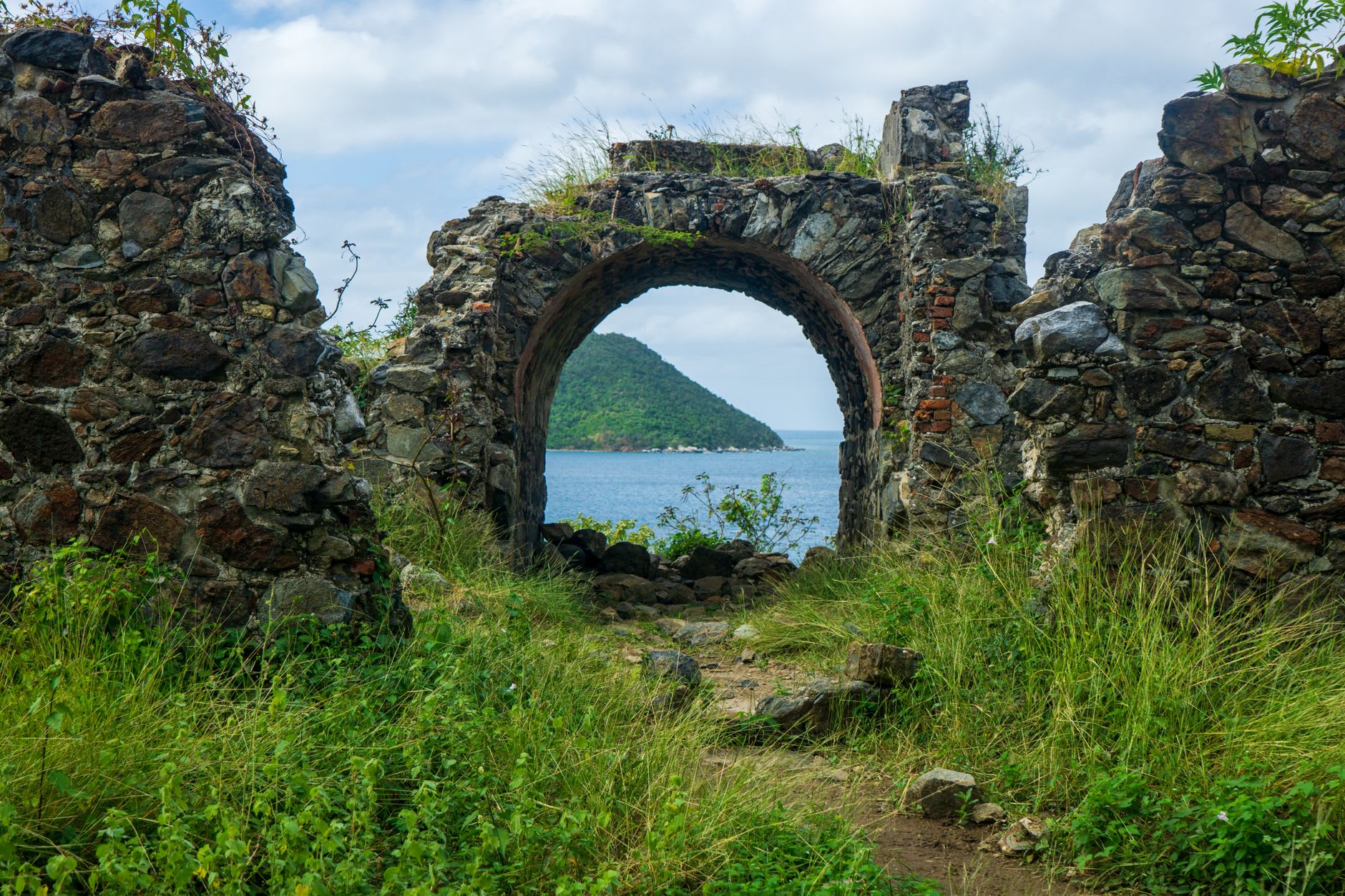
One of the windmill towers has been restored to operating condition — the wooden cap and sails can be seen in their original configuration — and a small interpretive trail around the site marks the locations of the boiling house, the still house, the slave hospital. What’s left is largely foundation and wall — the buildings didn’t survive the decline of the sugar economy and the hurricanes that followed — but the scale of the estate is apparent in the land itself. I walked the whole perimeter in forty minutes and what stayed with me was the silence of it: the scrub birds, the wind through the cane, the distance from the coast and its easy beauty.
I was one of three visitors on the morning I went, which meant I had the place essentially to myself. There’s something in that ratio — three visitors at Betty’s Hope, two hundred at Nelson’s Dockyard — that tells you something about which histories Antigua’s tourism infrastructure has made easier to absorb and which it has left at the end of an unpaved track. The naval history at English Harbour is framed as adventure; the plantation history at Betty’s Hope is framed as heritage. The distinction is worth sitting with.

The site is managed by the Museum of Antigua and Barbuda and is one of the more thoughtful heritage experiences on the island — small in ambition, specific in focus, honest about what it’s dealing with. A caretaker was there on my visit and talked about recent restoration work on the second windmill, speaking about the machinery with the technical affection of someone who had spent years understanding how it functioned. The conversation started with mill gears and ended somewhere near reparations. It was not a conversation I’d expected to have at a sugar ruin in the Caribbean on a Tuesday morning, and I’m glad I had it.
When to go: Open Tuesday through Saturday, mornings. The site is small and quiet enough that it doesn’t matter much which part of the season you visit — the plantation calendar was never the tourism calendar. Go in the morning before the heat in the interior becomes definitive, and bring water. The site has no café or vendor. Pair it with Fig Tree Drive for a day in Antigua’s interior, away from the coast entirely.