Tassili n'Ajjer
"Someone pressed a hand here in 3000 BC and I pressed mine beside it, and time did something strange and complete."
You reach Tassili n’Ajjer by driving south from Djanet until the road runs out, then continuing on foot. My guide was a Tuareg man named Moussa who had been walking these plateaus since childhood and who communicated directions almost entirely through small hand gestures and changes in pace. The plateau rises about 1,800 meters above the Saharan floor — a labyrinth of sandstone towers and corridors that the wind has spent millennia carving into shapes that look deliberate, like something an enormous patient sculptor left unfinished and then forgot about. The silence in these corridors is the first thing. It’s so complete it becomes a physical presence, something you adjust to the way you adjust to a new altitude.
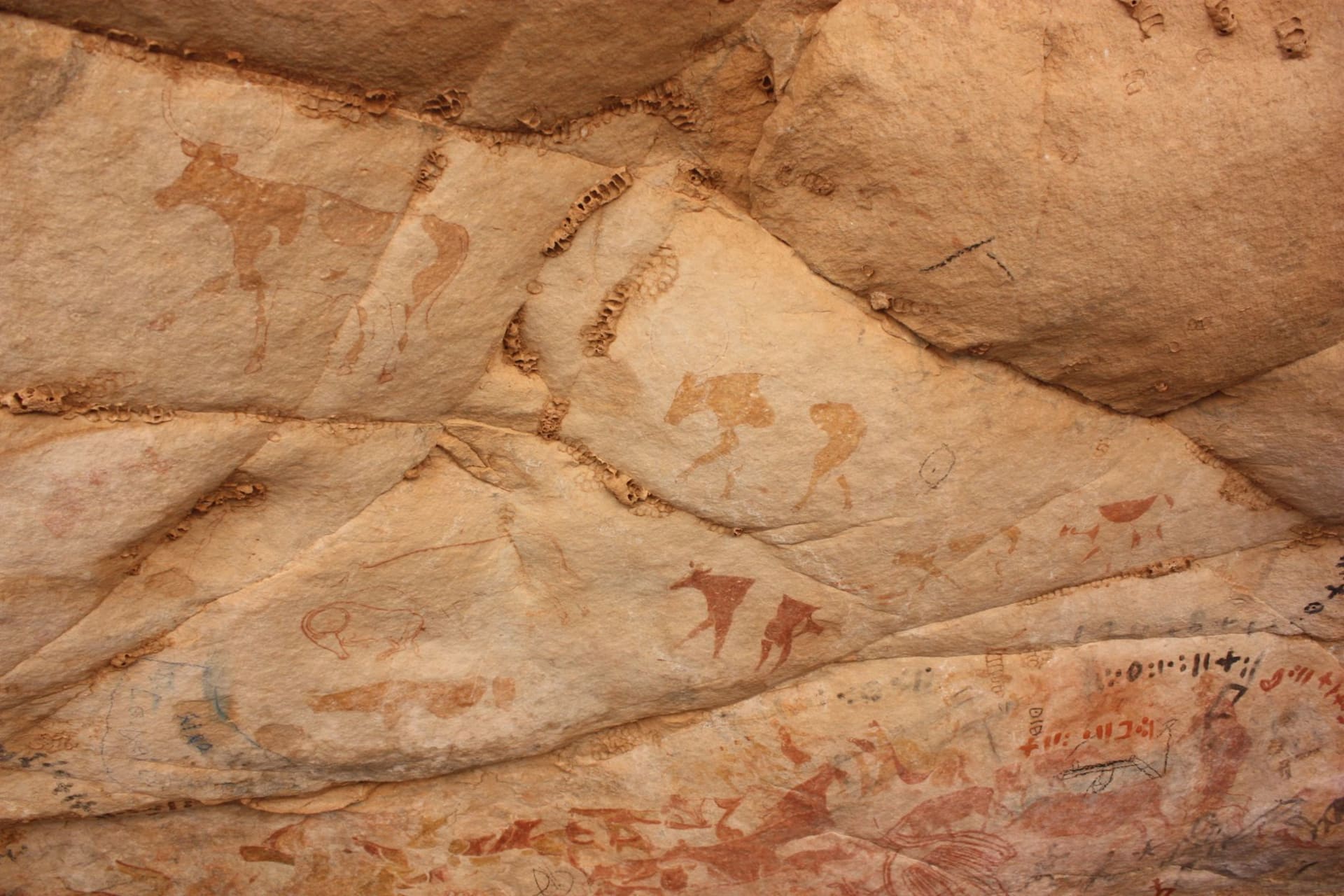
The rock paintings are what bring the handful of travelers who make it this far. Fifteen thousand images on stone, dating from roughly 10,000 BC to the first century AD — a complete visual record of a North Africa that was verdant, populated, alive in ways the modern Sahara makes impossible to imagine. There were cattle here once, and hippopotami and crocodiles and vast herds of animals that followed wet-season grasses across what is now the most arid terrain on earth. The painters recorded all of it: hunters with bows, women grinding grain, swimmers in rivers that dried up five thousand years ago. The ochre and white pigments have held in this dry air as they would hold nowhere wetter.
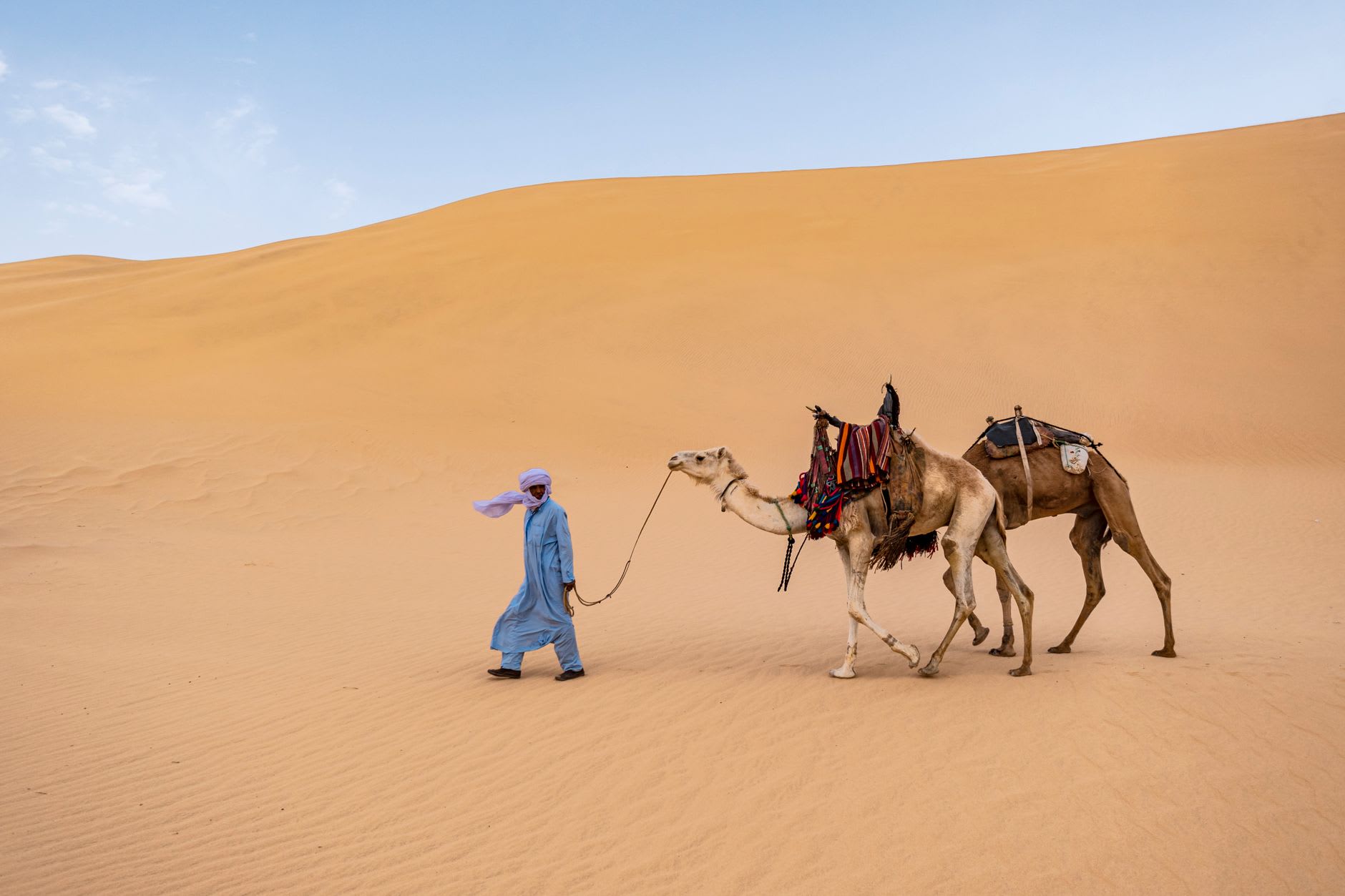
Moussa led me to a sheltered overhang on the second afternoon, shielded from the wind, and pointed at the wall. The painted hand was at shoulder height, ochre on cream-colored stone, five fingers spread, detailed enough that I could see the individual marks where the paint was pressed in harder. I stood there for a long time. Moussa squatted nearby, watching me process it, and eventually offered tea from a small gas burner he’d been carrying in his pack. The tea was sweet and cardamom-scented and necessary. He didn’t explain or contextualize what I’d seen. He didn’t need to.
What the plateau also offers, beyond the paintings, is landscape in its most fundamental form. The rock formations rise fifty meters, sometimes more, in columns that glow red-amber in the late afternoon light. Between them, the sand floors of the corridors are swept clean by the morning winds. I slept one night in a stone shelter Moussa showed me — just a rock face with a natural overhang, used by his family for generations — and watched the desert stars appear one by one in a clarity I’ve never experienced elsewhere. There are no lights anywhere below the plateau. The horizon is genuinely dark. I woke at four in the morning to check that nothing had happened to the sky, and nothing had, and it was still perfect.
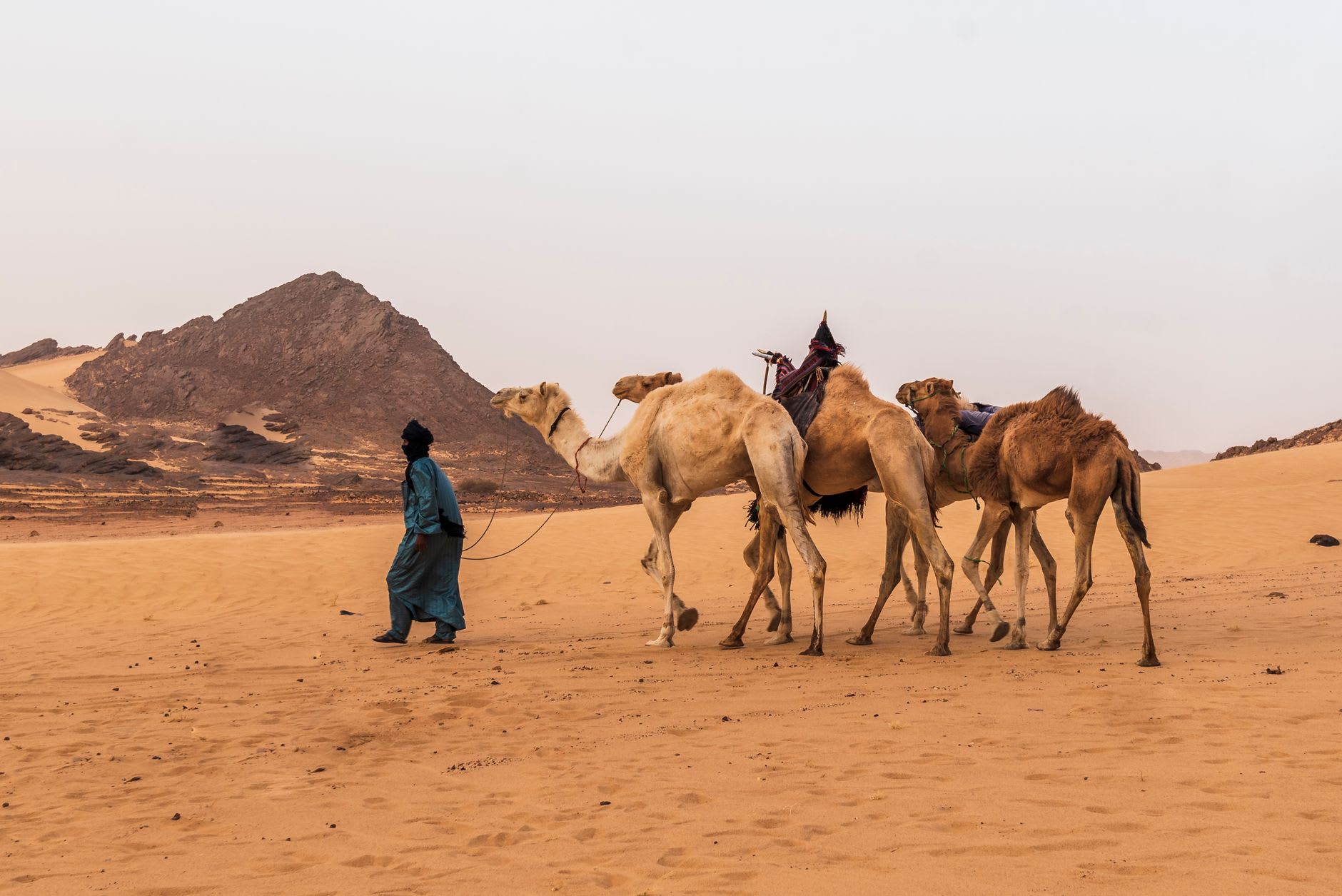
Getting here requires logistics: a permit from the Algerian authorities, a licensed guide who knows the plateau, enough water for however many days you plan to spend. The distances between shaded rest points are significant and the margin for navigational error is not comfortable. None of this is a deterrent — it’s the mechanism by which the site has stayed intact. The difficulty is the preservation.
When to go: November through February only. The plateau sits high enough that March can still be cold at night, but the real window is those four months when the air is clear and the temperature during the day stays below 25°C. Summer on the Tassili plateau is not survivable without extreme preparation and is not permitted without it.