Jasper
"In Jasper I saw a bull elk cross the main street at noon without breaking stride, and no one on the sidewalk looked especially surprised."
Jasper is four hours north of Banff on the Icefields Parkway, and the extra distance has made it a different kind of place. It has the same mountain setting, the same impossibly photogenic backdrop of rock and ice and forest, but it carries less of the resort-town self-consciousness that Banff sometimes can’t escape. The main street has a hardware store alongside the restaurants and outdoor gear shops. The locals have a different quality of patience, less accustomed to performing for visitors, more genuinely interested in talking about elk habitat or the conditions on the Skyline Trail. When I arrived in early evening, a bull elk with a full rack of antlers was standing on the median strip on Connaught Drive with the expression of an animal that has been here considerably longer than the road.
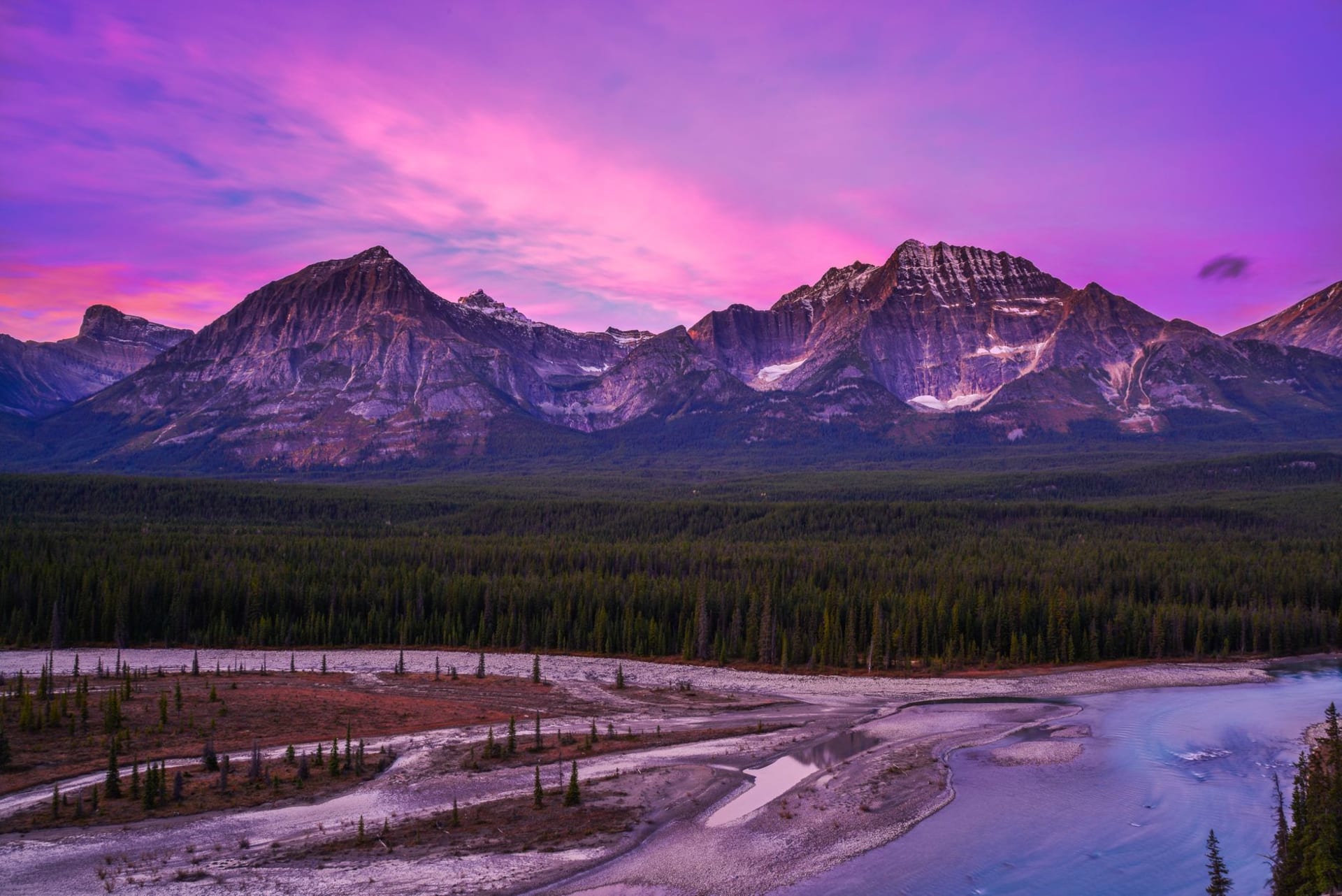
The Athabasca River runs through the valley below town in broad braided channels, grey-green from glacial sediment, shallow enough in late summer that you can wade across in spots. I spent a morning walking the river flats, watching osprey work the shallows and finding myself in a kind of absorptive silence that Jasper seems to generate more reliably than busier parks. There were other people around — it is a popular park — but the scale of the valley is such that dispersal happens naturally, and solitude arrives without much effort.

The Skyline Trail is thirty kilometres of ridgeline hiking that involves camping two nights and carrying everything you need, and it is one of the more demanding things I have done in the mountains. The high alpine sections traverse exposed tundra above the treeline with views extending forty or fifty kilometres on a clear day — Maligne Lake visible far below, the Columbia Icefield catching the afternoon light to the south, entire river systems threading through valleys that no road reaches. The descent on the second day goes through old-growth forest, the trees enormous and mossy and so quiet after the wind-blasted heights that the change feels pharmaceutical.
For something less committing, the Maligne Canyon walk follows a slot canyon carved by the Maligne River into deep limestone — the narrowest sections are perhaps two metres wide and the walls rise twelve metres overhead with the water white and loud below you. It can be done in an hour, though taking three hours and doubling back in better light makes it an entirely different experience. In winter it freezes solid and people walk the canyon floor between walls of ice, which I haven’t done but intend to.

The food situation in Jasper is honest rather than impressive — a few good options, a couple of reliable standby spots, nothing that requires a reservation weeks out. There’s a place on Patricia Street that does decent pho and stays open late, which matters after a long trail day when you need something hot and liquid and salt-forward. Locally, the thing everyone mentions is the Jasper Brewing Company, where the beer is standard craft fare but the room is warm and the mountain views through the windows do a lot of the work.
When to go: July through mid-September for the Skyline Trail and Maligne Canyon in summer condition. October for fewer visitors and elk in full rut — the bulls bugle at dawn and the sound carries through the whole valley. January and February for a dark-sky experience that Jasper takes seriously: it is a designated Dark Sky Preserve, and the Milky Way is visible on clear nights in a way that city-dwellers find genuinely startling.