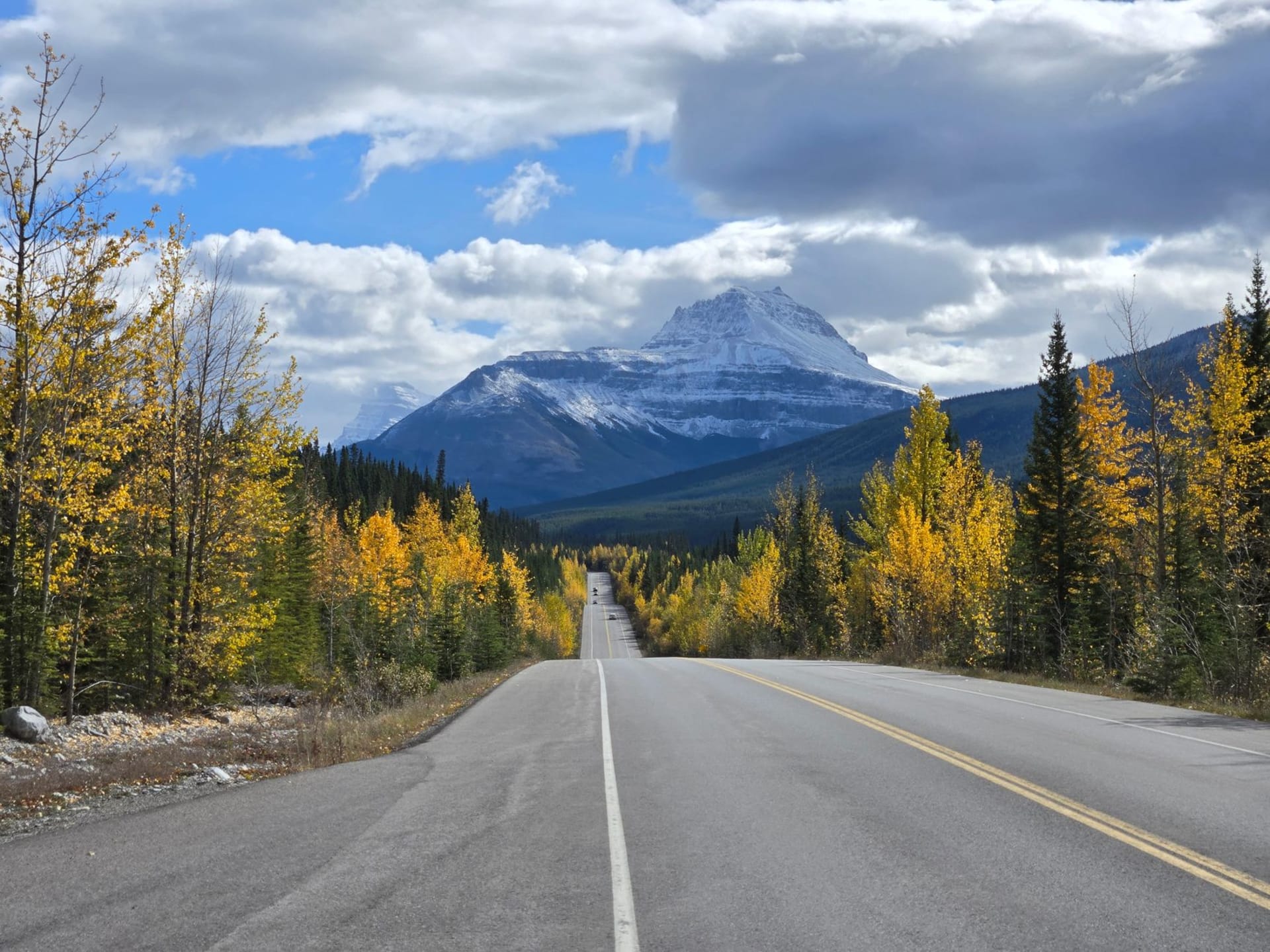
Icefields Parkway
"You don't drive the Icefields Parkway to get somewhere. You drive it because the road itself is the argument for being alive."
I left Banff at dawn on a September morning that had frosted overnight, and the road was quiet enough that I drove the first twenty kilometres without seeing another vehicle. The Bow Valley opened slowly ahead of me, mountains on both sides, the Bow River running pale blue-grey between gravel bars dusted white. The radio cut out after fifteen minutes and I didn’t try to find a signal. That radio silence held for most of the day, which felt appropriate — this is a road that asks for attention, not background.
The Icefields Parkway runs 230 kilometres from Lake Louise north to Jasper, and the designers — who laid it down in the 1930s using relief workers during the Depression — had the sense to make it slow. The speed limit is 90 kilometres per hour, the pullouts are frequent, and anyone driving it without stopping at every other viewpoint is failing to understand what the road is for. The drive can technically be done in three hours. I took nine, and it still felt rushed.

Peyto Lake is the photograph that catches people who haven’t been to Alberta — that extraordinary wolf-head shape of deep turquoise water seen from above, surrounded by spruce forest, framed by peaks. The viewpoint is crowded by 9 a.m. on any summer day. But at 7 a.m. on a September morning there were perhaps twelve people at the railing, and the lake was holding a thin mist across its surface that burned off slowly as I watched. The colour of Peyto Lake in that light — a green so saturated it seems lit from underneath — is the kind of thing that produces a specific crisis of vocabulary where no available adjective seems adequate.
The Columbia Icefield, roughly at the halfway point, is the largest icefield in the Rocky Mountains south of Alaska. The Athabasca Glacier descends from it and used to reach the road. It no longer does — markers along the trail show where the glacier face stood in 1890, in 1920, in 1950, in each decade since, and the recession is measured in hundreds of metres. Standing at the current face of the glacier, touching ice that has been compressing since before the French Revolution, the climate numbers that are abstract on a screen become something you can put your hand on.

North of the icefield the road enters the upper Sunwapta Valley and the character changes slightly — the mountains get bigger and the valley gets narrower and the spruce forest closes in. Sunwapta Falls appears without warning, a short trail off the road to a canyon where the Sunwapta River drops in two stages through a slot of brown limestone. The sound is the first thing — a deep bass rumble that you feel in your chest before you see anything. Then the spray, cold enough to make you step back. I ate lunch on a rock above the upper falls and watched a family try to get the perfect family photograph, which took twenty minutes and probably involved arguing later.
The road ends, or begins depending on direction, in Jasper, and the elk were in the meadows outside town as I arrived, grazing in the grey evening light with the casual indifference of animals that have no reason to move for anything.
When to go: Mid-June through September for the full experience with all viewpoints accessible. September is optimal — low traffic, October larches visible from the road near Lake Louise, and the light has that particular cold clarity of early autumn. The road stays open year-round for winter driving, though chains or winter tires are required. Driving it in snow, with the peaks blanketed and the valley floors white, is a completely different and equally valid experience.