Drumheller
"Nothing in the Canadian Rockies prepared me for Drumheller — this is a different kind of ancient, one measured not in glaciers but in bones."
I drove east from Calgary on a flat highway for ninety minutes with nothing to indicate that anything unusual was coming, and then the road dipped over a rim and the entire landscape fell away below me in a single revelatory moment. The Drumheller badlands opened beneath my wheels — a deep incised valley carved by the Red Deer River, its walls layered in stripes of rust and grey and cream, the floor studded with hoodoos, the whole thing lit by a late afternoon sun that made the eroded formations glow like something from a geology textbook’s dreams. I pulled over immediately, not because I had planned to but because continuing past it felt like a failure of attention.
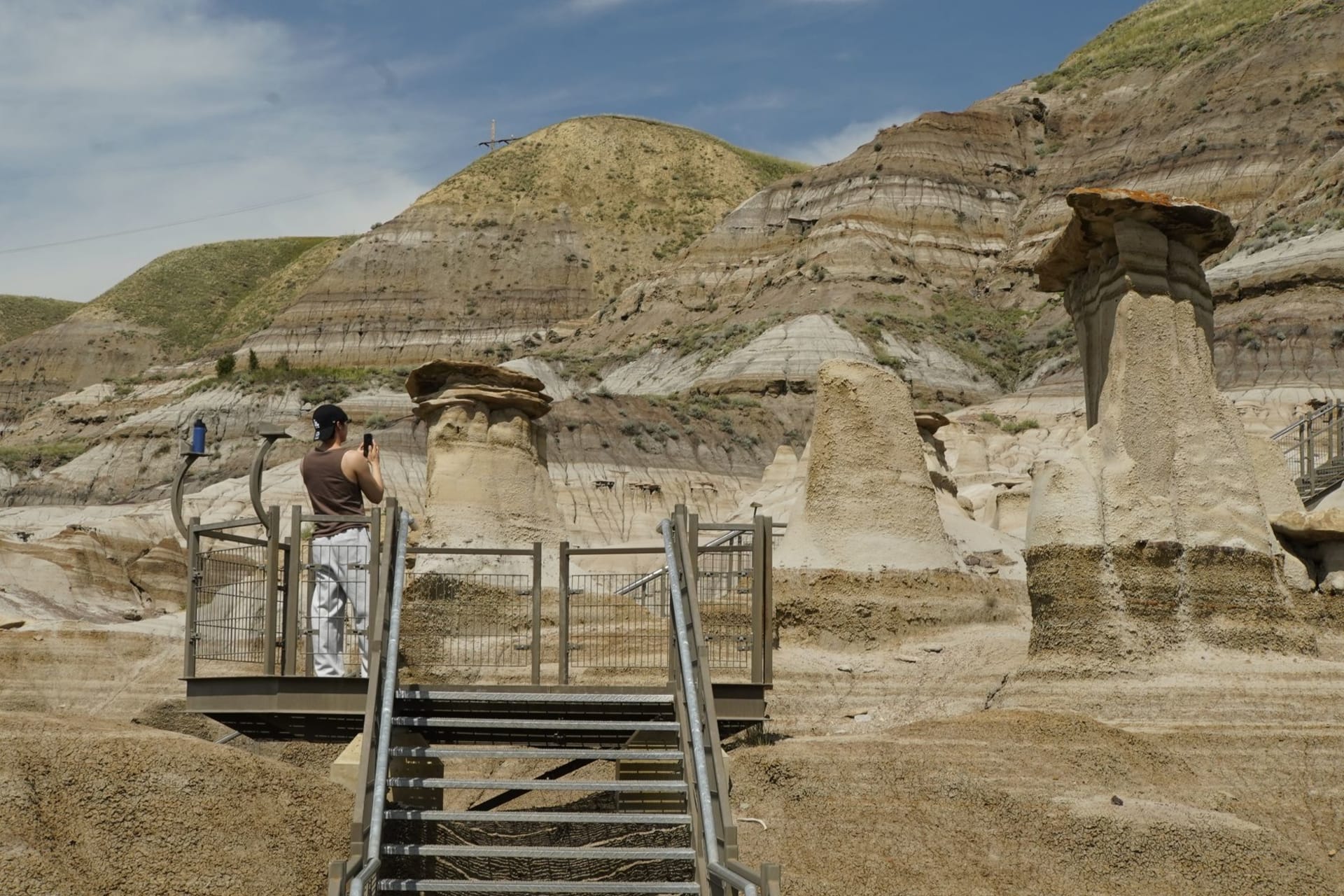
The hoodoos are the thing that photographs keep attempting. They’re columns of soft sandstone and mudstone topped by harder caprock that protects the softer material underneath — the surrounding material erodes away and what’s left are these tall mushroom-shaped pillars, sometimes capped with a balanced stone that seems structurally improbable. They range from two metres to fifteen metres tall, and walking among them in the morning before the tour buses arrive gives you a specific sensation of scale — your own smallness relative to geological time, the millions of years it took the Red Deer River to cut this valley and expose what was hidden inside.

What’s hidden inside is dinosaurs. The Cretaceous badlands of the Red Deer River valley are among the richest dinosaur fossil deposits in the world, and the Royal Tyrrell Museum of Palaeontology in nearby Midland Provincial Park holds one of the most significant collections of prehistoric life on the planet. I spent four hours there and could have spent eight — the mounted skeletons are extraordinary, the Albertosaurus and the Pachyrhinosaurus and the armoured Edmontonia, but what got me was the preparation lab, where I could watch paleontologists working at tables, brush and dental tools in hand, slowly liberating bone from the surrounding matrix. The work is patient in a way that makes other professional patience seem hurried.
The town of Drumheller itself has committed hard to its dinosaur identity — there is a world’s largest fiberglass dinosaur at the tourist information centre that you can climb inside and view the valley from its mouth, which sounds gimmicky and is gimmicky but also delivers a genuinely good view. The Atlas Coal Mine, a short drive away, preserves a tipple and a series of buildings from the coal era that ran parallel to the dinosaur era in terms of the valley’s economic importance. Standing in the old mine buildings with the badlands visible through the windows is a particular combination of industrial history and geological spectacle that doesn’t occur very many places.

The Horseshoe Canyon, about fifteen kilometres west of Drumheller, is where I would go first on a return visit. It’s a smaller, quieter version of the main valley, accessible by a rim trail and a steep descent path that takes you into the canyon floor. The colours there — burgundy and cream and pale green from the mineral content of the layers — are more varied than the main valley, and on a weekday morning I had the floor largely to myself, walking among formations that are technically eroding away year by year, each rainstorm washing a little more of the past into the river.
When to go: May through October, avoiding the heat of July and August which can push the valley floor past 35°C. September is excellent — warm days, cold mornings, and the cottonwood trees along the river bottom going gold. The museum is worth a full day regardless of season. Combine with a night in Drumheller rather than day-tripping: the valley at sunset and sunrise shows colours the midday light entirely misses.