Dinosaur Provincial Park
"You drive across flat wheat for an hour and then the ground just opens, and seventy-five million years are lying there in the dirt."
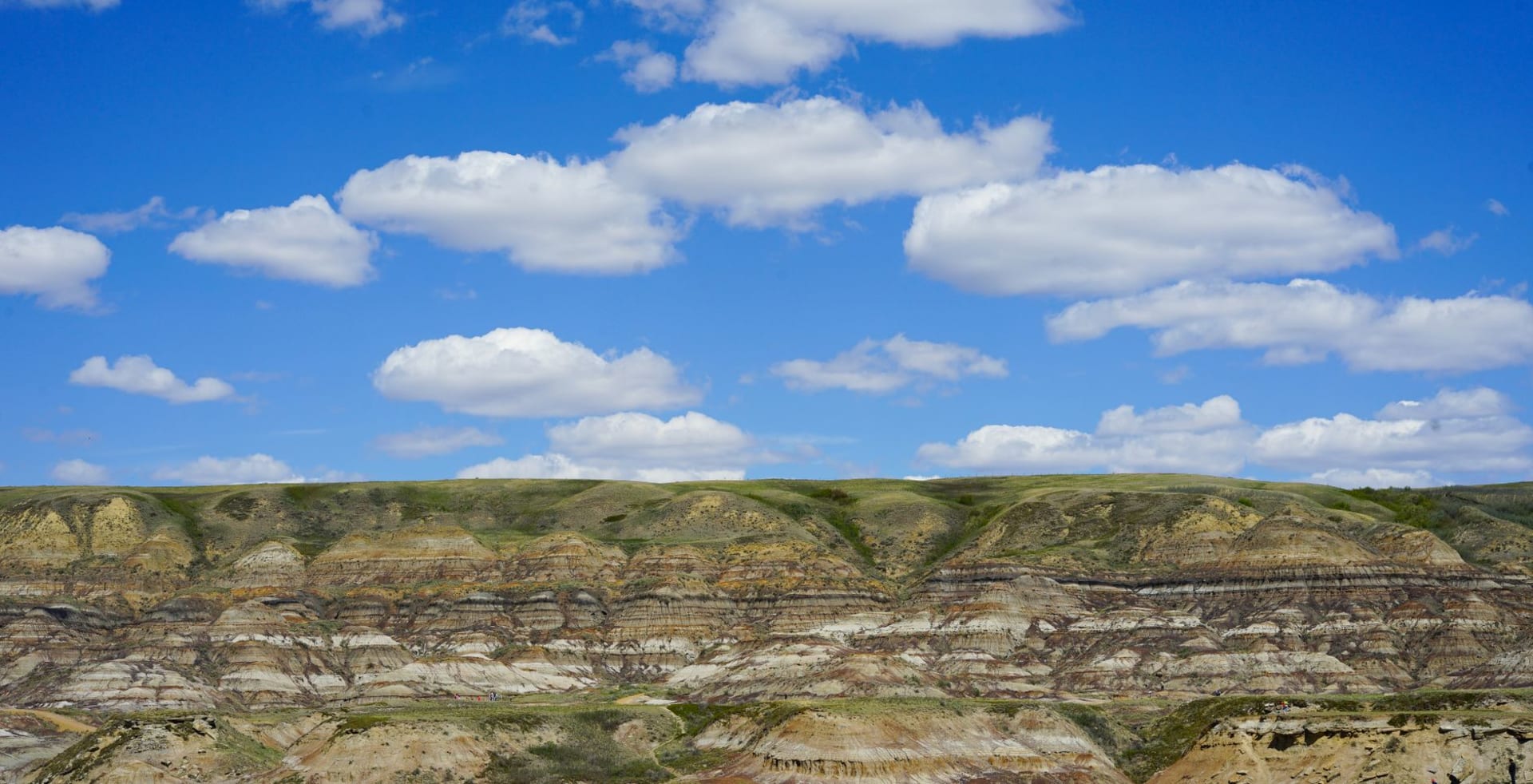
The drive to Dinosaur Provincial Park is the best part of the arrival, though it doesn’t look like it for most of the way. You leave the Trans-Canada near Brooks and head out across prairie so flat and so agricultural that I started to suspect I’d misread the map. Then, with no warning, the road tips over an edge and the whole world drops away into the Red Deer River valley — a labyrinth of grey and ochre hoodoos, dry gullies and striped sediment that looks like it belongs on another planet entirely. Lia, who had been asleep against the window, woke up, looked out, and said only, very quietly, that this was not what she had been promised by Alberta.
The richest dinosaur ground on Earth
This is not a place that merely has dinosaurs; this is one of the places that defined how we understand them. The park, a UNESCO World Heritage Site, has produced fossils of more than fifty dinosaur species, and the digging is still going on. Most of the badlands are a restricted natural preserve you can only enter on a guided hike or bus tour, which felt restrictive until I understood why — people were quite literally walking off with the place. On the public loop trails you can wander freely, and even there I crouched down at one point and realized the small grey fragments in the path were not stones at all but weathered bits of fossilized bone, lying around like loose change.

I booked a guided hike into the preserve, two hours with a young palaeontology student who had the specific, infectious enthusiasm of someone who genuinely could not believe they were being paid to do this. She showed us a hadrosaur bone bed still half-buried in a slope, a jacketed specimen waiting to be lifted, and the exact way the rock layers record the rivers and floodplains of the late Cretaceous. The detail that stuck with me was small: she pointed out that the dark bands are ancient swamp soils, and that the whole valley was once a humid, subtropical coast. Standing there in the dry Alberta wind, that was almost impossible to hold in my head.
Heat, hoodoos and a tin trailer
I will be honest that the badlands in midsummer are a furnace. The grey clay holds the heat and throws it back at you, there is essentially no shade, and the official advice to carry far more water than feels reasonable is correct. We hiked the short Badlands Trail in the late afternoon precisely to avoid the worst of it, and the low light did extraordinary things to the hoodoos, picking out every ridge and runnel in gold and shadow. A mule deer watched us from a ledge with frank indifference.

We stayed in the park’s small campground down by the river, in the cottonwoods, where the temperature finally broke after dark and the sky filled with more stars than I’d seen in years. There’s a comfort station, a visitor centre with a genuinely good little museum, and not much else, which is exactly right. In the morning a coyote crossed the road in front of the car, unhurried, and disappeared into the hoodoos as if it had somewhere ancient to be.
When to go
May, June and September are ideal — warm but not punishing. July and August are very hot and you should hike early or late and carry serious water. Book guided hikes well ahead in summer, as they sell out, and the river-bottom campground is worth reserving for the cool nights and the stars.