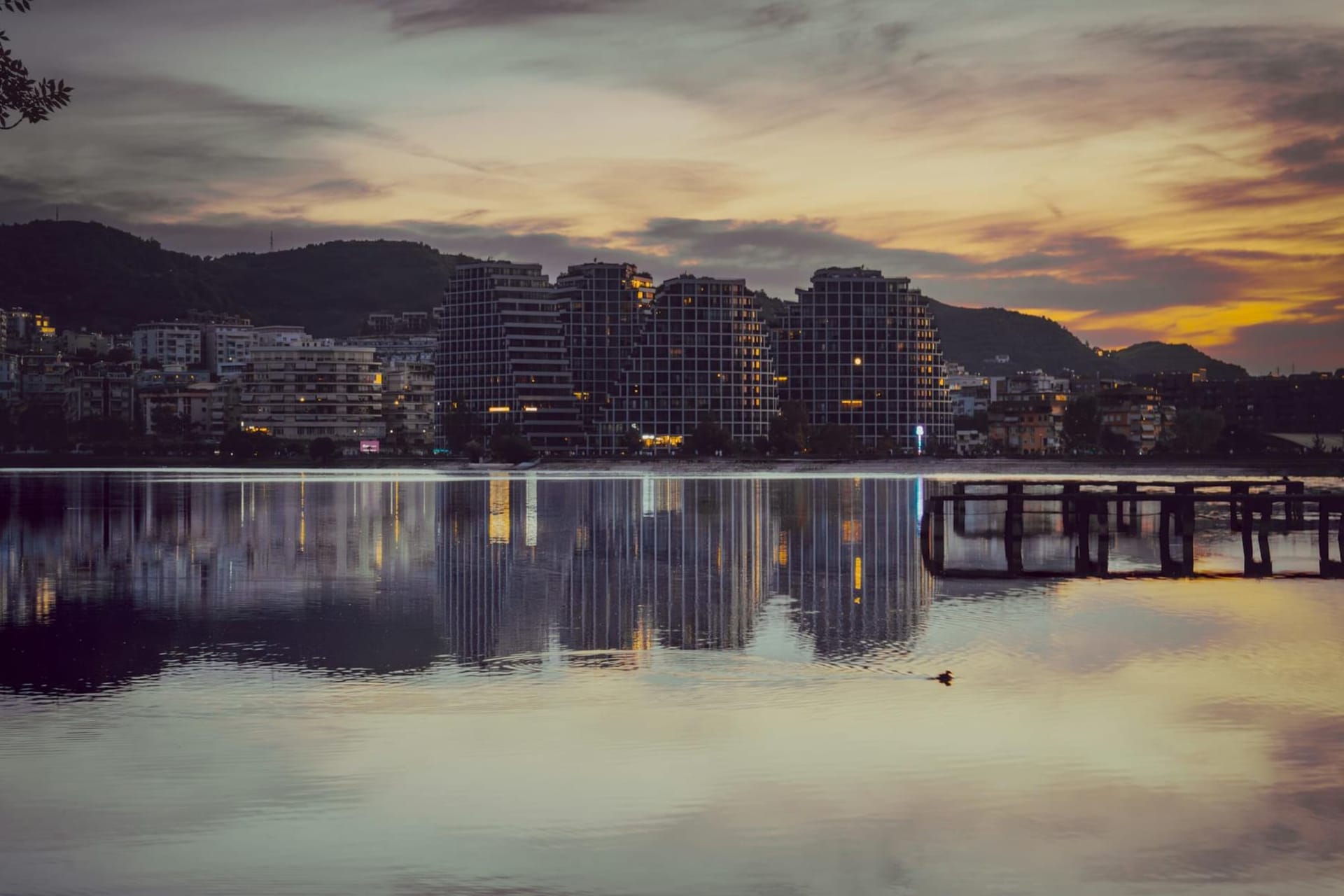
Painted in colors to banish communist gray, Albania's lively capital has reinvented itself into one of Europe's most surprising cities.
I arrived expecting a city still shaking off its gray. What I found instead was one that had moved on so completely that the gray had almost become myth — a reference point, not a wound.
The first thing that hits you on Rruga e Kavajës is not the color, though the color is everywhere. It is the noise. Horns, the hiss of an espresso machine through an open door, two men arguing beautifully over nothing in particular, a moped threading between them without either flinching. Tirana is alive in the way that cities with something to prove tend to be — fast, loud, and genuinely pleased with itself.
Blloku and the Pleasure of the Unlocked Gate
For decades, the neighborhood called Blloku was sealed off — reserved for the communist elite, walls and guards and silence. Now it is where the city drinks its afternoon coffee. Lia and I spent an entire afternoon doing exactly that, moving from café to café along Rruga Ismail Qemali, each terrace more packed than the last. The Albanian tradition of taking one’s time over a single espresso has survived every regime. Nobody rushes here. The sun cuts sharp between the painted buildings and everyone just sits in it, unhurried.
We ate byrek — the flaky savory pastry you find everywhere, stuffed with spinach and white cheese — from a bakery so small there was no room to stand inside. We ate it on the curb. It cost almost nothing and tasted of warm butter and necessity.
Skanderbeg Square at the Wrong Hour
Every guidebook will tell you to see Skanderbeg Square. What they will not tell you is to go at dusk on a weekday, when the tourists have left and the locals come out to walk loops around the fountain with no particular destination. The Et’hem Bey Mosque glows pink in that light, its minaret catching the last sun above the socialist-era buildings that ring the square. The National History Museum’s mosaic facade — enormous, Soviet in scale, depicting heroic Albanians through the centuries — felt, in that light, less like propaganda and more like grief processed in tile.
I had not expected to feel anything in front of it. That was the surprise.
What Nobody Mentions
The bunkers. They are everywhere — small concrete mushrooms embedded in hillsides, in parks, beside roads. Enver Hoxha had 173,000 of them built across the country, one for every few dozen citizens. In Tirana they have begun to repurpose them: a coffee kiosk, an art installation, a storage shed. It is an entirely Albanian solution — not erasure, not monument, just practicality applied to the absurd.
When to go: April through June offers mild temperatures and long evenings perfect for the café culture that defines the city. September and October are equally good, with thinner crowds and a golden quality to the light that makes the painted facades look like they were always meant to be this way.