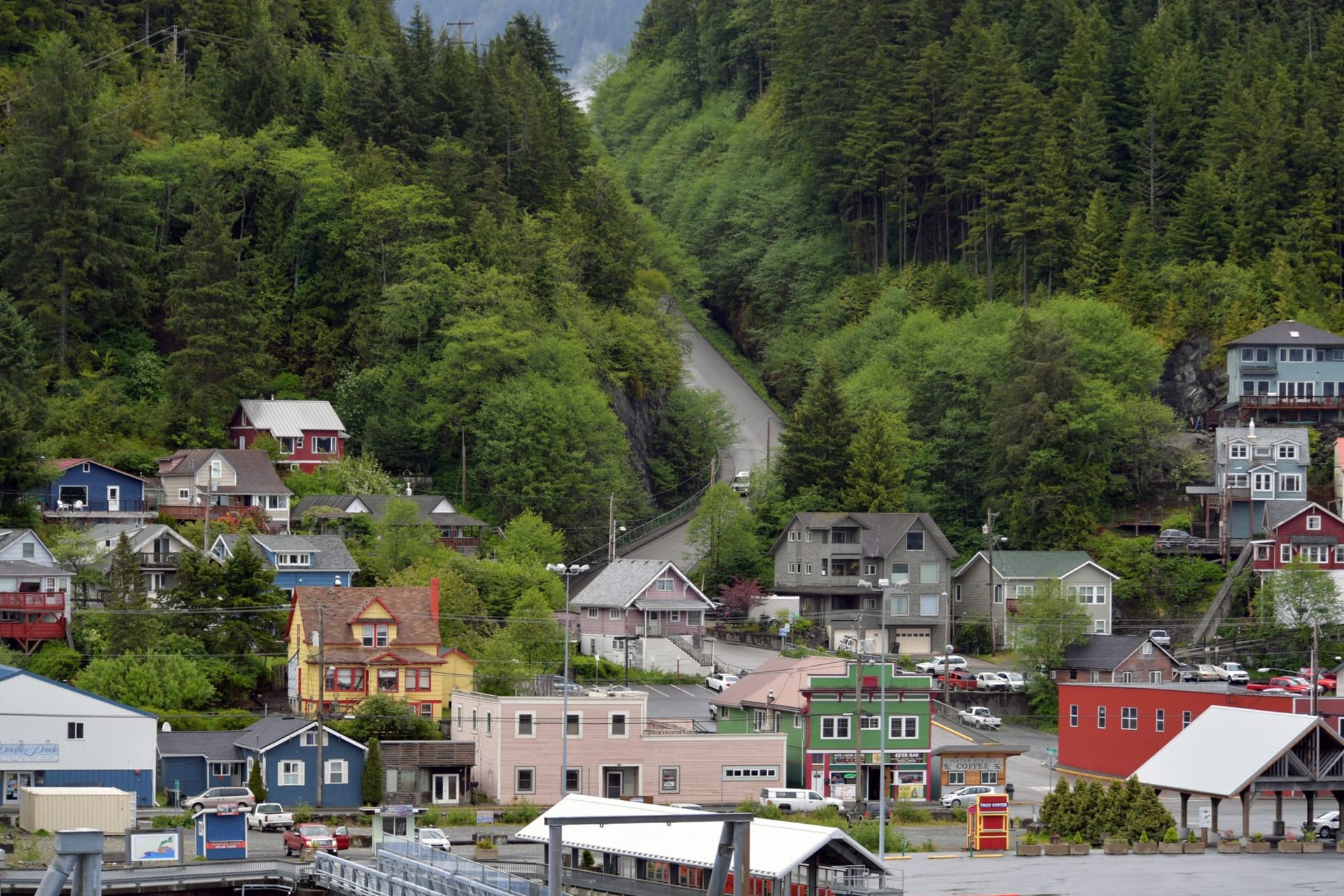
Ketchikan
"It rains here 160 days a year and nobody apologizes for it — that's how you know you're somewhere real."
Ketchikan is the first Alaskan port on the northbound Inside Passage, and it announces itself with rain. Not dramatic rain, not the kind of rain you can argue with — steady, grey, salt-flavored rain that falls with the equanimity of something that has always been here and will still be here when you leave. I stepped off the ferry in it and walked up to Creek Street, which is a boardwalk built on stilts directly over Ketchikan Creek, where the buildings lean out over the water at angles that suggest the original architects were optimistic about structural tolerance. The creek runs fast and clear below the boards, and in July it runs with sockeye salmon — thousands of them, pushing upstream, red and urgent — and watching them from above through the gaps in the planking is one of those experiences where you feel briefly connected to something cyclical and enormous.
Creek Street was, until the 1950s, the city’s red-light district — a floating economy of brothels and bars that served the cannery workers and fishermen who moved through the port. The building called Dolly’s House is preserved as a small museum, the personal effects and furnishings of its last madam left in place with a matter-of-fact honesty that I appreciated. There’s no shame in the telling, no excessive moralizing — just the story of people who were somewhere specific, doing what they could. The rain outside seemed fitting.
The totem poles are what Ketchikan is most formally known for, and the Totem Heritage Center holds the largest collection of standing 19th-century poles in existence — removed from abandoned Tlingit and Haida villages for preservation, housed in a climate-controlled building where you can walk among them at close range. The scale and intricacy of the carving is difficult to process. These are not decorative objects. Each pole encodes family history, clan rights, significant events — a genealogical and political record in wood, translated by people who knew what they were saying. The center also runs workshops where you can watch contemporary carvers working in the same tradition.

The eating in Ketchikan is honest and fish-forward. I had fish and chips made with halibut so fresh it had the texture of something that had been in water that morning — which it had — at a counter place with plastic chairs near the ferry terminal. The salmon jerky sold in the small market near the harbor is genuinely addictive, the kind of thing you buy one bag of and then go back for two more. The coffee is better than you’d expect and served with the velocity of a town that runs on an early schedule.
When to go: May through September. The rain is real and present in every month, so bring gear rather than hope. July brings the salmon run and the highest visitor numbers. Late May and early June have a fresh green quality to the rainforest that’s worth the relative unpredictability of the weather.