Eckerö
"The empire spent three times what the building was worth just to make a point at the edge of the world."
There is a building in Eckerö that has no business existing where it does. The Post and Customs House — Posten, as everyone here calls it — was built in the 1820s on the order of the Russian empire as the staging point for postal routes between St. Petersburg and Stockholm. It is a full neoclassical affair in imperial yellow, with a porticoed facade and proportions that would not embarrass a provincial capital building. It stands on the western shore of the island of Eckerö facing open Baltic water and a horizon with nothing between it and Sweden, and it looks like a piece of civic architecture that got separated from its city and wandered here alone. I stood in front of it for a long time trying to understand how anyone decided to build this here, and concluded they were sending a message to the Swedes: we have resources to burn even on the edge of nowhere.
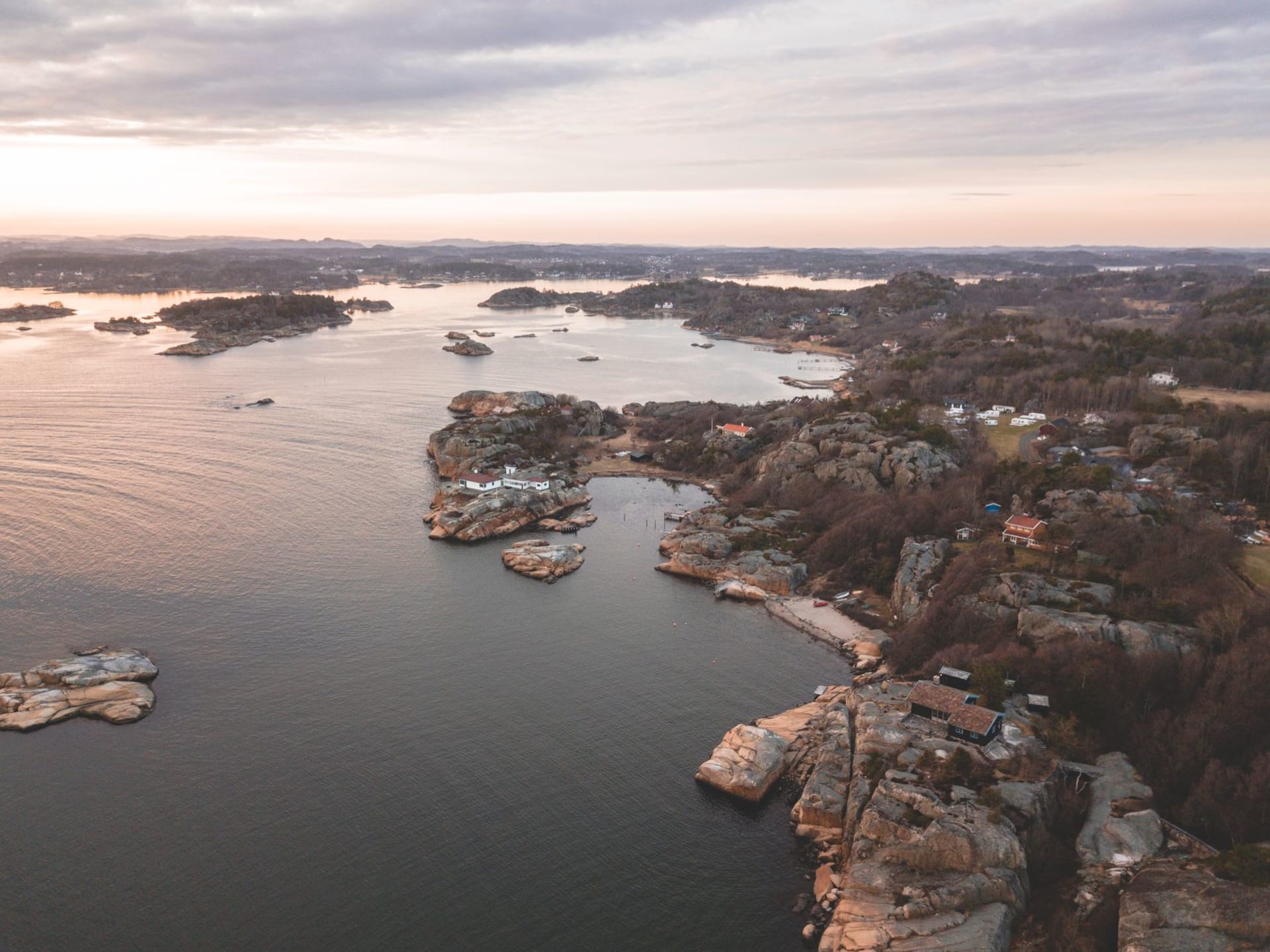
Eckerö is the westernmost municipality of Åland and, by extension, the westernmost point of the entire European Union — a fact the locals mention with a kind of dry pride, as though they’ve been handed an odd distinction and decided to make peace with it. The main island itself is small and flat, with the characteristic Ålandic combination of granite, birch forest, and water. But the western exposure gives it weather that the main island doesn’t get: Baltic weather, arriving direct from the open sea without any intervening islands to take the edge off. I felt this difference in my bones.

The Hunting and Fishing Museum, housed in a series of converted buildings near the old post house, turned out to be unexpectedly absorbing. The hunting culture of the outer archipelago — subsistence-based, centered on eider ducks, seals, and coastal fishing — has its own vernacular material culture: handmade wooden decoys, traditional rowing boats with distinctive hull shapes, nets made from plant fibers. The exhibits don’t aestheticize these objects; they explain how they worked and why they were made that way. I spent an hour in there and came out knowing more about eider duck hunting than I had ever planned to know, and found I didn’t mind.
The beach at Degersand, a few kilometers south of the post house, is one of the longest stretches of sand in Åland — a real beach with real waves arriving off the open sea, not the sheltered coves you find elsewhere in the archipelago. On the afternoon I went, the wind was from the southwest and the sea had a genuine chop, the waves breaking in a proper line. Two old men were swimming in a way that suggested they did this every day regardless of conditions, and afterward sat on a rock sharing a thermos of something. I went in briefly, emerged immediately, and watched them with a mixture of admiration and disbelief.

The ferry from Sweden arrives at Eckerö rather than Mariehamn — it’s the shorter crossing — and most passengers drive straight through to the capital without stopping. This is a reasonable decision logistically and a pity aesthetically. Eckerö repays a morning at minimum: the post house, the beach, the museum, and a walk along the western shore at sunset when the light lands on the water in a way that makes the horizon look backlit from below.
When to go: May through September works, but midsummer — June 20 to July 10 — is when the western light is at its most extreme, staying above the horizon until almost midnight and creating hour-long sunsets that hit Degersand beach from a perfect angle. The ferry connection from Sweden via Eckerö also makes it the logical entry point if arriving from the west.