Bodrum
"At 7am the fishermen are already back. By midnight the bar terraces are still full. Nobody seems to find this contradictory."
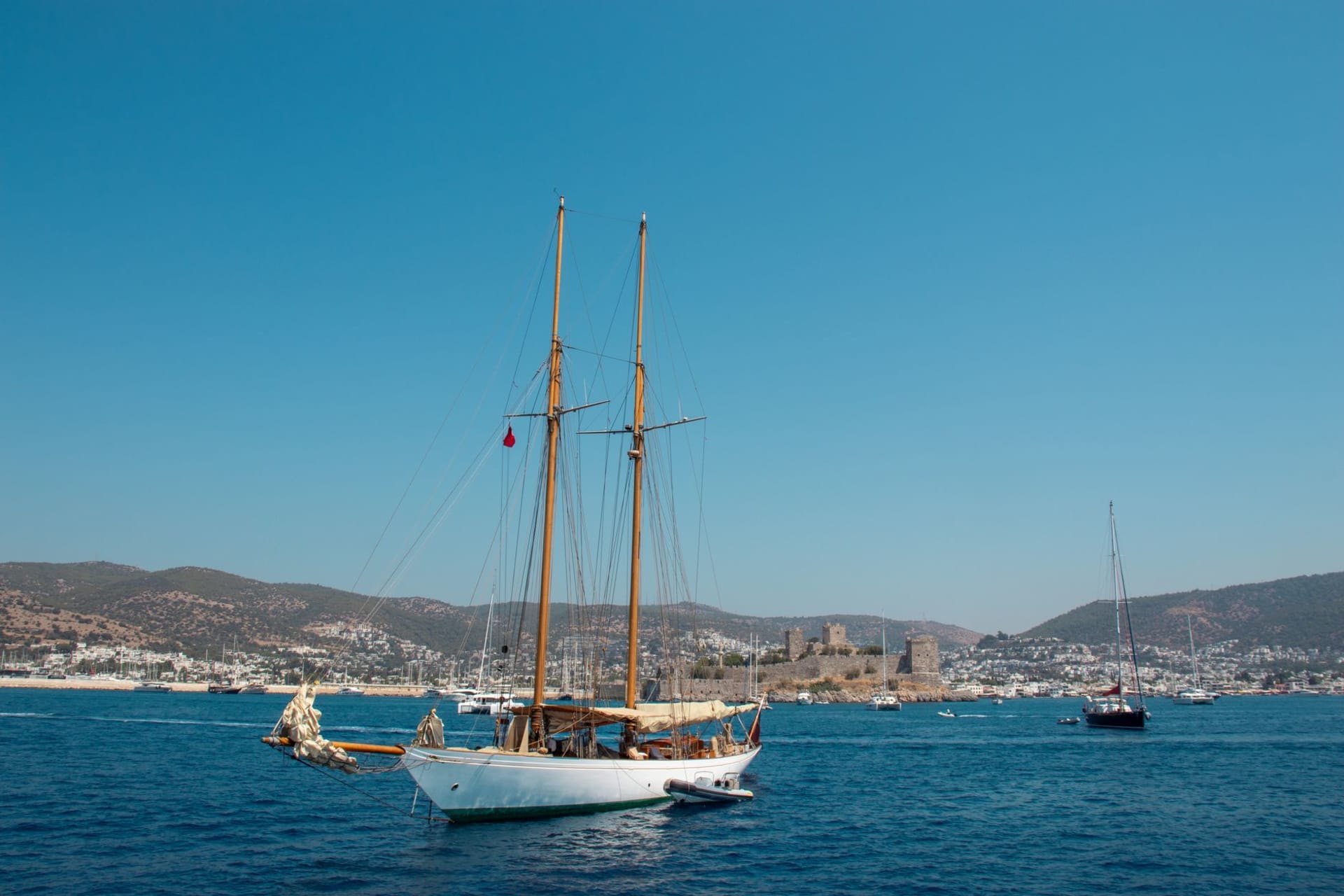
We sailed in on a morning that smelled of dried thyme and diesel and something faintly floral off the hills — and the contrast with the Greek islands we’d come from was immediate. Bodrum is rawer, louder, less managed. The marina was already arguing with itself when we docked, competing radio stations bleeding together from waterfront restaurants, a fisherman mending nets with the focused calm of someone who has learned to tune out everything. The Castle of St. Peter rose on its promontory above all of this, impassive, built from stones raided from the Mausoleum at Halicarnassus — which is to say that what the Knights of Saint John constructed here was partly assembled from one of the Seven Wonders of the Ancient World. Bodrum has always known how to repurpose things.

The castle now houses the Museum of Underwater Archaeology, which I expected to walk through in twenty minutes and instead spent three hours in. The Bronze Age shipwrecks recovered from the floor of the Aegean are displayed with meticulous care — amphora stacks and copper ingots and the ghostly outlines of hulls that sank three thousand years ago. Outside again, the old fish market is in full morning swing by the time the museum opens: silvery sea bream in rough wooden crates, women haggling with a focused intensity that makes price negotiation feel almost ceremonial. I bought a kilo of anchovies I had nowhere to cook and ate them that evening at a plastic-tabled meyhane where nobody spoke any language I understood and the house wine came in a ceramic pitcher and cost almost nothing.
The gulet yards down the coast from the main harbor are where Bodrum’s other identity lives. These heavy wooden sailing vessels — some of them thirty meters long, built by families who have been doing this for generations — are assembled and repaired on dry land, the smell of teak shavings and marine varnish hanging in the summer heat. There is something deeply satisfying about watching craftsmen work at this scale, fitting planks of wood to a hull with a precision that computers have not yet made redundant.

The nightlife is real and it is not subtle. Bar Street delivers exactly what it promises. But Bodrum has always been two cities — the loud one on the waterfront and the quieter one on the hillsides, where old Greek houses with bougainvillea-smothered walls sit behind wooden shutters. The writer Cevat Şakir Kabaağaçlı — known as the Fisherman of Halicarnassus — is buried here, and the white-cube aesthetic that defines the town’s architecture owes much to his eccentric advocacy for simplicity. Wander up into the back streets in the early morning and you will find that quieter Bodrum still breathing.
When to go: May and June for perfect warmth without the full crush; September is the most comfortable month after the summer peak. July and August are intense — hot, busy, and expensive — but the energy has a particular quality that some people find irresistible.