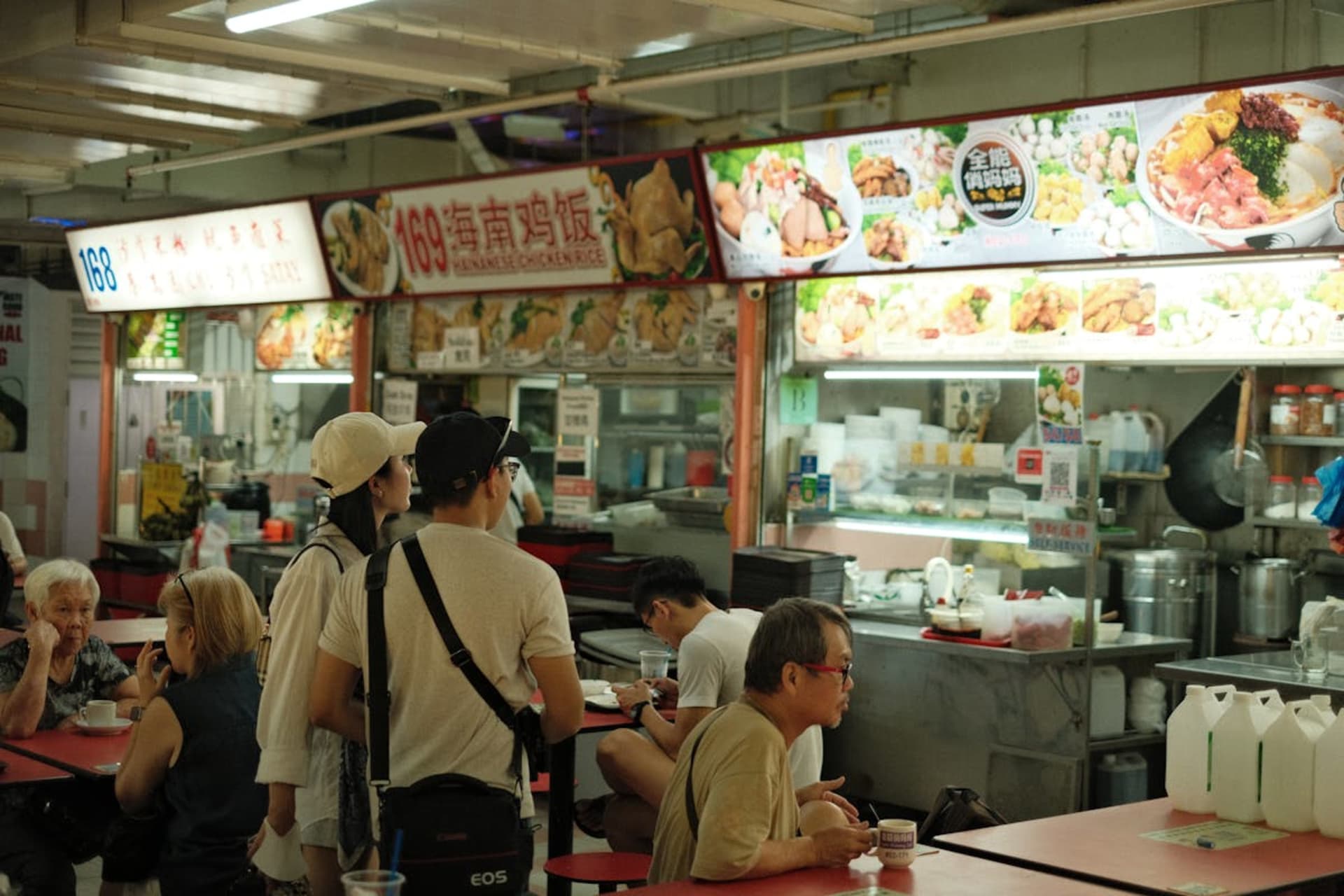
Five Days Eating Through Singapore's Hawker Centres
Why Singapore
I had been circling Singapore for years the way you circle something you know will rearrange your understanding of a subject. I write about food constantly — Mexico’s tacos, Portugal’s petiscos, Japan’s izakayas — and everyone I trusted kept saying the same thing: you need to eat in Singapore. Not dine. Not sample. Eat. The distinction matters. Singapore does not want you to have a tasting menu experience of its food culture. It wants you to sit on a plastic chair in an open-air food court and eat a plate of chicken rice that costs less than a coffee in Paris and that will make you question every meal you have paid more than five dollars for.
So in October 2025, Lia and I flew from Mexico City to Changi Airport — twenty-two hours of travel compressed into a blur of airline meals and turbulence — and stepped into the humid, orderly, faintly jasmine-scented reality of a country that has turned feeding people into an art form, a government policy, and a UNESCO-inscribed tradition. We had five days. I had a list of hawker centres. Lia had a list of temples. Between us, we covered a lot of ground.
Day One: Maxwell and the First Lesson
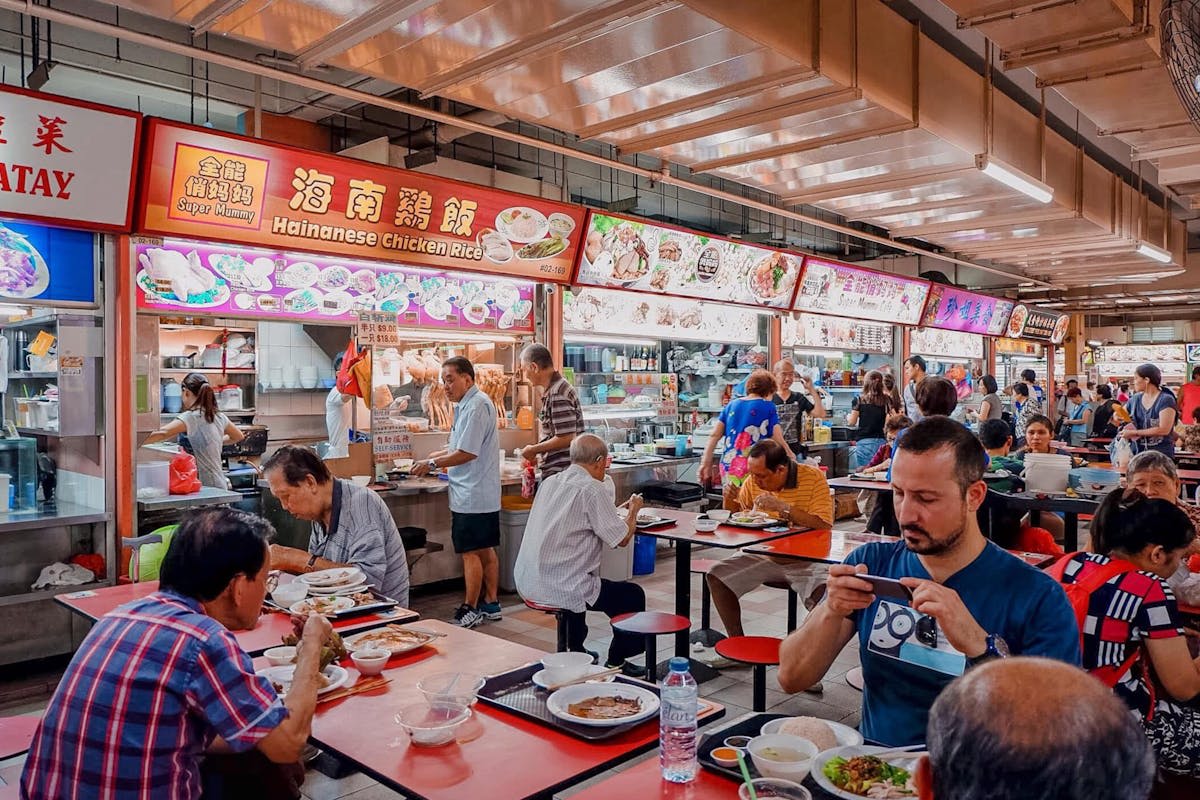
We dropped our bags at the hotel in Chinatown and went straight to Maxwell Food Centre, because the best cure for jet lag is refusing to acknowledge it and the second-best cure is chicken rice. The queue at Tian Tian was eighteen people deep at 11:30 in the morning, which in any other context would have made me reconsider, but in Singapore queues are endorsements — the longer the line, the better the food, and the locals who have been eating here for decades do not queue for sentiment.
The chicken arrived on a white plate: poached, pale gold, glistening. The skin had a gelatin layer beneath it that spoke to technique — the bird had been plunged into ice water after cooking, a Hainanese method that gives the skin its particular texture. The rice was fragrant with chicken fat and pandan leaf, each grain separate and aromatic. The chilli sauce — sambal and ginger, served in small dishes — elevated everything it touched. Three dollars fifty. I sat at a plastic table surrounded by office workers on their lunch break and ate in silence, because the plate demanded it.
The second stall was a roasted meat place — char siu and roast pork on rice, the pork crackling so crisp it shattered between my teeth and the char siu glazed with a maltose sweetness that was balanced by the soy and five-spice underneath. Four dollars. I was beginning to understand the economics of this country. The third stall was dessert: chendol, a bowl of shaved ice with coconut milk, pandan jelly, and gula melaka syrup that tasted like caramelized palm sugar and tropical rain. Two dollars. Lia and I shared it and agreed that we had eaten better in two hours than in most entire days in most entire countries.
That afternoon we walked Chinatown — the shophouses, the Buddha Tooth Relic Temple, the Sri Mariamman Temple — and I kept thinking about how the food and the architecture were telling the same story: layers of migration, adaptation, and refinement, Chinese and Indian and Malay and British traditions compressed into a few square kilometres and producing something that none of them could have produced alone.
Day Two: Old Airport Road and the Char Kway Teow Epiphany
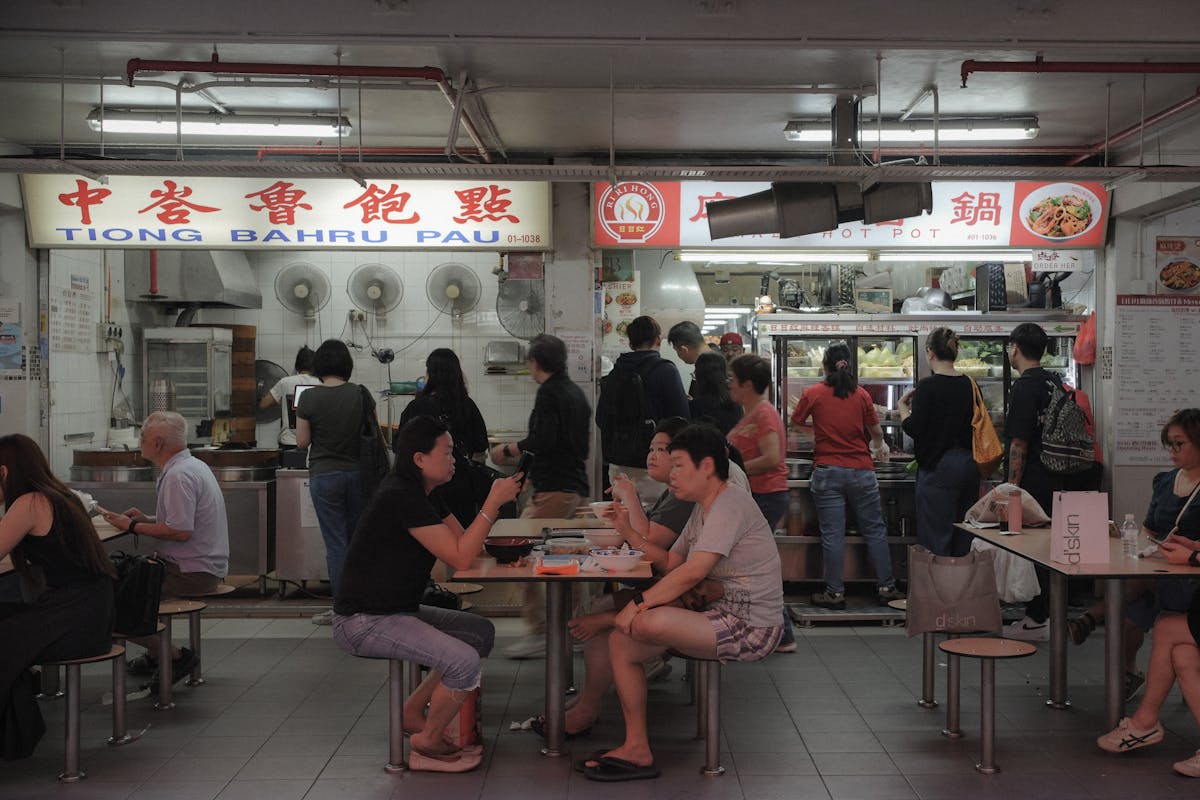
Old Airport Road Food Centre is not beautiful. It occupies the ground floor of an HDB housing block in a residential area that no tourist would visit without a specific reason. The specific reason is the food. We arrived at 11am and spent three hours eating our way from one end to the other, stall by stall, dish by dish, in what I can only describe as a pilgrimage.
The char kway teow changed me. I do not say this hyperbolically. The uncle running the stall was in his seventies, his wok blackened by decades of use, his movements so practiced they looked choreographed. Flat rice noodles, tossed in a wok with heat so intense the edges charred while the centres stayed silky. Cockles, Chinese sausage, bean sprouts, egg, dark soy sauce, and lard — always lard, because the stalls that switched to vegetable oil lost something essential and the ones that kept the lard kept their customers. The plate arrived smoking. I ate it standing because all the seats were taken, and the smokiness and the chew and the richness of the lard and the sweetness of the sausage combined into something that I am still thinking about, months later, sitting at my desk in Mexico City.
We also ate: lor mee (thick noodles in a dark, vinegary gravy), prawn noodles (the broth made from shrimp heads and pork bones, simmered for hours), and ice kacang (shaved ice with red beans, corn, jelly, and condensed milk, a dessert that should not work and does). Total bill for two people: sixteen dollars. I have spent more on a single glass of wine in restaurants that were not half as good.
Day Three: Tekka, Little India, and the Fish-Head Curry
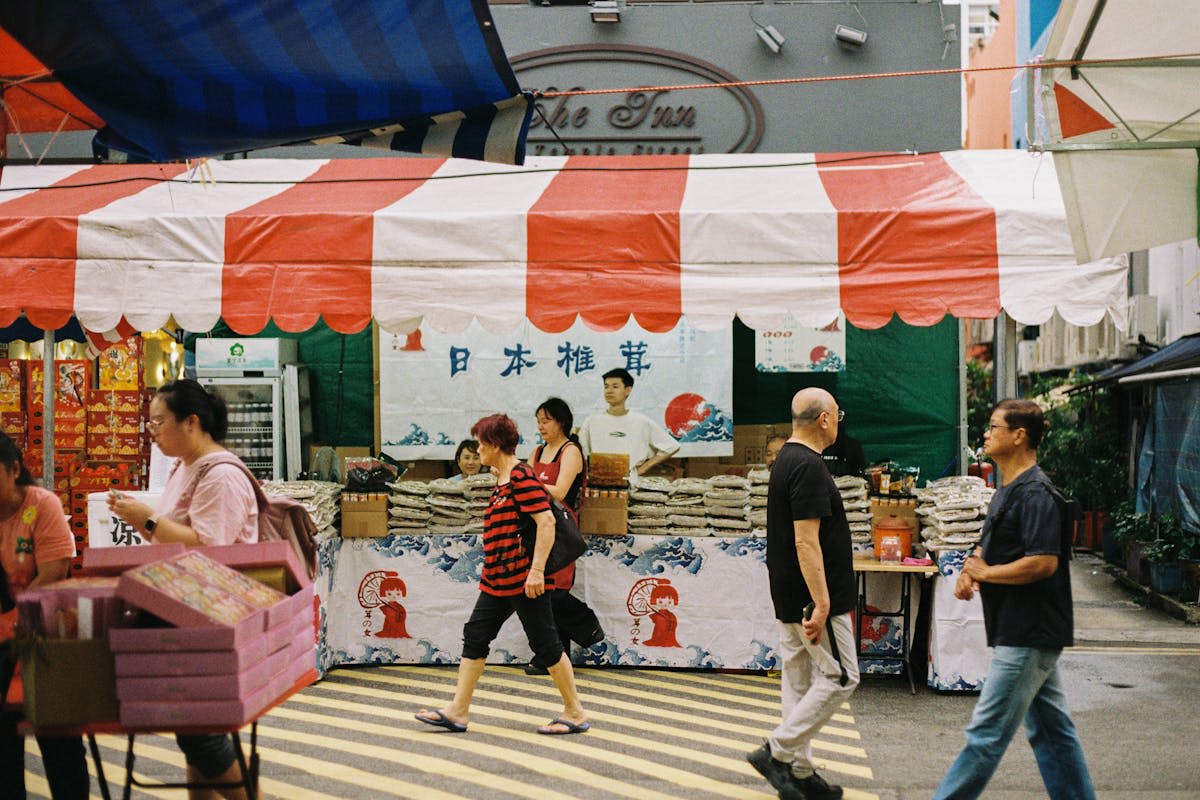
The walk from the MRT station to Tekka Centre is a transition between worlds. One moment you are in Singapore’s immaculate underground transit system — air-conditioned, silent, running on time to the second — and the next you are standing in a wave of jasmine and cumin and incense that hits you like a wall of scent. Little India is the most alive neighbourhood on the island, and Tekka Centre is its beating heart.
I ordered fish-head curry at a stall that had no English signage and a queue that suggested I was making the right decision. The head arrived in a clay pot: a massive red snapper, its eye staring upward with the resigned expression of something that knows it has been cooked well, swimming in a curry that was sour, spicy, thick, and fragrant with tamarind and curry leaves. I ate it with roti, tearing the bread and using it to scoop the curry and the soft flesh from the cheeks of the fish, which is where the best meat lives, and I thought about my grandmother in the south of France who made bouillabaisse and who would have understood this dish immediately — the principle of using the whole fish, of extracting every gram of flavour, of treating the head not as waste but as the prize.
Lia had biryani from the stall next door — fragrant with saffron and cardamom, the rice dyed golden with turmeric, the chicken marinated and grilled before being layered with the rice and steamed. We shared. We always share. It is the only way to eat in a country where every stall serves something you cannot afford to miss.
The afternoon in Little India was a sensory marathon: the Sri Veeramakaliamman Temple with its painted gopuram, Mustafa Centre with its twenty-four-hour everything-store, the flower garland sellers along Serangoon Road stringing jasmine with a speed that made their fingers blur. We ended at a corner stall for teh tarik — tea pulled between two cups from a height that adds froth and theatricality — and watched the street darken and the lights come on and the neighbourhood shift into its evening register.
Day Four: East Coast and the Satay Ritual
We rented bicycles and rode East Coast Park in the late afternoon, the sea breeze doing the work of air conditioning, the casuarina trees casting long shadows on the path. The East Coast Lagoon Food Village sits right on the beachfront, and we timed our arrival for sunset, which turned out to be the right decision for reasons that went beyond the light.
The satay stalls are the draw. Charcoal grills tended by men who have been doing this for decades, the smoke rising in columns that you can smell from the bicycle path. We ordered forty sticks — chicken and mutton — and sat at a plastic table overlooking the sea as the sky turned orange and the container ships on the horizon became silhouettes. The satay arrived with peanut sauce, cucumber, onion, and ketupat rice cakes, and the ritual of dipping and eating and watching the light change was one of those meals that lodges in memory not because of any single extraordinary element but because everything — the food, the setting, the company, the hour — aligned perfectly.
Afterward, we cycled inland to Katong and walked the Peranakan shophouses on Koon Seng Road — pastel facades with ornate tiles and carved doors that tell the story of the Straits-born Chinese community. We ate kueh pie tee at a Nyonya restaurant — tiny crisp cups filled with turnip and prawn — and I thought about how Singapore contains entire culinary traditions that most visitors never encounter because they stop at chicken rice and satay. The Peranakan kitchen is a world unto itself, and Katong is its capital.
What Singapore Taught Me About Food
I came to Singapore thinking I understood street food. I live in Mexico, where the taco stands operate with a precision and a devotion that I have written about extensively and lovingly. I have eaten my way through Bangkok’s soi stalls and Oaxaca’s mercados and Lisbon’s tascas. I thought I knew the landscape.
Singapore showed me something different. Not better — I am not ranking the cultures, because ranking them misses the point — but different in a way that expanded my understanding of what a food system can be. The hawker centres are not just good food in accessible spaces. They are a deliberate, government-supported infrastructure for preserving culinary heritage. The buildings are maintained by the state. The stalls are licensed and inspected. The prices are kept low through subsidized rents. The UNESCO inscription was not a marketing exercise. It was an acknowledgment that Singapore had built something worth protecting: a system where a cook could dedicate a lifetime to perfecting a single dish and serve it to thousands at a price that anyone could afford.
Five days. Fourteen hawker centres. Somewhere around forty individual stalls. A running total I stopped keeping because the numbers were too low to feel like real expenses. And one persistent, nagging thought that followed me onto the plane home: I need to go back. There are stalls I missed. There are dishes I did not try. There is a city out there that has turned the simple act of feeding people into something approaching grace, and five days was not enough. It never is.
Travel with intention
Curated guides, quiet destinations, and stories worth reading — delivered when we have something worth sharing.
No spam. Unsubscribe anytime.