AlUla — The Ancient Valley That Rewrote My Map
The Valley
I did not expect Saudi Arabia to be the country that surprised me most in 2026. I had been to Jordan, to Oman, to Egypt — I thought I understood the desert, understood what carved stone and ancient trade routes look like, understood the particular way the Middle East holds its history in its landscape. AlUla proved me wrong on every count.
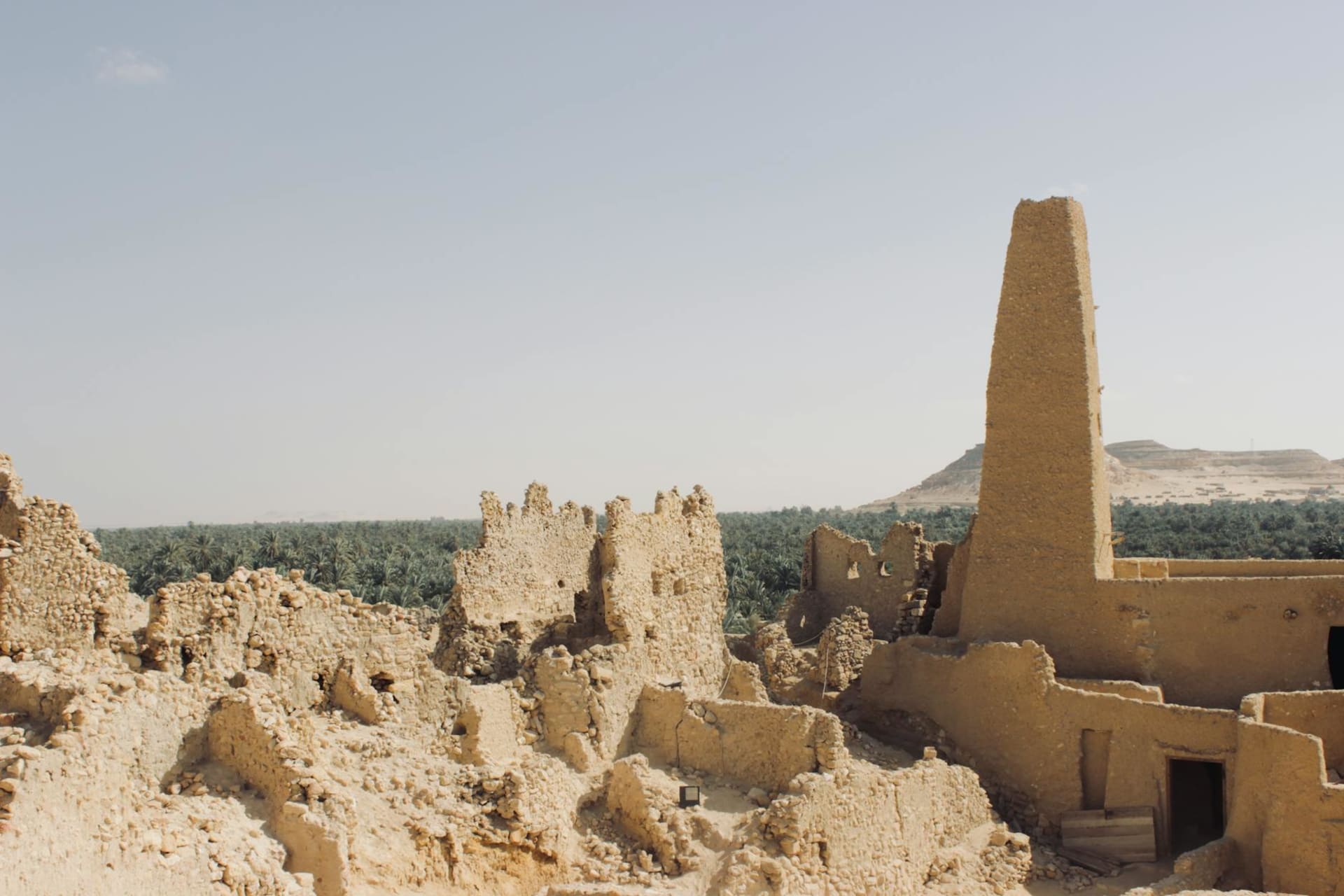
The valley is two hundred kilometers of sandstone formations, oasis gardens, and archaeological sites spanning seven thousand years of continuous human habitation. Seven thousand years. When the earliest inhabitants of this valley were carving their first inscriptions into rock, the pyramids of Giza did not yet exist. Rome was a swamp. Paris was a forest. And this valley — green where the springs feed it, red and gold where the sandstone rises — was already a crossroads, a place where trade routes from the incense lands of Yemen to the markets of the Mediterranean converged and left their mark.
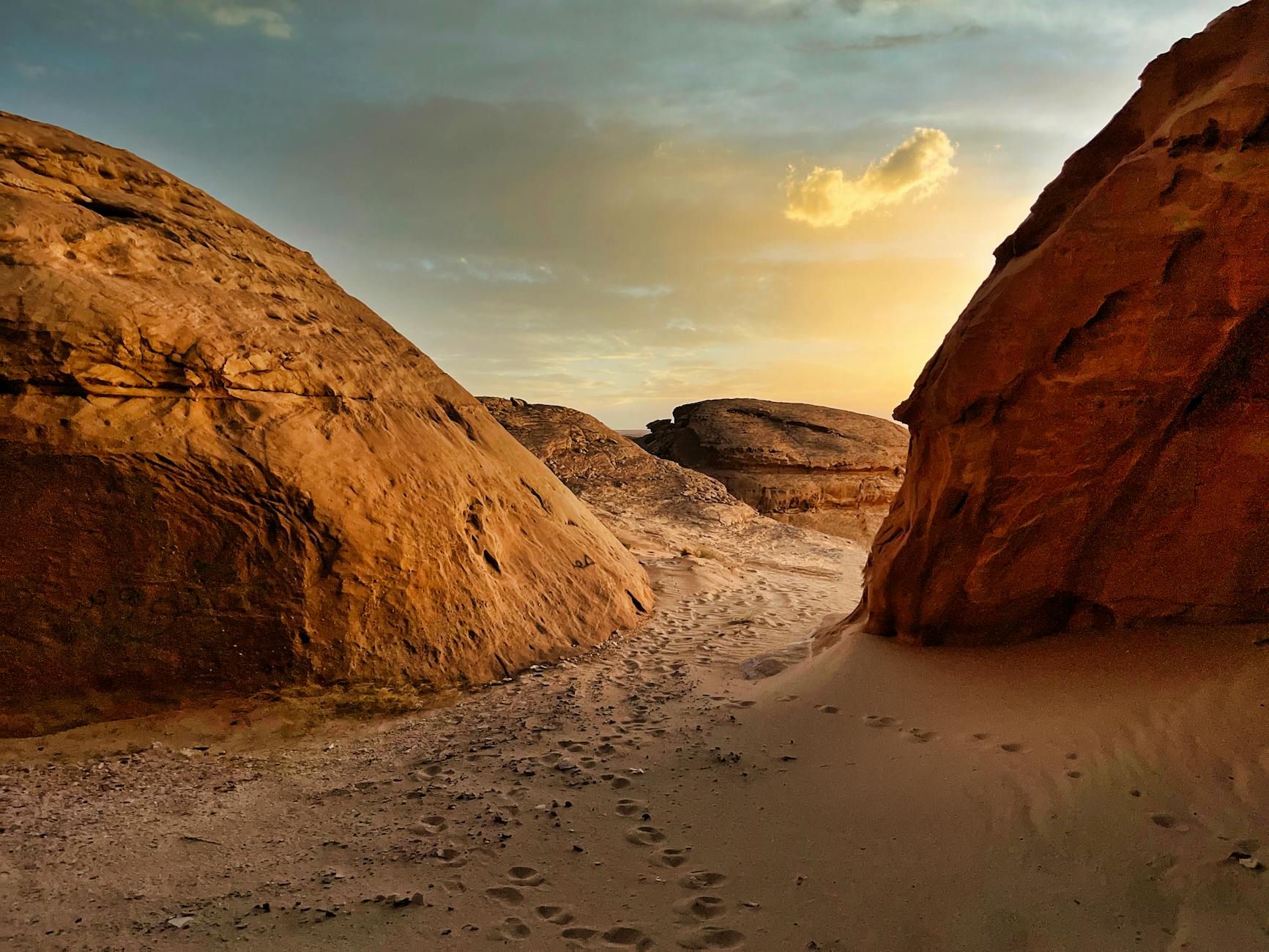
I arrived from Riyadh on a domestic flight that cost less than a dinner in Paris. The AlUla airport is new, small, and efficient — the Saudi government has poured investment into this valley with an ambition that borders on the geological. The drive from the airport to the hotel took twenty minutes, and every minute of it offered a landscape that made me reach for my phone and then put it down again, because some things should be seen first with eyes, not screens. The sandstone formations rise from the valley floor like the ruins of a civilization built by giants — towers, walls, arches, columns, all carved by wind and time into shapes that seem deliberate, as if the desert had been sculpting with intent.
Hegra at Dawn
The Nabataeans were traders, not warriors. This is the first thing to understand about Hegra. The tombs they carved into the sandstone monoliths of this desert — over one hundred of them, dating from the first century BC to the first century AD — were not monuments to conquest but to commerce. These were wealthy merchants who controlled the incense route, who moved frankincense and myrrh from southern Arabia to the ports of the Mediterranean, and who became so prosperous that they could afford to commission their own eternity in stone.
I visited at dawn, joining a small group at the Hegra visitor center as the sky was still grey. The guide, a young Saudi woman with a PhD in archaeology and the particular intensity of someone who has spent years studying a site she loves, led us into the necropolis as the first light hit the facades. The effect was immediate and physical. The Qasr al-Farid appeared first — the lonely tomb, the one carved from a single isolated pinnacle, its upper facade complete with Nabataean eagles and stepped merlons, its lower half rough and unfinished, the chisel marks still visible. Two thousand years of desert wind have not smoothed them. The sculptors worked from top to bottom, and something — war, bankruptcy, plague, a change in fashion — stopped them before they reached the base. The incompleteness is what makes it beautiful. It is the most honest monument I have ever seen: ambition, frozen mid-sentence.
The other tombs are grouped in clusters along the bases of larger outcrops, their facades ranging from simple recessed panels to elaborate compositions that borrow from Greek, Egyptian, and Mesopotamian architecture with the confidence of a culture that saw no contradiction in mixing traditions. Eagles sit above doorways. Sphinxes guard the entrances. Medusa heads — Medusa, in the Arabian desert — stare down from cornices. And the inscriptions, carved in flowing Nabataean script, name the commissioner, the craftsman, and sometimes include a curse for anyone who dares to reuse the burial chamber. I read one translation that ended with: “And may Dushara and all the gods pursue anyone who sells this tomb or buys it or pledges it or gives it away.” Two thousand years later, the curse still felt potent.
The Open-Air Library
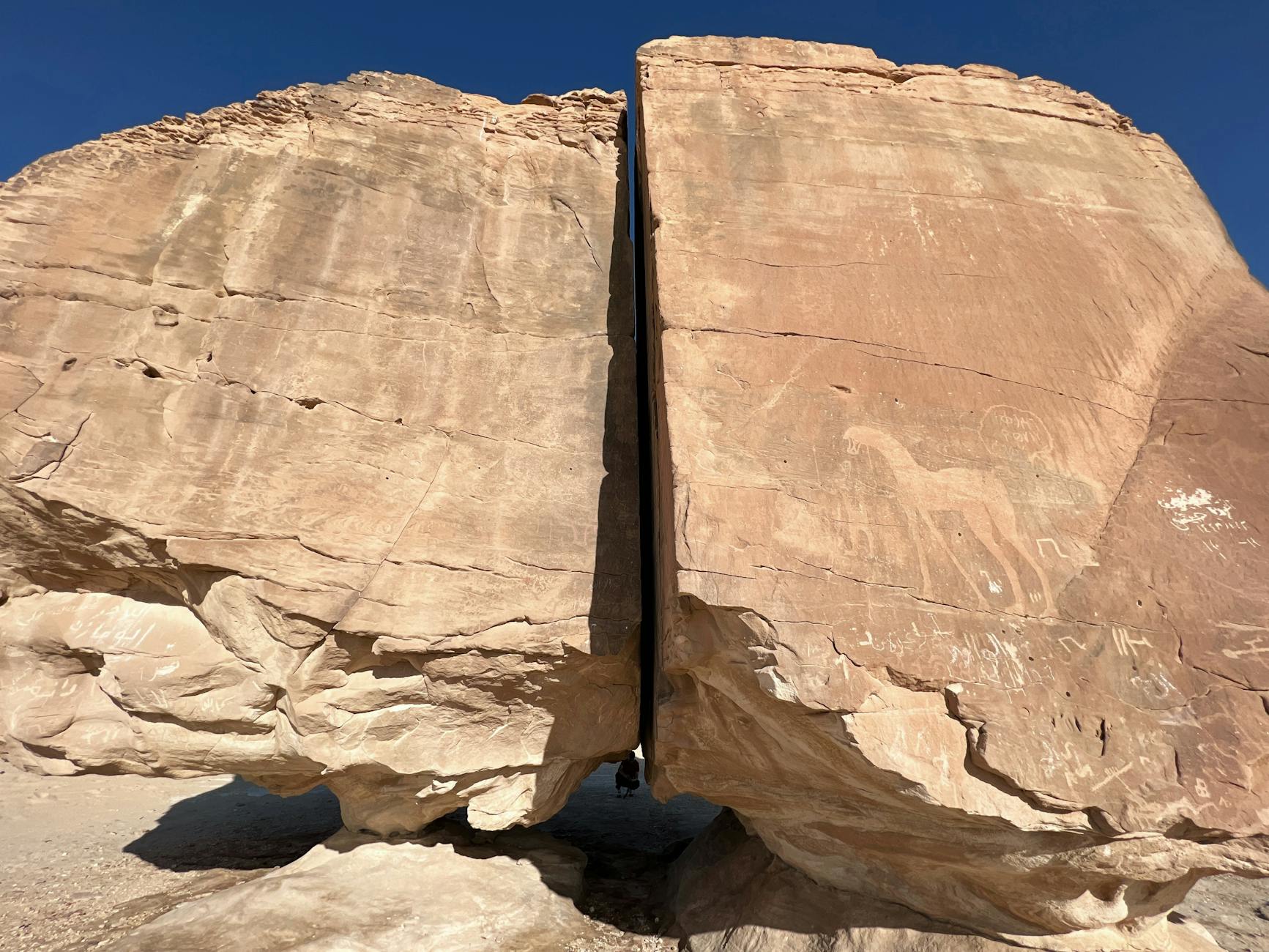
Jabal Ikmah is a twenty-minute drive from Hegra, and it is the site that moved me most. An open-air library of ancient inscriptions — thousands of texts carved into rock faces in Dadanite, Lihyanite, Nabataean, Thamudic, and early Arabic scripts, spanning over a millennium of writing. The scripts evolved on these walls. You can trace the visual development of written Arabic from its earliest ancestors, carved into sandstone by hands that were inventing an alphabet in real time.
The content of the inscriptions ranges from the monumental to the mundane. Trade records sit alongside love declarations. Religious dedications neighbor complaints. One inscription, the guide translated, recorded a merchant’s gratitude for surviving a journey through the desert. Another was simply a name and a date — someone standing at this rock face, two thousand years ago, and writing: I was here. I understood the impulse completely. I resisted adding my own.
What struck me most was the sheer density of human expression on these walls. This was not a temple or a palace — it was a roadside, a stopping point on a trade route, a place where travelers paused and felt compelled to leave a mark. The rock face is covered in text the way a bathroom stall in a Paris cafe is covered in graffiti, except that this graffiti is two thousand years old and written in scripts that archaeologists have spent decades deciphering. The impulse to write on walls is not a modern failing. It is one of the oldest human impulses, and Jabal Ikmah is its monument.
The Desert at Night
The stars above AlUla are not the stars I know from Mexico or from the French countryside. They are the stars that existed before light pollution, before electricity, before any human technology intervened between the eye and the sky. The Milky Way is not a faint suggestion — it is a bright, textured river across the entire dome of the sky, so dense and so close that the distance between you and the universe feels like a misunderstanding.
I sat outside after dinner, wrapped in a blanket against the January cold — AlUla at night in winter drops to near-freezing, another fact that contradicts every assumption about Saudi Arabia — and I watched the sky for an hour. The silence was complete. No traffic. No music. No voices. Just the occasional rustle of wind through the sandstone formations, which in the dark became silhouettes, black shapes against the star field, looking exactly like the ancient sentinels they have been for millennia.
It occurred to me, sitting there, that the Nabataeans saw this same sky. That the inscribers at Jabal Ikmah wrote their messages under these same stars. That the seven thousand years of human habitation in this valley all took place beneath this same dome, and that the sky was the one constant — the trade routes shifted, the empires rose and fell, the scripts evolved, the religions changed, but the stars above AlUla were the same stars that shone on the first person who looked up from this valley floor and felt the particular smallness that comes from understanding your place in the scheme of things.
What AlUla Does
Saudi Arabia is not an easy sell. I know this. The geopolitics are complicated, the social record is fraught, and the tourism push is transparently strategic — a government diversifying away from oil, building a post-petroleum identity, and investing billions in cultural infrastructure with an eye on economic transformation rather than pure preservation. All of this is true, and none of it diminishes what is actually in the valley.
AlUla is one of the most extraordinary archaeological landscapes on earth. The Nabataean tombs at Hegra are as accomplished as anything at Petra. The inscriptions at Jabal Ikmah are among the most important collections of ancient writing in the Middle East. The sandstone formations are a geological gallery that no sculptor could improve. And the fact that all of this existed in near-obscurity until a few years ago — that a UNESCO World Heritage Site could sit in the desert, largely unvisited, while millions of tourists filed through Petra and Luxor and Angkor Wat — tells you something about the power of borders and politics to determine which histories get told.
The borders are open now. The histories are being told. And the window — that precious window between obscurity and overtourism, between the moment a place is discovered and the moment it is consumed — is open at AlUla right now. I do not know how long it will last. I know that standing before the Qasr al-Farid at dawn, alone, in silence, reading an inscription carved by a hand that stopped mid-sentence two thousand years ago, I felt something shift in my understanding of what the desert holds and what the world has yet to find.
Go now. The sentence is still unfinished. The silence is still intact.
Travel with intention
Curated guides, quiet destinations, and stories worth reading — delivered when we have something worth sharing.
No spam. Unsubscribe anytime.