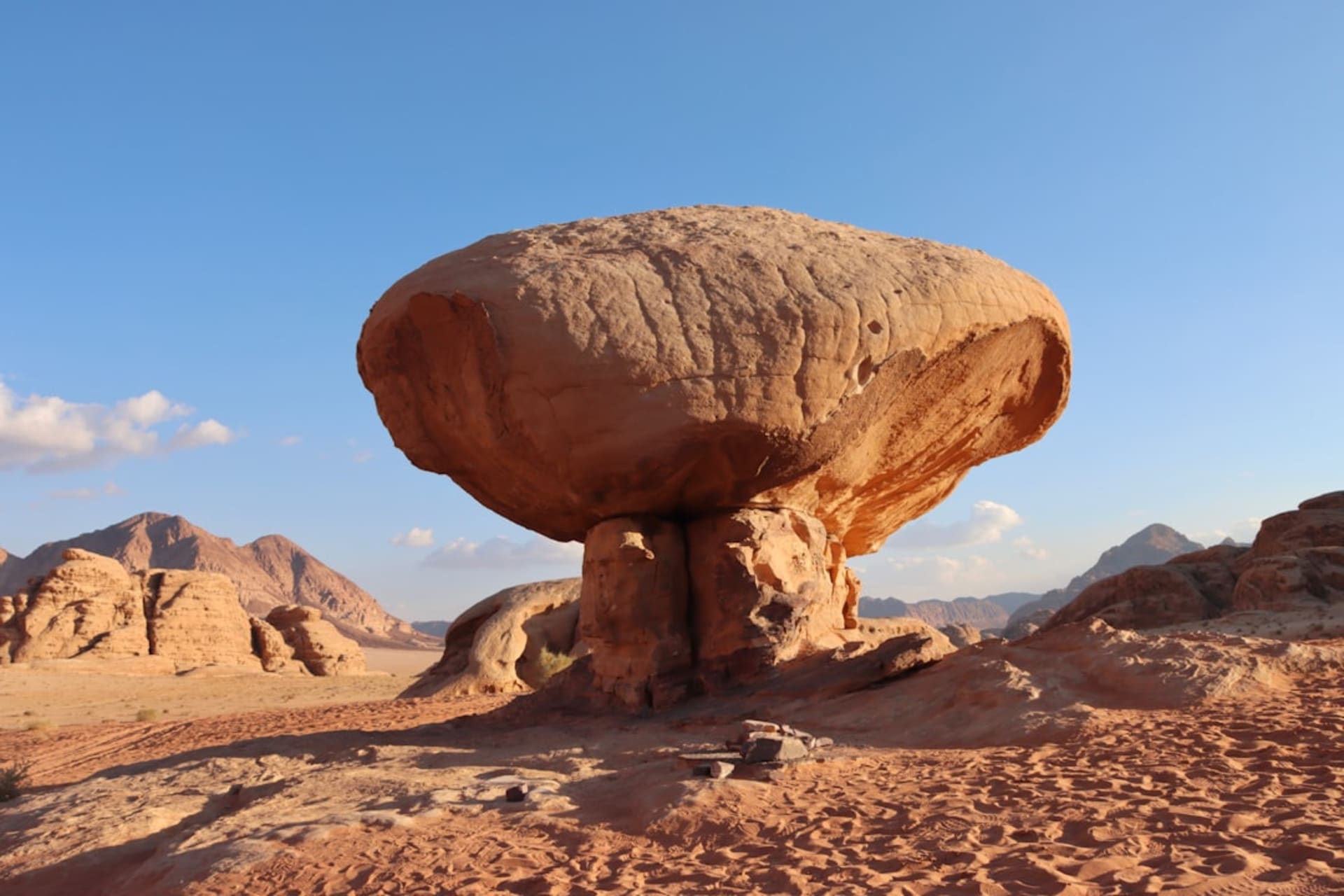
The first thing you notice is that it shouldn’t be there. The Mushroom Rock stands in open desert, isolated from the surrounding cliffs, a column of sandstone about four meters tall that narrows at the base and widens at the top in a shape so specific it looks manufactured. Every person who sees it for the first time makes the same involuntary sound — something between a laugh and an oh.
Wind erosion is the explanation, and it’s the correct explanation, but it doesn’t fully satisfy. The mechanism makes sense: the base of the column is softer, younger sandstone, more susceptible to abrasion from wind-carried sand that travels close to the ground; the harder caprock on top resists better and protects the column beneath it while the softer material erodes away. What you’re looking at is essentially a differential erosion diagram. What it looks like is something a giant arranged deliberately as a joke.
Geology as Theater
Wadi Rum has no shortage of dramatic geology — the whole place is an argument for the aesthetic power of deep time. But Mushroom Rock has a quality the cliffs and canyons don’t quite achieve: intimacy. It’s at eye level. You can walk around it in thirty seconds. Touch the stem (which is narrower than it looks; I could nearly wrap both hands around it) and feel the granular texture of sandstone that’s been worked by centuries of wind, the surface rough as coarse sandpaper.
The cap overhangs by about a meter on each side, which creates a small shadow at the base. On a hot afternoon I stood in that shadow for a while and thought about the particular patience required by geological time — not waiting, exactly, since the rock isn’t waiting for anything. Just becoming, over millions of years, whatever the forces around it make it.
As a Photographic Object
Mushroom Rock is unambiguously photogenic, which is why it appears on roughly 40 percent of Wadi Rum Instagram accounts. This knowledge did not prevent me from photographing it extensively. The most useful angles are from low and close, shooting upward to emphasize the cap against the sky, or from a distance with a person in frame to establish the scale. The evening light from the west, which catches the rock broadside, turns the sandstone a particularly convincing amber.
Lia sat at the base and drew it in her notebook while I circled with a camera. When I looked at what she’d drawn later, it was more accurate than my photographs — the sketch caught the slight lean of the column, the way the cap is slightly asymmetrical, the small fissure running up one side of the stem that suggests the whole thing is slower to fall than you’d expect.
Getting There
Mushroom Rock sits in the central area of the protected zone, about 18 kilometers from Rum Village. It’s a standard stop on the half-day and full-day jeep circuits, usually visited in the late morning or early afternoon. The stop is brief — 15 to 20 minutes is standard — which is appropriate. There’s a limited amount of Mushroom Rock to look at, and the desert has other claims on your time.
When to go: The formation looks best in late afternoon light, when shadows emphasize the form and the sandstone’s color deepens toward orange. It’s accessible year-round with no particular seasonal advantage. If you’re building a custom jeep itinerary, ask to include it as an afternoon stop rather than a morning one.