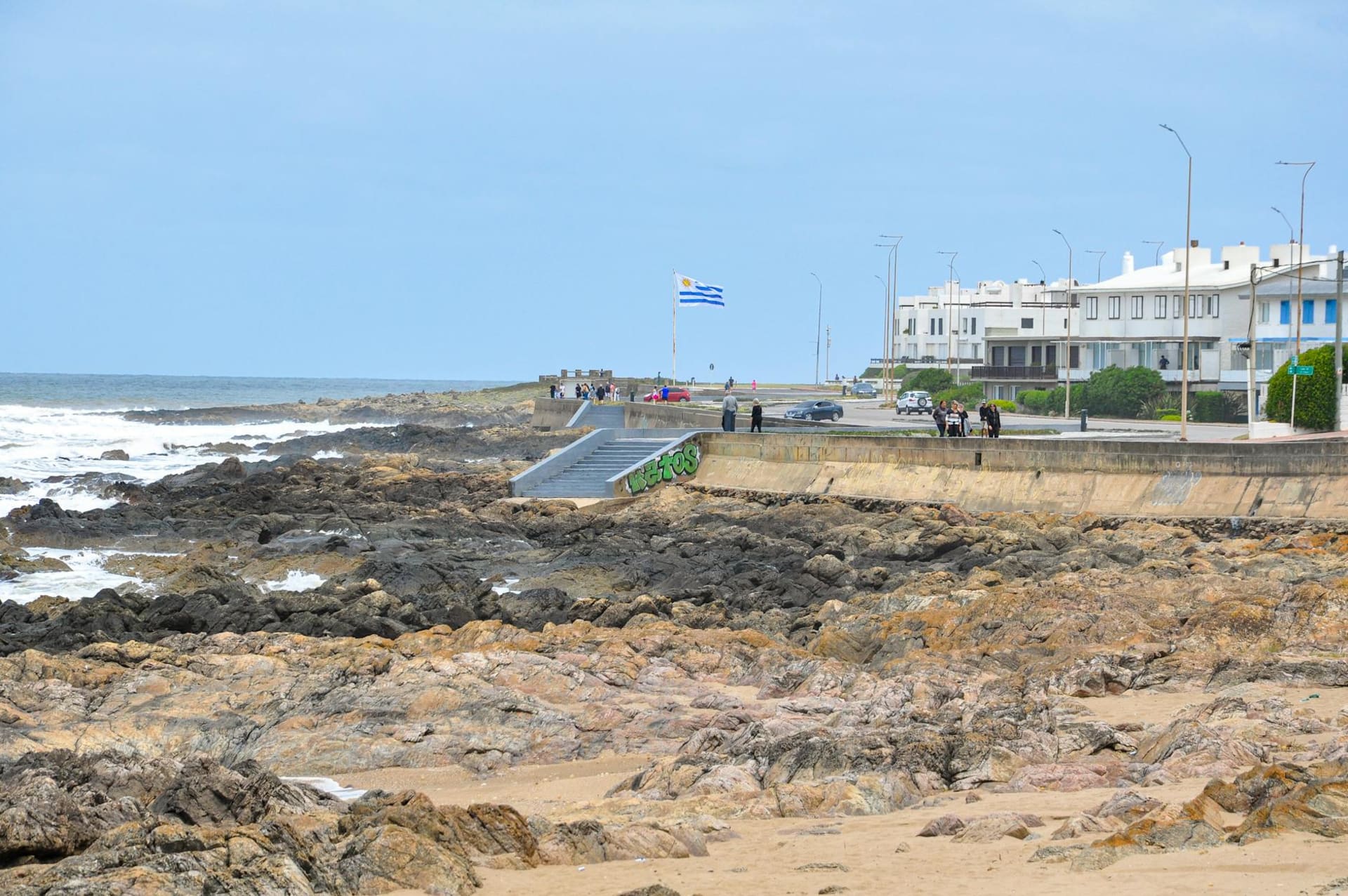
Punta del Este
"Punta del Este is where Buenos Aires comes to summer and immediately forgets to be Buenos Aires."
South America's most glamorous beach resort, where La Mano sculpture rises from the sand and yachts fill the port.
There is a particular quality to the light in Punta del Este at seven in the evening — a warm, slightly theatrical gold that settles over the Puerto Marina as if the whole city has been styled for a magazine shoot it wasn’t entirely expecting. The yachts gleam. The terrace crowds order their second round of tannat. Everyone looks just slightly more relaxed than they actually are.
La Mano and Playa Brava
I had seen photographs of Los Dedos — the five giant concrete fingers clawing up through the sand on Playa Brava — but nothing prepares you for the casual surrealism of turning a corner on Rambla Lorenzo Batlle Pacheco and finding them just there, half-buried, permanent, as though the beach swallowed something enormous and these are what remain. Lia stood beside one finger for scale and started laughing. It is genuinely absurd. It is also, somehow, genuinely moving — Mario Irarrázabal’s sculpture has this way of making you feel the weight of what lies beneath the visible surface of things, which is not what I expected from a landmark I’d written off as a photo-op.
Playa Brava lives up to its name. The Atlantic here is rough, bottle-green, insistent. The waves arrive from far out and break hard. On Playa Mansa, a ten-minute walk around the peninsula’s tip, the water turns calm and pale, almost Mediterranean in its stillness — the same city, two completely different temperaments.
The Peninsula and What Feeds You
The old town grid of La Peninsula is small enough to walk in an hour and interesting enough to spend an afternoon in. I ate chivito — Uruguay’s answer to everything, a stacked sandwich of beef, ham, egg, mozzarella, olives, and bacon served at a counter on Calle 20 — and understood immediately why Uruguayans treat it as a national argument rather than just a meal. Every place makes it differently. Every local has a theory.
The surprise came at dusk on the port side, past the marina, where I found a cluster of older men playing tejo beside a warehouse that had no business being picturesque and absolutely was. No tourists. Just the sound of metal on stone and someone’s radio.
The Tone of the Place
Punta del Este operates on a register of aspiration that is almost endearing — Buenos Aires money crossed with Uruguayan ease, the result being something louder than Montevideo and more humane than the Hamptons. It does not pretend to be something it isn’t. It is a resort town that has committed fully to being a resort town, and there is a certain integrity in that.
When to go: December through February is peak summer, when the energy is highest and the beaches are alive — expect crowds and elevated prices. March brings warmth without the chaos, which is when I’d go again.